

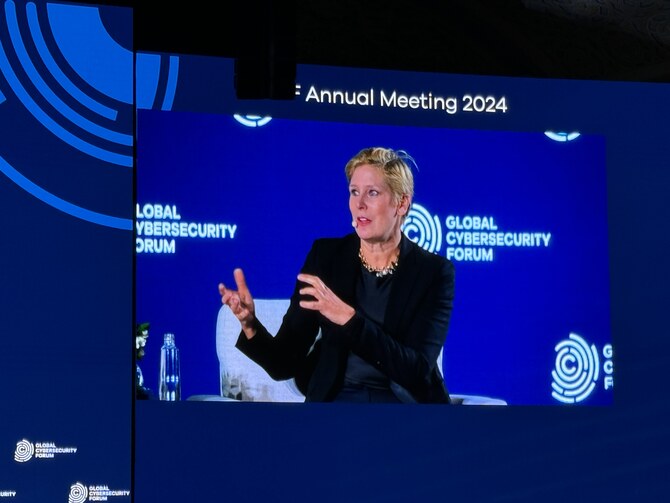

RIYADH: Saudi Arabia is redefining its approach to cybersecurity as it advances its Vision 2030 agenda, aiming to broaden participation in the field beyond traditional military roles, a forum was told.
Speaking on the first day of the Global Cybersecurity Forum in Riyadh, Silvana Koch-Mehrin, founder and president of global network Women Political Leaders, emphasized the need to make the industry more inclusive, stating: “Cybersecurity does not mean military.”
Koch-Mehrin highlighted the diverse opportunities within the sector that appeal to women, particularly as they navigate the digital landscape.
“It has a lot of different facets, passion, and relevance for women, especially as mothers and as individuals who live in the digital world. This is something women would be interested in working on,” she said.
This push aligns with Saudi Arabia’s commitment to cybersecurity as a national priority, not only to safeguard its digital infrastructure but also to create opportunities for women in the workforce.
Hala bint Mazyad Al-Tuwaijri, president of the Human Rights Commission in Saudi Arabia, pointed out that the reforms enabling this shift have been profound and far-reaching.
“For a very long period of time, women were highly educated in Saudi, not all of them very young, and also they were only employed in certain sectors,” Al-Tuwaijri said.
She added: “With the Vision 2030, and with the opening of different sectors for women, and also for the older reforms, the legal, structural procedure reforms that happened. These new sectors that opened, allowed for that kind of leap in the participation of women.”
Al-Tuwaijri emphasized that empowering women in cyberspace is as essential as in the real world.
“It’s a necessity — an economic and security necessity — for us to have women play a role because, from our experience in Saudi Arabia, the empowerment of women could not have reached these levels without the participation of women,” she said.
Koch-Mehrin underscored the importance of challenging ingrained biases in the workplace and society, saying: “Perceptions on leadership and which jobs are for men or women are deeply rooted in many societies. It’s impressive to see what’s happening in Saudi Arabia, where these norms are being questioned and changed. This shift will be a major driver for future change.”
One effective tool for facilitating this change, according to Koch-Mehrin, is mentoring, both traditional and reverse – where mid-level women work with senior male executives to raise awareness about unconscious biases.
“Mentoring is critical,” she said, adding: “But I would also say reverse mentoring is very important, and some corporations do that already. It’s not only about traditionally male executive mentoring mid-level women on how to get up to the executive level but also about raising awareness about what it’s actually like for women in these spaces.”
Saudi Arabia has made significant strides in strengthening its cybersecurity capabilities, reflecting the Kingdom’s growing focus on digital security as it becomes more interconnected globally.
The establishment of the National Cybersecurity Authority and initiatives like the Global Cybersecurity Forum position the Kingdom as a leader in safeguarding its digital landscape.
As the country undergoes rapid digital transformation, ensuring the protection of data and infrastructure has become a national priority, where women can play a critical role.


