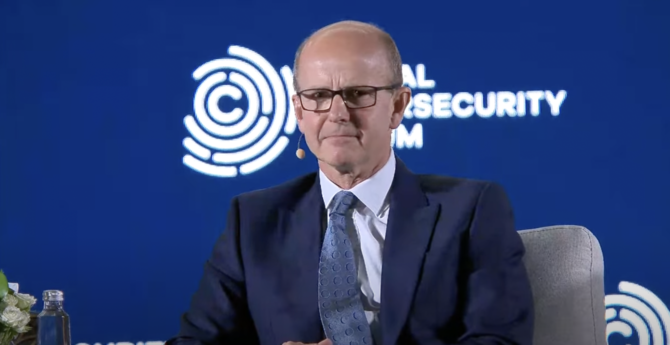

RIYADH: Genuine partnership between the public and private sector is crucial to ensure technology safety within cyberspace, a former director at the UK Government Communications Headquarters said.
Speaking in a panel discussion titled “Pathways to De-escalation: Shared priorities for reducing tensions and advancing stability in cyberspace” on the first day of the Global Cybersecurity Forum in Riyadh, Sir Jeremy Fleming explained that the private sector has many of the levers needed to facilitate and highlight cyber threats effectively.
This falls in line with the fact that on the domestic front, working with the private sector offers governments a chance to leverage insights and expertise to improve digital defense.
According to the Global Cybersecurity Index 2024, almost 63 percent of countries reported having inter-agency processes for cybersecurity within their governments.
“Big technology companies have as good a radar on what’s happening in cyberspace as governments do, and so that leads to two conclusions for me. The first is that there is no point in governments talking to each other about cyberspace. There has to be a genuine partnership with the private sector because the private sector has many of the levers we need to make sure that this technology is safe, to make sure that threats are called out,” Fleming said.
“Now, there is a space in all of that for, for secret stuff, there’s a space for the things that only governments can do. But again, that has to be in tandem with the private sector,” he added.
Fleming further highlighted the importance of effective communication within the sector.
“The second thought is that I spent the last 15 years thinking and talking about cyber, but if you ask me to give you a crisp definition of it, I’m still struggling. And so, I think we have a communication problem here in how we talk about cyber and how we engage our populations in making sure that it stays at the top of the agenda,” the former director of GCHQ said.
“The debate we’re having at the moment about artificial intelligence and particularly safety is a way into this,” he added.
Also speaking during the same panel, the former President of the European Commission and former Prime Minister of Portugal, Jose Manuel Barroso, shed light on child protection within cyberspace.
“There are some areas where I believe international cooperation can be relatively sincere; one of them is child protection,” Barroso said.
“I don’t see any reason why the governments, in spite of geopolitical interests and differences, should not consider child protection a global public good,” he added.
Barroso continued to highlight that cybercrime will increase because there are politically and economically malign actors, and some of the technologies, including AI, generative AI, and others, make the digital space even more difficult to manage.
“It’s true that according to some experts, some of those innovations can also help us fight cybercrime, it’s true. But the reality is that the digital space is becoming increasingly difficult to manage from a security point of view, for states, for companies,” he said.
“So, my first word is let’s prepare. Preparedness is the key at the national level. At the regional level, in the European Union, we are doing something. We have a European Agency for Cyber Security. I believe it’s not sufficient,” the former president of the European Commission added.
Also present at the panel, former US Secretary of Defense Mark Esper tackled what businesses need in order to navigate the digital economy.
“As businesses try to navigate more and more the digital economy, they’re going to need more consistency, more predictability. They cannot afford patchworks of regulatory law or privacy and data sharing, things like that. So, we’re going to need to smooth out, smooth out that electronic environment,” Esper said.
“In cyberspace, it’s an asymmetric tool that rich countries, poor countries, strong countries, weak countries, organizations or people or even governments can use that tool against others to gain an advantage or to level the playing field,” he added.
The former US secretary of defense emphasized how cyberspace is not static, but instead, is dynamic.
“As you see increasing advances in artificial intelligence and quantum sciences and advanced logarithms and software, it’s going to make this offense-defense component all the more challenging out there,” he said.
Experts from technology, public policy, defense, and other sectors will gather in Riyadh for the two-day Global Cybersecurity Forum.
The event will focus on fostering collaboration under the theme “Advancing Collective Action in Cyberspace,” with the goal of enhancing multi-stakeholder engagement and driving joint initiatives on key strategic priorities.
The program will feature five core sub-themes, each addressing a crucial aspect of cybersecurity.