



RIYADH: Cybersecurity industry leaders have emphasized the growing importance of digital protection as the world becomes increasingly interconnected at a special event in Riyadh.
Speaking at the Global Cybersecurity Forum, Saad Al-Aboodi, CEO of the Saudi Information Technology Co., highlighted the global nature of the challenge during an address at the event, titled “Advancing Collective Action in Cyberspace.”
He said: “We live in multiple and parallel grids of data connectivity, transportation, energy, and supply chains. Our systems and infrastructures are globally interconnected, whether directly or indirectly, making cybersecurity a critical global issue that affects every aspect of modern society.”
Al-Aboodi stressed the growing shift from physical to digital assets, underscoring the necessity of robust cybersecurity measures.
“It’s a fact of life that our societies are tech-driven, and as we become more digitally interconnected, we are pushing more assets from the physical space to cyberspace,” he said.
He further argued that cybersecurity needs to understand the economics of the online world, as well as promoting responsible emerging technologies, and enhancing international collaboration.
“Starting with the economics of cybersecurity, it’s a subject worth deeper contemplation by academia, think tanks, industry players, and policymakers,” Al-Aboodi said.
“One would need to calculate the value of assets, cost of protection, cost of damage, and the cost to launch a cyberattack using today’s tools on today’s exposure services.”
Al-Aboodi pointed out that while the global cybersecurity market is worth approximately $180 billion in 2024, the cost of cybercrime could reach $9.5 trillion by the end of the year.
He also warned of the increasingly intertwined relationship between physical and cyber warfare, leading to rising costs for protection and attacks. “The value of assets, the cost of cyberattacks, and the cost of protection will rapidly increase,” he said.
Artificial intelligence was another major topic of discussion, with Al-Aboodi describing AI as an “embedded technology” that has far-reaching impacts.
“It’s not a standalone technology or a sector on its own,” he explained, adding: “It is pervasive and impactful in whatever it does and wherever it goes.”
Al-Aboodi further underscored the importance of cooperation in safeguarding the future of cyberspace, saying: “Only through collective action — governments, industries, and individuals working together — can we build a future where cyberspace is safe, dependable, and sustainable.”
Megat Zuhairy, CEO of Malaysia’s National Cyber Security Agency, reinforced the need for trust in the digital space.
“When it comes to investments coming into Malaysia, the main priority is to see whether there is a conducive environment, specifically in cybersecurity,” he said.
“It’s always about shared responsibility, but sharing, understanding, and collaboration require trust. Trust is very important, regardless of how advanced the technology or skills are,” Zuhairy added.
Suk-Kyoon Kang, CEO of AhnLab, underscored the role of AI in achieving security efficiency. “One of the key objectives of AI is to achieve security efficiency and make people’s lives easier,” he said.
AhnLab has been training AI models with over one petabyte of data, processing 10 million detections daily to accurately identify threats such as phishing emails and text messages.
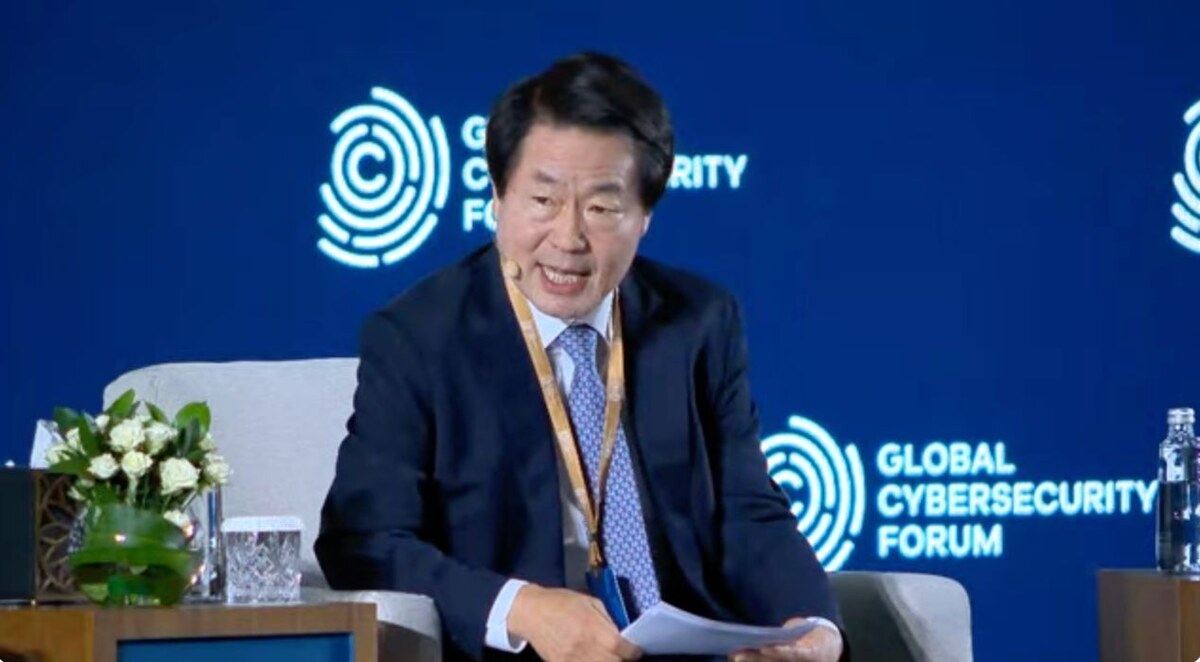
Suk-Kyoon Kang, CEO of AhnLab. AN
Miguel Angel Canada, head of National Coordination at Spain’s National Cybersecurity Institute, emphasized the economic opportunities within the industry.
“Cybersecurity is not a security issue — it’s a business opportunity,” Canada said.
He called for stronger connections between research and market applications to ensure that new technologies translate into products and services.
Timothy Sherman, vice president and CTO of Security Solutions Engineering at Cisco Systems, emphasized the universal importance of cybersecurity. “Cybersecurity should be a given right for everybody,” Sherman said.
The two-day Global Cybersecurity Forum is a platform for experts to call for unified global action to address growing cyber threats.


