

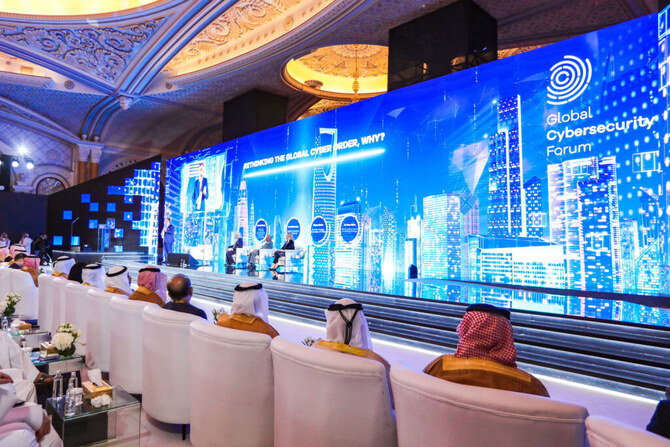
Global leaders gather in Riyadh to forge collective action on cybersecurity

The event will focus on fostering collaboration under the theme 'Advancing Collective Action in Cyberspace,' with the goal of enhancing multi-stakeholder engagement and driving joint initiatives on key strategic priorities. File
Short Url
Updated 02 October 2024
Follow

Global leaders gather in Riyadh to forge collective action on cybersecurity

RIYADH: Experts from technology, public policy, defense, and other sectors will gather in Riyadh for the Global Cybersecurity Forum Annual Meeting on Oct. 2-3.  

The event will focus on fostering collaboration under the theme “Advancing Collective Action in Cyberspace,” with the goal of enhancing multi-stakeholder engagement and driving joint initiatives on key strategic priorities.  

The program will feature five core sub-themes, each addressing a crucial aspect of cybersecurity. “Beyond Cyber Discord: Building trust within geopolitical competition” will examine ways to overcome geopolitical tensions and cultivate trust among nations.  

“Cyber Psychology: Decoding human behaviors in Cyberspace” will explore the motivations of cybercriminals and strategies to protect users from cyber manipulation.  

The sub-theme “Cyber Social Fabric: Strengthening development and inclusion in Cyberspace” will focus on promoting social cohesion and equitable participation in the digital realm.  

Another critical topic, “Thriving Cyber Economy: Developing strong markets and building resilient cyber ecosystems,” will discuss strategies for economic growth and market integration within the cybersecurity sector. Lastly, “New Cyber Frontier: Integrating convergent technologies in Cyberspace” will investigate the impact of advanced technologies on the future of cybersecurity.  

The event builds on the success of previous editions, aiming to promote a collective approach to addressing challenges and opportunities in cyberspace.  

Day One  

The first day will kick off with various expert forums, fireside chats, and closed sessions, starting with the speaker session titled “Pathways to De-escalation: Shared priorities for reducing tensions and advancing stability in Cyberspace.”  

This session will delve into the effects of rising inter-state tensions in cyberspace and highlight opportunities for progress through new diplomatic channels, evolving norms, and emerging technologies.  

Also on the agenda is “Leadership Launchpad: Charting Paths to Leadership in Cybersecurity,” which will focus on strategies to advance mid-to-senior female cybersecurity professionals into executive roles. Additionally, “Ctrl + Invest” will showcase women-led ventures in the cybersecurity space.  

Another significant session, “Pioneering Pathways: Unleashing potential in the Cybersecurity sector,” will examine the diverse economic contributions of the cybersecurity industry in tech-driven markets, addressing its potential amid technological changes and the associated risks and opportunities for ecosystem development.  

“Equipping the Defenders: What law enforcement needs to win” will address the critical needs of law enforcement in tackling online child abuse, talent shortages, future skill requirements, and propose actionable solutions.  

In “Cyber Statecraft: The new chessboard of geopolitics,” participants will discuss strategies to integrate cybersecurity into national defense, enhancing geopolitical advantage and ensuring long-term security.  

“The Multilateral Frontier: Assessing the state of play and imperatives for collective action in cyber diplomacy” will analyze the current state of UN negotiations, emphasizing significant progress while addressing challenges in establishing robust international norms and frameworks for cyber governance.  

“Code, Clicks, and Culture: Social Transformation in the Technological Age” will focus on the social transformations driven by technological advancements and the cultural shifts resulting from increased interconnectedness and technology adoption across demographics.  

Additional panel discussions and closed sessions will also take place throughout the first day.  

Day Two  

The second day will feature in-depth discussions on the economic, political, and defense roles of cybersecurity in the digital era.  

One notable session, “The History of Cyber Diplomacy Future: Drawing insights from collaborative progress on trade, nuclear, and climate,” will explore how trade agreements, nuclear disarmament, and climate negotiations can inform effective strategies for cyber diplomacy.  

In “Principles of Stability: Applying the lessons of the past to the current and future challenges in Cyberspace,” participants will examine challenges through the lens of the Secure Future Initiative, a multiyear program focused on evolving Microsoft’s design, development, and operational standards for security.  

“Navigating the Future: Advancing the Global Cybersecurity Agenda to build confidence in cyberspace” will trace the evolution from the World Summit on the Information Society Action Line 5—which laid the groundwork for trust and security in information and communication technologies—to the establishment of the ITU Global Cybersecurity Agenda. This session will highlight how the principles of Action Line 5 have shaped the ITU’s broader approach to cybersecurity.  

Panels will cover the security of the healthcare sector, strategies for psychological defense against cyberattacks, and the critical role of the sector during mega events. These discussions aim to address specific sector vulnerabilities and broader resilience strategies in the face of evolving cyber threats.  

Child protection in cyberspace  

Concurrent with the GCF Annual Meeting, the Child Protection in Cyberspace Global Summit will take place on Oct. 2-3 in Riyadh.  

This summit will bring together key stakeholders worldwide to ensure that children are safe and protected in cyberspace. The event is held in collaboration with ITU, UNICEF, GCF, the DQ Institute, and WeProtect Global Alliance.  

“Protecting children online is a shared responsibility,” said ITU Secretary-General Doreen Bogdan-Martin. “With today’s children spending an increasing amount of time online, it is crucial to protect and empower them. The Child Protection in Cyberspace Global Summit will bring together leaders from all sectors to ensure our youngest users can thrive online.”  

The summit will convene prominent figures from government, international organizations, academia, and the private sector to explore multi-stakeholder collaboration for enhancing child protection in cyberspace. The second day will conclude with a high-level roundtable themed “Advancing Collective Action for Child Protection in Cyberspace.”  

“We must work together to make the Internet a safe place for children to learn, socialize, and express themselves,” said UNICEF Executive Director Catherine Russell. “This Summit marks an important opportunity to coordinate global efforts to maximize the benefits of digital technology in children’s lives while protecting them from harm.”  

The summit aims to achieve four key objectives: consolidating global efforts and advancing collective action; enhancing the global response to pressing challenges; mitigating emerging threats facing children in cyberspace; and ensuring child protection resonates with the agenda of global decision-makers.  

These objectives align with the goals of the Child Protection in Cyberspace initiative and support the UN Sustainable Development Goals 4, 5, 16, and 17 under the 2030 Agenda for Sustainable Development.  

“We are gathering in Riyadh because we all recognize that as the risks to children in cyberspace grow in number and complexity, we must collaborate to develop innovative partnerships to advance our collective efforts to protect them,” said Majed Al-Mazyed, governor of Saudi Arabia’s National Cybersecurity Authority, speaking on behalf of the GCF Board of Trustees.  

The event will focus on finding pathways toward a safer cyberspace for children, including designing new collaborative approaches and mechanisms to enhance responsiveness to emerging technological threats.  

“What we need today is coordinated, multi-stakeholder collaboration that enhances not only children’s safety and well-being in cyberspace but also their cyber literacy, as our highest priority,” said Yuyhun Park, founder of the DQ Institute.  

A 2022 GCF global report found that 72 percent of children worldwide have experienced at least one type of cyber threat, with the most prevalent being unwanted ads and inappropriate content. Nearly one in five children reported facing bullying or unwanted sexual advances.  

“Child exploitation is an urgent and growing problem. We need to focus on preventing harm and work together for a cyberspace designed to protect children globally from exploitation,” said Iain Drennan, executive director of WeProtect Global Alliance.


Mapping Saudi soils to grow better crops

Updated 19 December 2025
Follow

Mapping Saudi soils to grow better crops

  • Palm trees, root crops, and coastal plants reveal the land’s story

RIYADH: Saudi Arabia’s land tells stories written beneath the feet. From fertile plains and rugged highlands to vast deserts, the Kingdom’s diverse landscapes shape what can grow, where it grows, and how agriculture can thrive.

Alongside geography and climate, soil conditions play a decisive role in agricultural success. Understanding soil types across the Kingdom helps determine which crops can flourish and what interventions may be needed to sustain them.

In an interview with Arab News, Turki Almutairi, a senior environmental specialist at the National Afforestation Center under the National Center for Vegetation Cover Development and Combating Desertification, outlined the main soil types found across Saudi Arabia.

High amount of salt makes the soil unfit for the production of most crops, even if the soil is fertile. (Supplied)

“The dominant soil in the Kingdom are sandy desert soils, alongside calcareous soils in the central region. Rocky and stony soils are present along mountainous and hilly landscapes,” he said.

“Alluvial soils are common in wadies (valleys), while saline and sodic soils are located in depressions (Sabkhas) and along coastlines. Pockets of clayed soils can be also found around few sites along the Kingdom.”

The Kingdom’s vast territory gives rise to unique soil characteristics in each region, enabling different crops to grow depending on local conditions.

“Soil is the growing medium for plants. The role of soil includes structural stabilization, providing nutrients and a communication medium for plants,” Basil Nasir, soil lead at engineering consultancy William Sale Partnership, told Arab News.

Basil Nasir, soil lead at the engineering consultant company, William Sale Partnership (WSP). (Supplied)

According to Nasir, assessing soil use is essential before determining whether it is fertile or infertile, as different soils support different plant types.

“The soil used for trees differs from the soil used for ornamental plants and from the soil used for aquatic plants. It varies according to the specific needs of each plant, and based on this, we determine what the soil requires and assess its fertility,” he said.

Nasir explained that soil characteristics are shaped by both physical and chemical components. In addition to water and air, mineral particles such as sand, silt and clay are key indicators of soil health. Organic matter, derived from plant and animal remains, forms the fourth major component.

The balance between these elements determines soil behavior. One important physical trait is water-holding capacity, which influences what types of plants a soil can support.


Opinion

This section contains relevant reference points, placed in (Opinion field)

“If the soil is like dunes, adding water will cause it to run off, but if the soil is clay, its ability to retain water will be very high. If you add water and return the next day, you will find that the water is still there,” said Nasir.

Chemical properties, such as whether soil is alkaline or acidic, are equally important. Understanding both physical and chemical traits allows for proper assessment and treatment when needed.

“What determines whether a plant is suitable for a particular environment is primarily the plant's nature. For example, some plants have fibrous roots and therefore do not require well-draining soil,” Nasir added.

“A palm tree, for example, does not care whether it was planted in one soil or the other because its roots are fibrous. Therefore, palm trees are strong plants and are suitable to grow in both dry and wetlands, while preferring sandy areas.”

Soil Salinity can be treated through Soil leaching which means washing the soil with certain amount of water to reduce the salt in it. (Supplied)

Crops such as potatoes, onions, carrots and beetroots — where the edible part grows underground — typically thrive in sandy soils. As a result, plantations of these crops are commonly found in northern regions such as Hail and in Wadi Ad-Dawasir.

In the eastern region, including Al-Ahsa, wetlands are more common due to climatic conditions. Growing plants in such environments often requires human intervention.

“Plants that are coastal or could be found in lagoons or lakes must have some sort of soil around them, like lotus flowers and mangrove trees.”

“An important parameter to keep in mind is that there is no air in its soil, and they are adapted to this condition. However, the lack of air, along with the presence of organic matter, will create a situation where anaerobic bacteria react with the soil, potentially causing diseases we can easily avoid,” said Nasir.

He emphasized that removing organic matter from such soils is essential to ensure plant survival in aquatic environments.

Mountainous and rocky regions in Saudi Arabia are generally volcanic, resulting in low water-holding capacity and challenging growing conditions. However, volcanic ash contributes to high fertility, allowing certain crops to flourish.

As a result, western regions support tree crops such as coffee, mangoes, some banana varieties and pomegranates.

There are various types of soils such as clay, sandy, silty and loamy. Each type provides excellent conditions for specific plants. (Supplied)

As development accelerates across the Kingdom, soil improvement efforts are expanding under the National Greening Program.

“Soil is considered fundamental for the National Greening Program’s objectives. Understanding the soil variability along the Kingdom is a precondition for fostering sustainable soil management,” Almutairi told Arab News.

Adding, “In this line, the NGP is working towards the establishment of the Saudi Soil Information System (TURBA-KSA), which consists of mapping soils and its functional properties in the Kingdom using state-of-the-art technology.”

He also noted the creation of the “Land Rehabilitation Watch” to report, verify and monitor land rehabilitation nationwide.

“This milestone allows the Kingdom to understand how soil and land health are progressing against national and international targets of land degradation neutrality. Documenting good soil and land management practices is also important, so that those successful practices could be scaled up along the Kingdom, which is a priority task for NGP,” he said.

Raising public awareness is another key pillar of the program.

“Assessing different emerging technologies and soil amendments is a daily activity of NGP, as it then provides technical support to partners on the selection and application of these technologies.”

DID YOU KNOW?

• Saudi Arabia cultivates around 1 million hectares, mainly in Riyadh, Qassim, Hail, and Jouf.

• Farming follows the seasons: winter brings onions, garlic, and carrots, while summer yields watermelon, tomatoes, and cucumbers.

• The Kingdom is a top date producer, with over 31 million palm trees generating nearly 1.54 million tons, especially in Riyadh and Qassim.

Almutairi stressed that soil is often overlooked because it lies unseen beneath the surface, despite its critical role.

Yet soil produces 95 percent of food, stores water, holds more carbon than vegetation and the atmosphere, suppresses contaminants, regulates water, carbon and nutrient cycles, and hosts microorganisms linked to the human microbiome.

He emphasized the need to engage the general public, particularly urban communities disconnected from nature. Education helps people understand where food comes from and how contact with soil — such as walking barefoot — can support well-being. Healthy soils also contribute to cleaner water and air, he added.

Almutairi also called for stronger advocacy among decision-makers, noting that investment in healthy soils supports climate action, food security and sustainable development.

He concluded that key strategies include officially observing UN World Soil Day on Dec. 5, integrating soil education into curricula, launching annual social media campaigns, using art to raise awareness, and organizing public events that connect soils to everyday life.