

Airlines in the Gulf adjust routes after Iran’s attack on Israel

1 / 2
Two Emirates aircraft sit on the tarmac at Liszt Ferenc Airport in Budapest, Hungary on Oct. 1, 2024, after three earlier Emirates flights interrupted their journey over Turkiye, turned back and landed in Budapest due to the conflict in the Middle East. (MTI via AP)
2 / 2
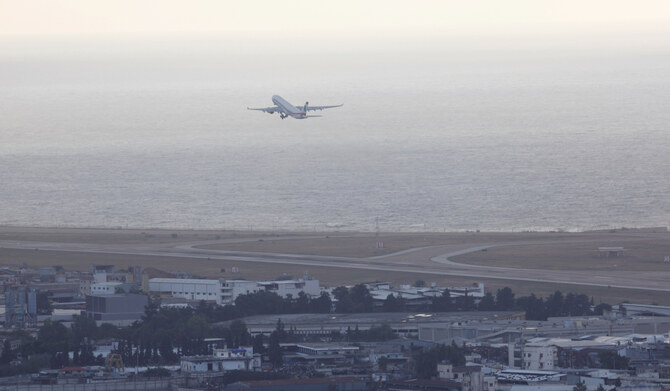
A Lebanese Middle East Airlines plane takes off from Beirut-Rafic Al Hariri International Airport on Oct. 1, 2024. (Reuters)
Short Url
Updated 02 October 2024
Follow

Airlines in the Gulf adjust routes after Iran’s attack on Israel

  • Neighboring countries have closed their airspace and airline crews are navigating alternative routes to avoid the escalating conflict

DUBAI: Several airlines operating in the Gulf have adjusted their flight routes to ensure passenger safety following Iran’s attack on Israel.

Neighboring countries have closed their airspace and airline crews are navigating alternative routes to avoid the escalating conflict.

Etihad Airways

Abu Dhabi’s Etihad Airways said it is rerouting several flights on Wednesday due to airspace restrictions in parts of the Middle East. Etihad said it is continuously monitoring security and airspace updates as the situation evolves.

Emirates Airlines

Emirates canceled all flights to and from Iraq (Basra and Baghdad), Iran, and Jordan on Oct. 2 and 3. The airline is closely monitoring the situation in the region and is in contact with relevant authorities regarding any developments.

Qatar Airways

Qatar Airways temporarily suspended flights to and from Iraq and Iran due to airspace closures.

Flydubai

Flydubai canceled flights to Jordan, Iraq, Israel, and Iran on Oct. 2 and 3 due to the temporary closure of airspace, according to a statement provided to Reuters.

Kuwait Airways

Kuwait Airways said on Tuesday it had adjusted the flight routes for some of its services, resulting in changes to destination timings.

“This is in application of necessary security measures and to ensure the safety of passengers,” the airline said.

A spokesperson for tracking service FlightRadar24 said flights diverted “anywhere they could,” and a snapshot of traffic in the region showed flights spreading in wide arcs to the north and south, with many converging on Cairo and Istanbul.

FlightRadar24 said Istanbul and Antalya in southern Turkiye were becoming congested, forcing some airlines to divert south.

Iran launched the strikes in retaliation for Israel’s campaign against Tehran’s Hezbollah allies in Lebanon, and Israel vowed a “painful response” against its enemy.

Eurocontrol, a pan-European air traffic control agency, earlier sent a warning to pilots about the escalating conflict.

“A major missile attack has been launched against Israel in the last few minutes. At present the entire country is under a missile warning,” it said in an urgent navigation bulletin.

Shortly afterwards it announced the closure of Jordanian and Iraqi airspace as well as the closure of a key crossing point into airspace controlled by Cyprus.

An Iraqi pilot bulletin said its Baghdad-controlled airspace was “closed due to security until further notice.”

Iraq’s transport ministry later announced the reopening of Iraqi airspace to incoming and outgoing civilian flights at Iraqi airports. FlightRadar24 said on X that “it will be a while before flights are active there again.”

Jordan also reopened its airspace after closing it following the volley of Iranian missiles fired toward Israel, the Jordanian state news agency reported.

Lebanon’s airspace will be closed to air traffic for a two-hour period on Tuesday, Transport Minister Ali Hamie said on X.

The latest disruptions are expected to deal a further blow to an industry already facing a host of restrictions due to conflicts between Israel and Hamas, and Russia and Ukraine.


Lebanon PM says IMF wants rescue plan changes as crisis deepens

Updated 4 sec ago
Follow

Lebanon PM says IMF wants rescue plan changes as crisis deepens

  • “We want to engage with the IMF. We want to improve. This is a draft law,” Salam said
  • “They wanted the hierarchy of claims to be clearer. The talks are all positive”

DAVOS, Switzerland: The International Monetary Fund has demanded amendments to a draft rescue law aimed at hauling Lebanon out of its worst financial crisis on record and giving depositors access to savings frozen for six years, Prime Minister Nawaf Salam said.
The “financial gap” law is part of a series of reform measures required by the IMF in order to access its funding and aims to allocate the losses from Lebanon’s 2019 crash between the state, the central bank, commercial banks and depositors.
Salam told Reuters the IMF wants clearer provisions in the hierarchy of claims, which is a core element of the draft legislation designed to determine how losses are allocated.
“We want to engage with the IMF. We want to improve. This is a draft law,” Salam said in an interview at the World Economic Forum annual meeting in ⁠the Swiss mountain resort of Davos.
“They wanted the hierarchy of claims to be clearer. The talks are all positive,” Salam added.
In 2022, the government put losses from the financial crisis at about $70 billion, a figure that analysts and economists forecast is now likely to be higher.
Salam stressed that Lebanon is still pushing for a long-delayed IMF program, but warned the clock is ticking as the country has already been placed on a financial ‘grey list’ and risks falling onto the ‘blacklist’ if reforms stall further.
“We want an IMF program and we want to continue our discussions until we get there,” he said, adding: “International pressure is real ... The longer we delay, the more people’s money will evaporate.”
The draft law, which was passed by Salam’s government in December, is under parliamentary review. It aims to give depositors a guaranteed path to recovering their funds, restart bank lending, and end a financial crisis that has left nearly a million accounts frozen and confidence in the system shattered.
The roadmap would repay depositors up to $100,000 over four years, starting with smaller accounts, while launching forensic audits to determine losses and responsibility.
Lebanon’s Finance Minister Yassine Jaber, who is driving the reform push with Salam, told Reuters it was ⁠essential to salvage a hollowed-out banking system, and to stop the country from sliding deeper into its cash-only, paralyzed economy.
The aim, Jaber said, is to give depositors clarity after years of uncertainty and to end a system that has crippled Lebanon’s international standing.
He framed the law as part of a broader reckoning: the first time a Lebanese government has confronted a combined collapse of the banking sector, the central bank and the state treasury.
Financial reforms have been repeatedly derailed by political and private vested interests over the last six years and Jaber said the responsibility now lies with lawmakers.
Failure to act, he said, would leave Lebanon trapped in “a deep, dark tunnel” with no way back to a functioning system.
“Lebanon has become a cash economy, and the real question is whether we want to stay on the grey list, or sleepwalk into a blacklist,” Jaber added.