WASHINGTON: The SpaceX crew that will ferry back in February two astronauts stranded on the International Space Station docked with the orbiting laboratory on Sunday, a live stream of the mission showed.
The Falcon 9 rocket took off at 1:17 p.m. (1717 GMT) from Cape Canaveral, Florida on Saturday, with the Crew-9 mission aboard a Dragon spacecraft making contact with the ISS at 5:30 p.m. Sunday.
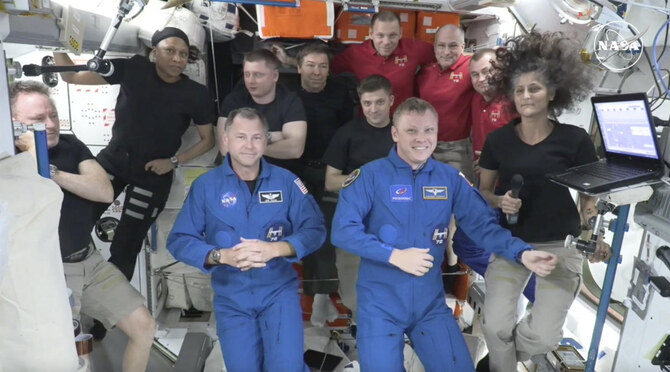
After docking was completed, NASA astronaut Nick Hague and Russian cosmonaut Alexander Gorbunov boarded the station just after 7:00 pm, embracing their floating colleagues.
“I just want to say welcome to our new compadres from Dragon Freedom,” said station commander Suni Williams, who is one of the two stranded astronauts.
“Alex, welcome to the International Space Station, and Nick, welcome back home,” she said.
When Hague and Gorbunov return from the space station in February, they will bring back space veterans Williams and Butch Wilmore, whose stay on the ISS was prolonged for months due to problems with their Boeing-designed Starliner spacecraft.
The newly developed Starliner was making its first crewed flight when it delivered Wilmore and Williams to the ISS in June.
They were supposed to be there for only eight days, but after problems with the Starliner’s propulsion system emerged during the flight there, NASA was forced to weigh a radical change in plans.
After weeks of intensive tests on the Starliner’s reliability, the space agency finally decided to return it to Earth without its crew, and to bring the two stranded astronauts back home on SpaceX’s Crew-9 mission.
SpaceX, the private company founded by billionaire Elon Musk, has been flying regular missions every six months to allow the rotation of ISS crews.
But the launch of Crew-9 was postponed from mid-August to late September to give NASA experts more time to evaluate the reliability of the Starliner and decide how to proceed.
It was then delayed a few more days by the destructive passage of Hurricane Helene, a powerful storm that roared into the opposite side of Florida on Thursday.
In total, Hague and Gorbunov will spend some five months on the ISS. Wilmore and Williams will spend eight months there.
Crew-9 will conduct some 200 scientific experiments during their stay.


![]()

SpaceX docks at ISS to take stranded astronauts home next year
Short Url
https://arab.news/phca8
SpaceX docks at ISS to take stranded astronauts home next year


Latest updates


Recommended


© 2026 SAUDI RESEARCH & PUBLISHING COMPANY, All Rights Reserved And subject to Terms of Use Agreement.