WASHINGTON: Boeing’s Starliner spacecraft landed uncrewed in a New Mexico desert late on Friday, capping a three-month test mission hobbled by technical issues that forced the astronauts it had flown to the International Space Station to remain there until next year.
NASA astronauts Butch Wilmore and Suni Williams, who became the first crew to fly Starliner in June, remained on the ISS as Starliner autonomously undocked at 6:04 p.m. ET (2204 GMT) on Friday, beginning a six-hour trek to Earth using maneuvering thrusters that NASA last month deemed too risky for a crew.
Starliner returned to Earth seemingly without a hitch, a NASA live stream showed, nailing the critical final phase of its mission.
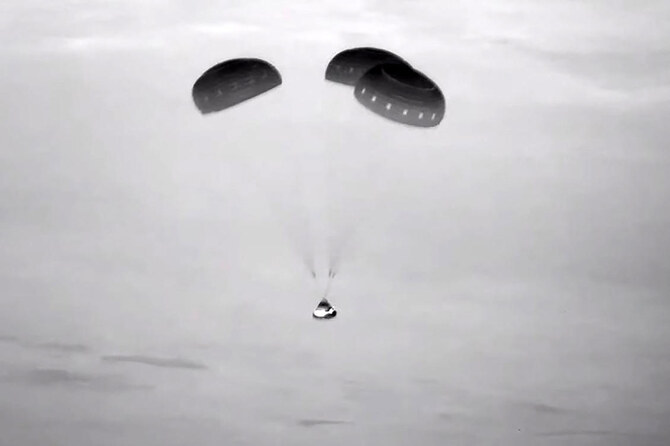
The spacecraft reentered Earth’s atmosphere at around 11 p.m. ET at orbital speeds of roughly 17,000 miles (27,400 km) per hour. About 45 minutes later, it deployed a series of parachutes to slow its descent and inflated a set of airbags moments before touching down at the White Sands Space Harbor, an arid desert in New Mexico.
Though the mission was intended to be a final test flight before NASA certifies Starliner for routine missions, the agency’s decision last month to keep astronauts off the capsule over safety concerns threw the spacecraft’s certification path into uncertainty, despite the clean return Boeing executed.
Wilmore and Williams, stocked with extra food and supplies on the ISS, will return to Earth on a SpaceX vehicle in February 2025. What was initially supposed to be an eight-day test has turned into an eight-month mission for the crew.
The ISS, a football field-sized science lab some 250 miles (402 km) in space, has seven other astronauts on board who arrived at different times on other spacecraft, including a Russian Soyuz capsule. Wilmore and Williams are expected to continue doing science experiments with their crewmates.
Five of Starliner’s 28 maneuvering thrusters failed with Wilmore and Williams on board during their approach to the ISS in June, while the same propulsion system sprang several leaks of helium, which is used to pressurize the thrusters.
Despite successfully docking on June 6, the failures set off a monthslong investigation by Boeing — with some help from NASA — that has cost the company $125 million, bringing total cost overruns on the Starliner program just above $1.6 billion since 2016, according to a Reuters analysis of securities filings.
Boeing’s Starliner woes have persisted since the spacecraft failed a 2019 test trip to the ISS without a crew. Starliner did a re-do mission in 2022 and largely succeeded, though some of its thrusters malfunctioned.
The aerospace giant’s Starliner woes represent the latest struggle that call into question Boeing’s future in space, a domain it had dominated for decades until Elon Musk’s SpaceX began offering cheaper launches for satellites and astronauts and reshaped the way NASA works with private cFompanies.
Boeing will recover the Starliner capsule after its touchdown and continue its investigation into why the thrusters failed in space.
But the section that housed Starliner’s thrusters — the “service module” trunk that provides in-space maneuvering capabilities — detached from the capsule as designed just before it plunged into Earth’s atmosphere.
The service module bearing the faulty thrusters burned up in the atmosphere as planned, meaning Boeing will rely on simulated tests to figure out what went wrong with the hardware in space.


![]()

Without astronauts, Boeing’s Starliner returns to Earth
Short Url
https://arab.news/m4ztf
Without astronauts, Boeing’s Starliner returns to Earth
- NASA astronauts Wilmore and Williams to return on SpaceX vehicle in February 2025
- Boeing’s Starliner program faces $1.6 billion in cost overruns since 2016


Latest updates


© 2026 SAUDI RESEARCH & PUBLISHING COMPANY, All Rights Reserved And subject to Terms of Use Agreement.