

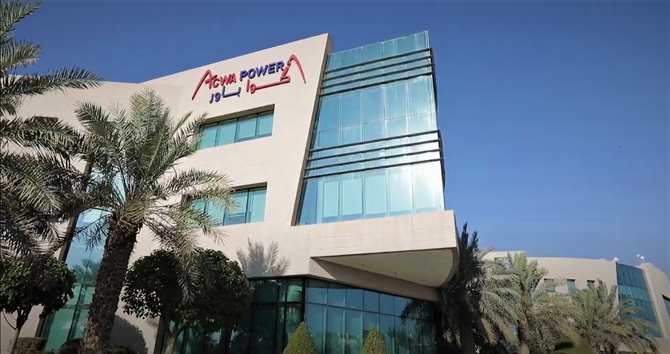
ACWA Power, Badeel, and SAPCO reach $3.2bn financial close on 3 solar PV projects  

The projects will deliver a combined solar capacity of 5.5 gigawatts.  Supplied
Short Url
Updated 29 September 2024
Follow

ACWA Power, Badeel, and SAPCO reach $3.2bn financial close on 3 solar PV projects  

RIYADH: Saudi Arabia’s upcoming solar photovoltaic projects — Haden, Muwayh, and Al Khushaybi — have reached financial close, securing a total investment of $3.2 billion.  

Spearheading these initiatives is the Kingdom’s energy transition leader, ACWA Power, along with Public Investment Fund-owned Water and Electricity Holding Co., also known as Badeel, and Saudi Aramco Power Co., an Aramco subsidiary.  

The projects will deliver a combined solar capacity of 5.5 gigawatts.  

These initiatives are part of Saudi Arabia’s National Renewable Energy Program, which is overseen by the Ministry of Energy and is reflected in PIF’s commitment to develop 70 percent of the country’s renewable energy target capacity by 2030.  

“Financial closure of the projects signals our dedication and commitment to providing clean, consistent and cost-effective energy. We are grateful to our stakeholders and our financial partners for their invaluable support in enabling us to make this vision a reality,” said Marco Arcelli, CEO of ACWA Power.  

The Haden and Muwayh plants, each with a capacity of 2 GW, are located in the Makkah region, while the Al Khushaybi plant, with a capacity of 1.5 GW, is situated in the Qassim region.  

The facilities will be jointly owned by Badeel, ACWA Power, and SAPCO, with the Saudi Power Procurement Co. serving as the procurer and off-taker for the projects.  

The $2.5 billion senior debt financing for these projects was secured through a consortium of local, regional, and international banks, including Banque Saudi Fransi, Mizuho Bank, and Riyad Bank, as well as the Saudi National Bank, Standard Chartered Bank, Emirates NBD, First Abu Dhabi Bank, and HSBC. 

“Reaching the financial close of these solar PV projects represents a major milestone in our journey to support Saudi Arabia’s rapidly growing renewable energy sector and contribute to PIF’s commitment to developing 70 percent of Saudi Arabia’s renewable energy by 2030,” Sultan Al-Nabulsi, acting CEO at Badeel, said.  

This financial close follows significant investments by PIF in the renewable energy value chain. In July, PIF announced three new joint ventures to boost local production of wind turbine and solar PV components, with the intention of leveraging the global energy transition and supporting efforts to position Saudi Arabia as a manufacturing hub for the renewables sector.  

PIF and its partners are currently developing several projects with a total capacity of 13.6 GW, representing investments of over $9 billion.  

These projects include Sudair, Shuaibah 2, Ar Rass 2, Al Kahfah, and Saad 2 and are intended to support local private sector development through increased domestic supply chain participation.  

“We are pleased to extend our partnership with ACWA Power and Badeel, providing further impetus for the Kingdom’s rapidly growing renewables sector. Together, we are taking our renewables portfolio to the next level, advancing the energy transition to meet the rising demand for power with fewer emissions,” the Senior VP of New Energies at Saudi Aramco, Waleed Al-Saif, said.  

With the addition of these three new projects, ACWA Power’s solar portfolio in Saudi Arabia now includes 14 projects, totaling more than 17.8 GW of combined PV capacity. This brings ACWA Power’s total renewable capacity portfolio to 35 GW. 


Saudi Arabia’s non-oil exports surge 32.3% in October: GASTAT  

Updated 12 sec ago
Follow

Saudi Arabia’s non-oil exports surge 32.3% in October: GASTAT  

RIYADH: Saudi Arabia’s non-oil exports, including re-exports, rose 32.3 percent year on year in October to reach SR33.88 billion ($9.03 billion), according to official data. 

Preliminary figures released by the General Authority for Statistics showed that national non-oil exports, excluding re-exports, increased by 2.4 percent in October compared to the same period a year earlier. 

The rise in non-oil exports underscores progress under Saudi Arabia’s Vision 2030 program, which aims to diversify the economy by reducing reliance on crude oil revenues. 

In its latest report, GASTAT stated: “The ratio of non-oil exports (including re-exports) to imports increased to 42.3 percent in October 2025 from 33.4 percent in October 2024. This was due to a 32.3 percent increase in non-oil exports and a 4.3 percent increase in imports during the same period.”  

It added: “The value of re-exported goods increased by 130.7 percent during the same period, driven by a 387.5 percent increase in transportation equipment and parts, which represented 37.4 percent of total re-exports.” 

The report showed that machinery, electrical equipment, and parts led the non-oil export basket, accounting for 23.6 percent of outbound shipments and recording an 82.5 percent year-on-year increase. 

Chemical products followed with a 19.4 percent share of non-oil exports. 

In October, Moody’s said in a report that Saudi Arabia is on course to sustain annual non-oil sector growth of between 4.5 percent and 5.5 percent over the next five to 10 years as its Vision 2030 diversification program gathers pace. 

Earlier this month, GASTAT reported that Saudi Arabia’s gross domestic product expanded by 4.8 percent in the third quarter compared to the same period in 2024, driven by growth in both oil and non-oil activities. 

The authority added that oil activities advanced by 8.3 percent year on year in the third quarter, while the non-oil sector grew by 4.3 percent over the same period. 

Top non-oil destinations 

China was the top destination for Saudi non-oil goods, with shipments totaling SR14.68 billion. 

The UAE ranked second, receiving goods worth SR11.37 billion, followed by India at SR10.25 billion, Japan at SR8.37 billion, and South Korea at SR7.37 billion. 

In October, Saudi Arabia exported non-oil goods valued at SR5.20 billion to the US, while Bahrain and Egypt received products worth SR5.02 billion and SR4.01 billion, respectively. 

Export gateways  

GASTAT said ports played a crucial role in facilitating non-oil shipments during October. 

Jeddah Islamic Seaport handled the largest volume of non-oil exports at SR3.76 billion, followed by Ras Al Khair Seaport at SR3.64 billion and King Fahad Industrial Seaport in Jubail at SR3.21 billion. 

Jubail Seaport was the exit point for goods worth SR2.88 billion, while Ras Tanura Seaport and King Abdulaziz Seaport in Dammam handled non-oil shipments valued at SR2.53 billion and SR2.21 billion, respectively. 
 
Overall merchandise exports 

Saudi Arabia’s total merchandise exports stood at SR103.98 billion in October, representing an 11.8 percent increase compared to the same month a year earlier. 

The share of oil exports in total exports declined to 67.4 percent in October 2025, from 72.5 percent in October 2024. 

China was the Kingdom’s largest export destination, accounting for 14.1 percent of total exports. The UAE and India followed with shares of 10.9 percent and 9.9 percent, respectively. 

Japan, South Korea, the US, Bahrain, Egypt, Singapore, and Poland were also among the top 10 export destinations. 

“Exports of the Kingdom to those 10 countries account for 70.4 percent of total exports,” added GASTAT.  

Imports in October 

Imports rose 4.3 percent year on year in October to SR80.07 billion, while the merchandise trade surplus increased by 47.4 percent compared to the same month last year, according to the report. 

China was the Kingdom’s largest source of imports, accounting for 24.8 percent of total inbound shipments, followed by the US at 8.7 percent and the UAE at 6.4 percent. 

Switzerland, India, Germany, Japan, Italy, France, and Egypt were also among the top 10 countries exporting goods to Saudi Arabia. 

Sea routes remained the dominant entry channel for imports, handling SR44.49 billion worth of goods, while air and land routes accounted for SR27.25 billion and SR8.33 billion, respectively. 

King Abdulaziz Seaport in Dammam was the leading sea entry point with imports valued at SR20.57 billion. 

Jeddah Islamic Seaport handled inbound shipments worth SR15.82 billion, followed by Jubail Seaport at SR1.83 billion and King Fahad Industrial Seaport in Jubail at SR854.9 million. 

Among land entry points, Al-Batha Port processed SR3.75 billion worth of goods, while Riyadh Dry Port and the King Fahad Bridge handled SR2.13 billion and SR822.9 million, respectively. 

By air, King Khalid International Airport received SR11.99 billion in imports during October, while King Abdulaziz International Airport and King Fahad International Airport handled SR10.38 billion and SR4.65 billion, respectively.