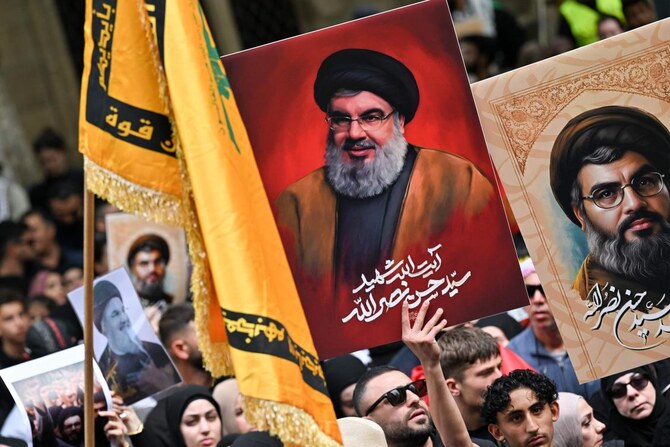
In the wake of Sayyed Hassan Nasrallah’s killing, Hezbollah faces the enormous challenge of plugging the infiltration in its ranks that allowed its arch enemy Israel to destroy weapons sites, booby-trap its communications and assassinate the veteran leader, whose whereabouts had been a closely guarded secret for years. Nasrallah’s killing in a command HQ on Friday came barely a week after Israel’s deadly detonation of hundreds of booby-trapped pagers and radios. It was the culmination of a rapid succession of strikes that have eliminated half of Hezbollah’s leadership council and decimated its top military command.
In the days before and hours after Nasrallah’s killing, Reuters spoke to more than a dozen sources in Lebanon, Israel, Iran and Syria who provided details of the damage Israel has wrought on the powerful Shiite paramilitary group, including to its supply lines and command structure. All asked for anonymity to speak about sensitive matters.
One source familiar with Israeli thinking told Reuters, less than 24 hours before the strike, that Israel has spent 20 years focusing intelligence efforts on Hezbollah and could hit Nasrallah when it wanted, including in the headquarters.
The person called the intelligence “brilliant,” without providing details.
Israeli Prime Minister Benjamin Netanyahu and his close circle of ministers authorized the attack on Wednesday, two Israeli officials told Reuters. The attack took place while Netanyahu was in New York to speak at the UN General Assembly.
Nasrallah had avoided public appearances since a previous 2006 war. He had long been vigilant, his movements were restricted and the circle of people he saw was very small, according to a source familiar with Nasrallah’s security arrangements. The assassination suggested his group had been infiltrated by informants for Israel, the source said.
The Hezbollah leader had been even more cautious than usual since the Sept. 17 pager blasts, out of concern Israel would try to kill him, a security source familiar with the group’s thinking told Reuters a week ago, citing his absence from a commanders’ funeral and his pre-recording of a speech broadcast a few days before.
Hezbollah’s media office did not respond to a request for comment for this story. US President Joe Biden on Saturday called Nasrallah’s killing “a measure of justice” for his many victims, and said the United States fully supported Israel’s right to defend itself against Iranian-backed groups.
Israel says it carried out the hit on Nasrallah by dropping bombs on the underground headquarters below a residential building in southern Beirut.
“This is a massive blow and intelligence failure for Hezbollah,” Magnus Ranstorp, a veteran Hezbollah expert at the Swedish Defense University. “They knew that he was meeting. He was meeting with other commanders. And they just went for him.”
Including Nasrallah, Israel’s military says it has killed eight of Hezbollah’s nine most senior military commanders this year, mostly in the past week. These commanders led units ranging from the rocket division to the elite Radwan force.
Around 1,500 Hezbollah fighters were maimed by the exploding pagers and walkie talkies on Sept. 17 and Sept. 18.
On Saturday, Israel’s military spokesperson Lt. Col. Nadav Shoshani told reporters in a briefing that the military had “real-time” knowledge that Nasrallah and other leaders were gathering. Shoshani did not say how they knew, but said the leaders were meeting to plan attacks on Israel.
Brig. Gen. Amichai Levin, commander of Israel’s Hatzerim Airbase, told reporters that dozens of munitions hit the target within seconds.
“The operation was complex and was planned for a long time,” according to Levin.
Depleted
Hezbollah has shown the ability to replace commanders quickly, and Nasrallah’s cousin Hashem Safieddine, also a cleric who wears the black turban denoting descent from Islam’s Prophet Muhammad, has long been tipped as his successor.
“You kill one, they get a new one,” said a European diplomat of the group’s approach. The group, whose name means Party of God, will fight on: by US and Israeli estimates it had some 40,000 fighters ahead of the current escalation, along with large weapons stockpiles and an extensive tunnel network near Israel’s border.
Founded in Tehran in 1982, the Shiite paramilitary outfit is the most formidable member of Iran’s so-called Axis of Resistance of anti-Israel allied irregular forces, and a significant regional player in its own right.
But it has been materially and psychologically weakened over the past 10 days.
Thanks to decades of backing from Iran, prior to the current conflict Hezbollah was among the world’s most well-armed non-conventional armies, with an arsenal of 150,000 rockets, missiles and drones, according to US estimates.
That is ten times the size of the armory the group had in 2006, during its last war with Israel, according to Israeli estimates.
Over the past year, even more weapons have flowed into Lebanon from Iran, along with significant amounts of financial aid, a source familiar with Hezbollah’s thinking said.
There have been few detailed public assessments of how much this arsenal has been damaged by Israel’s offensive over the past week, which has hit Hezbollah strongholds in Bekaa Valley, far from Lebanon’s border with Israel.
One Western diplomat in the Middle East told Reuters prior to Friday’s attack that Hezbollah had lost 20 percent-25 percent of its missile capacity in the ongoing conflict, including in hundreds of Israeli strikes this week. The diplomat did not provide evidence or details of their assessment.
An Israeli security official said “a very respectable portion” of Hezbollah’s missile stocks had been destroyed, without giving further specifics.
In recent days, Israel has struck more than 1,000 Hezbollah targets. The security official, when asked about the military’s extensive target lists, said Israel had matched Hezbollah’s two-decade build up with preparations to prevent it launching its rockets in the first place — a complement to the Iron Dome air defense system that often downs missiles fired at the Jewish state.
Israeli officials say the fact that Hezbollah has only been able to launch a couple of hundred missiles a day in the past week was evidence its capabilities had been diminished.
Iran connection
Before the strike on Nasrallah, three Iranian sources told Reuters Iran was planning to send additional missiles to Hezbollah to prepare for a prolonged war. The weapons that were to be provided included short-to-medium-range ballistic missiles including Iranian Zelzals and an upgraded precision version known as the Fateh 110, the first Iranian source said.
Reuters was unable to reach the sources after the Nasrallah assassination.
While Iran is willing to provide military support, the two Iranian sources said it does not want to be directly involved in a confrontation between Hezbollah and Israel. The rapid escalation in hostilities over the past week follows a year of skirmishes tied to the Gaza war.
Iranian Revolutionary Guards’ deputy commander Abbas Nilforoushan was killed in the Israeli strikes on Beirut on Friday, Iranian media reported on Saturday, citing a state TV report.
Hezbollah may need certain warheads and missiles along with drones and missile parts to replenish those destroyed by Israeli strikes across Lebanon last week, a senior Syrian military intelligence source added. Iranian supplies have in the past reached Hezbollah by air and sea. On Saturday, Lebanon’s transport ministry told an Iranian aircraft not to enter its airspace after Israel warned air traffic control at Beirut airport that it would use “force” if the plane landed, a source at the ministry told Reuters.
The source said it was not clear what was on the plane.
Land corridors are currently the best route for missiles, parts and drones, through Iraq and Syria, with the help of allied armed groups in those countries, an Iranian security official told Reuters this week. The Syrian military source, however, said Israeli drone surveillance and strikes targeting convoys of trucks had compromised that route. This year, Israel stepped up attacks on weapons depots and supply routes in Syria to weaken Hezbollah ahead of any war, Reuters reported in June.
As recently as August, an Israeli drone hit weapons concealed in commercial trailers in Syria, the source said. This week, Israel’s military said its warplanes bombed unspecified infrastructure used to transfer weapons to Hezbollah at the Syria-Lebanon border.
Joseph Votel, a former army general who led US forces in the Middle East, said Israel and its allies could well intercept any missiles Iran sent by land to Hezbollah now.
“That might be a risk they’re willing to take, frankly,” he said.


![]()

Nasrallah’s killing reveals depth of Israel’s penetration of Hezbollah
Short Url
https://arab.news/4kkam
Nasrallah’s killing reveals depth of Israel’s penetration of Hezbollah
- Nasrallah’s killing came just over a week after detonation of booby-trapped pagers
- Israel has eliminated half Hezbollah’s leadership council, destroyed many of its weapons dumps


Latest updates


© 2026 SAUDI RESEARCH & PUBLISHING COMPANY, All Rights Reserved And subject to Terms of Use Agreement.