



ISLAMABAD: Former Prime Minister Imran Khan’s Pakistan Tehreek-e-Insaf (PTI) party called off its protest in the garrison city of Rawalpindi on Saturday after police fired tear gas during the day to disperse hundreds of supporters and cut off the power supply at the demonstration site in the evening.
Security was intensified, with shipping containers placed at the entry and exit points of Rawalpindi to prevent PTI sympathizers from entering the city. The party seeks to build public pressure on the government for the ex-premier’s release, who has been in jail for over a year and has faced charges ranging from treason to corruption.
PTI is also protesting the government’s proposed constitutional amendments, which it claims are designed to suppress judicial independence, an allegation the government denies.
Video clips on social media showed police firing tear gas at supporters to prevent them from reaching Rawalpindi. Later, authorities cut power to the protest area to halt the possibility of a major demonstration.
“The protest has been called off due to the injuries and the violence that has been done by the Punjab police,” Zulfi Bukhari, a former federal minister and close aide of Khan, said while expressing gratitude to the protesters.
Referring to the protests that broke out on May 9, 2023, after the former premier’s brief arrest in a graft case in which people holding PTI flags vandalized government buildings and military properties, he maintained the party did not want its workers blamed again for any violence or destruction of public property.
Bukhari claimed the police used rubber bullets on peaceful protesters.
“We understand the scheming that is going on and we understand what’s going to be tried to do against us,” he added.
Speaking to Arab News, Inspector Sajjad-ul-Hassan, spokesperson of the Rawalpindi police, justified the used of tear gas to “disperse violent protesters.”
“They were pelting stones on the cops deployed in the city,” he said.
Asked if the law enforcement personnel also used rubber bullets, he denied in the negative.
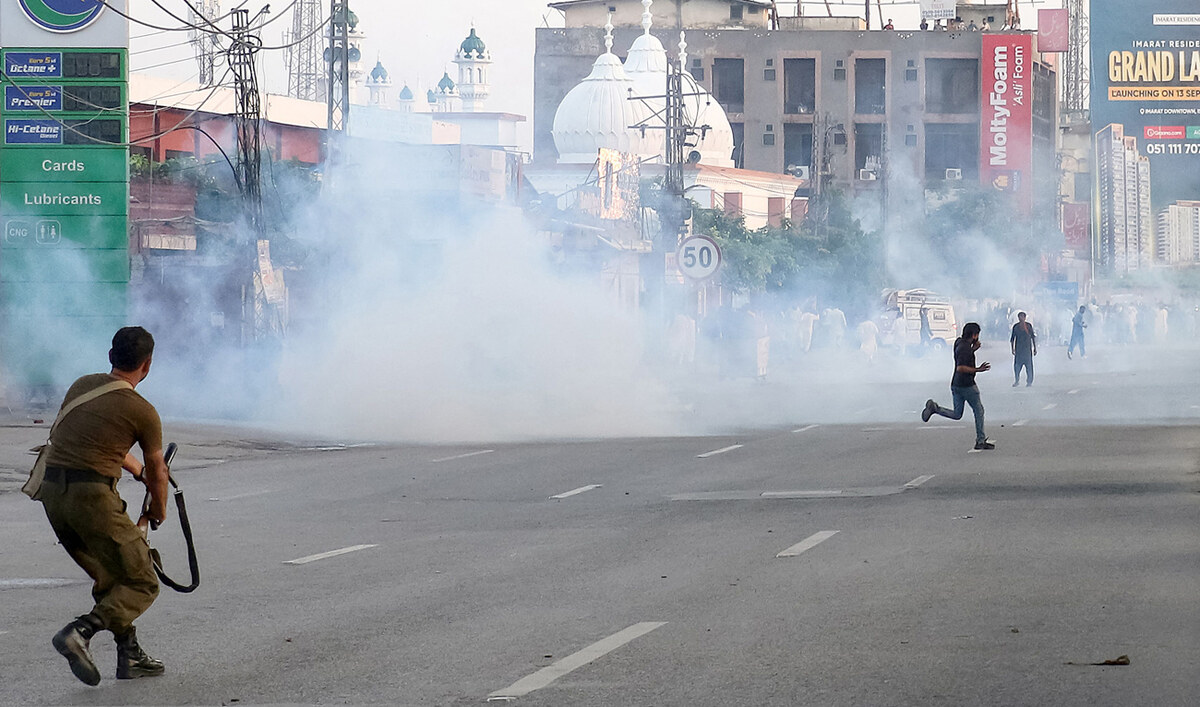
A policeman fires teargas shell toward supporters of Pakistan’s jailed former prime minister Imran Khan’s Pakistan Tehreek-e-Insaf (PTI) party, during a protest demanding his release in Rawalpindi on September 28, 2024. (AFP)
“This is just a propaganda against the police,” he added.
Authorities had blocked all major entry and exit points of the city ahead of the protest, making it difficult for people to commute. A day earlier, the Punjab Home Department issued a notification imposing Section 144, a legal provision that bans gatherings of four or more people.
Apart from Rawalpindi, the ban was also enforced in the nearby cities of Jhelum, Chakwal and Attock.
‘SECTION 804’
Earlier, the top PTI leaders vowed to continue with their protest despite the government’s attempts to defeat their plan.
“God willing, you will see what will happen today,” Khyber Pakhtunkhwa Chief Minister Ali Amin Gandapur, who belongs to Khan’s party, told reporters from inside his car, leading a convoy of hundreds of charged up supporters toward Rawalpindi, earlier in the day.
“Section 804 has been imposed across Pakistan,” he shouted, referring to the prisoner identification number assigned to Khan when he was first arrested in August last year.
PTI leader Shaukat Yousafzai uploaded a video on social media in which a thick cloud of smoke is visible in the background.
“You can see that they have started shelling at Attock,” Yousafzai said. “They are shelling unarmed citizens. But God willing, they will not be able to stop us.”
Addressing the situation in a media talk, Senator Talal Chaudhry of the ruling Pakistan Muslim League-Nawaz party said protest was everyone’s right, but “we will not allow violence and disruption in the name of protest.”
He also questioned the rationale behind the protest at a time when the country’s macroeconomic indicators are looking up.
“Is this protest taking place because inflation has come down in Pakistan from 37 percent to 9 percent,” he asked. “Is this protest taking place because Pakistan’s stock exchange has reached from 40,000 to 80,000 points?”
He wondered why did “armed people from other provinces” come to Punjab to protest.
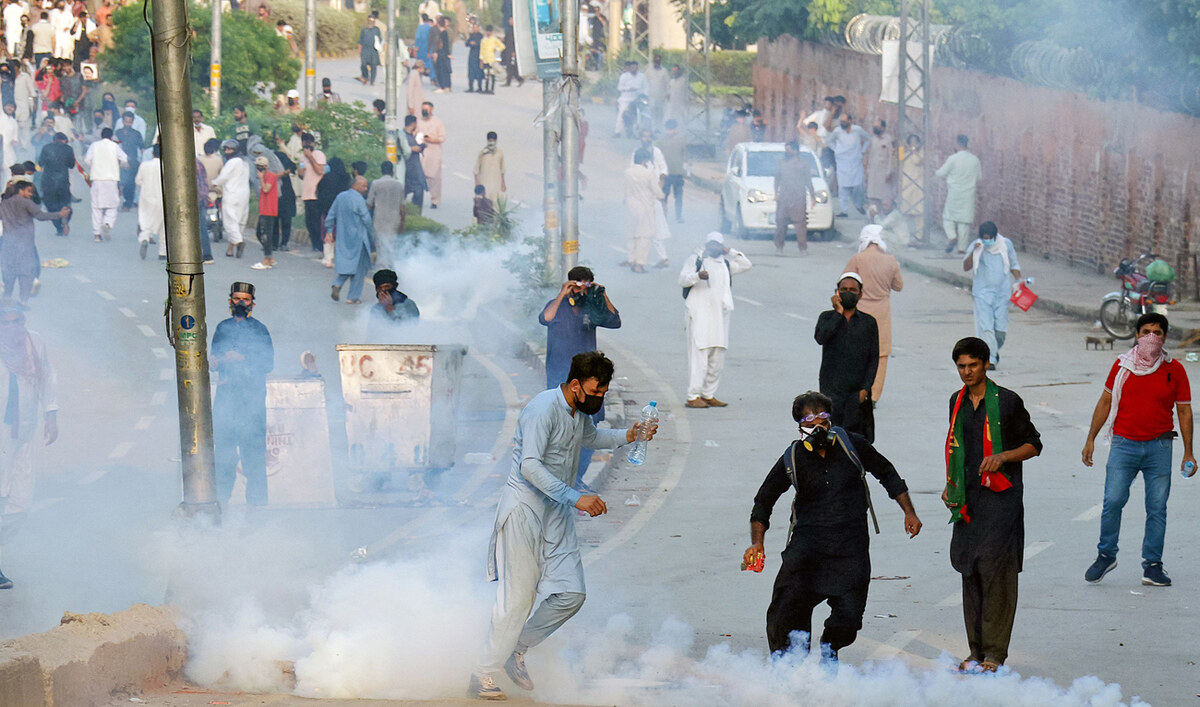
Supporters of Pakistan’s jailed former prime minister Imran Khan’s Pakistan Tehreek-e-Insaf (PTI) party, attempt to throw back teargas shells fired by riot policemen as they protest demanding Khan’s release in Rawalpindi on September 28, 2024. (AFP)
“This is not a protest but an attempt to generate violence,” he added. “They want to create such circumstances where people once again talk about default in Pakistan. Once again, the poor have nothing to eat [and] Pakistan moves toward chaos again. We won’t let such attempts by these people succeed.”
Prior to that, Punjab Information Minister Azma Bokhari addressed a news conference in Lahore, warning protesters of stern action if they took law into their own hands.
“Section 144 has been imposed in Rawalpindi and Rangers have been deployed also,” Bokhari warned. “And today if anyone tries to interfere in peace and security, if anyone tries to take the law into their hands, tries to block streets or public squares, then the law will deal with them with an iron fist.”


