

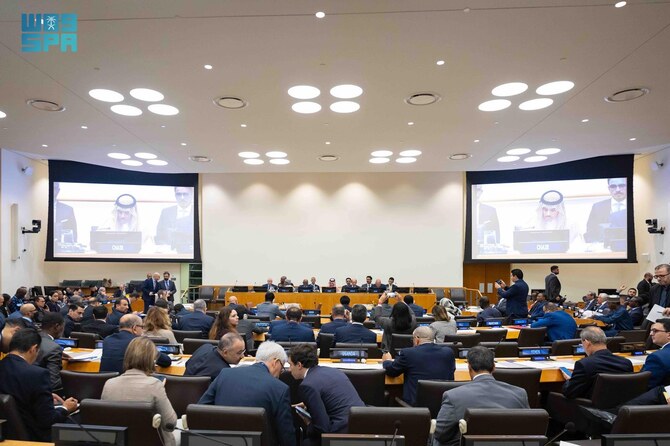

NEW YORK CITY: Arab foreign ministers at the UN have called for an immediate end to Israeli strikes on Lebanon and a ceasefire in Gaza, with officials from countries around the world lending words of support to the Palestinian cause.
The appeal came during a special Security Council meeting convened by Algeria on Thursday, with the Palestinian prime minister delivering an impassioned message condemning the “dehumanization” of his people.
An Arab delegation spoke to the media before the meeting, with Saudi Foreign Minister Faisal bin Farhan and Jordanian Foreign Minister Ayman Safadi outlining the position of the two kingdoms on Israel’s latest escalation and a solution to the crisis.
“We address the Palestinian issue through what has been established in international law — the formation of a Palestinian state,” Prince Faisal said.
“And that will indeed open up the horizon, not just for normalization, but also for integration, for cooperation.”
Safadi called on the Security Council to “perform its duty” and “do what it has to do to protect regional, international peace.”
He said: “It is time to face the truth, and the truth is, unless Netanyahu is stopped, unless this (Israeli) government is stopped, war will encompass all of us.
“The real danger in the region are the policies of this government of Israel, are the actions of this government of Israel, and the failure of the international community to stop it and say enough.”
The two foreign ministers were joined by, among others, Palestinian Prime Minister Mohammad Mustafa, who in the Security Council meeting condemned the “insanity” of the council’s inability to stop Israel’s war in Gaza.
UN Secretary-General Antonio Guterres opened proceedings, delivering a speech in which he warned that “nothing can justify the collective punishment of the Palestinian people.”
He said: “Monday was the bloodiest day in Lebanon since 2006. Shockwaves radiating from the unprecedented death and destruction in Gaza now threaten to push the entire region into the abyss: A full-scale conflagration with unimaginable consequences.”
The prime minister of Slovenia, which is heading the Security Council for September, warned that “facts on the ground” made the prospects of a two-state solution almost impossible.
Robert Golob said: “We need courage from leaders in the region and from this council to change the trajectory we are facing,” said Robert Golob.
Mustafa, who was appointed prime minister earlier this year, praised the Slovenian presidency for its “honorable positions.”
“We would also like to express our thanks and appreciation to the secretary-general of the UN for his wise leadership of this organization that has been the victim of attacks and unprecedented defamation by Israel,” he added.
“A whole year has passed since the beginning of the Israeli aggression against our people in the Gaza Strip — the Gaza strip that has been destroyed and sieged for 365 days and nights of terror, of killing, of displacement, of destruction, of disease, of pain, of hunger, of despair, of sadness, of need, of deprivation, and on top of all of that, they’ve dehumanized us and they took away our dignity.”
Mustafa questioned the commitment of UN member states to forcing an end to the Israeli war.
“We came to the UN and we felt solidarity, great solidarity, with our people and our just cause. But we leave the UN and we see that the Israeli massacres have not ended, and the Security Council, to this very day, did not put an end to the Israeli aggression, did not adopt measures that would put pressure to bear on the Israeli government,” he said.
As well as Gaza, Mustafa highlighted Israel’s latest actions in Lebanon, which he condemned as a violation of sovereignty, the UN Charter and international law.
“They are acting as a rogue state because they are convinced that they are above the law and they are entitled to things that other countries are not entitled to,” he added.
“So, how would they not repeat the same aggression in Lebanon if they were not held accountable for their crimes in Palestine? Will the Security Council continue with its traditional position where it calls for Israel to put an end to the war and expects Israel to comply?
“When will you activate your tools at the Security Council that will compel Israel to comply to maintain international peace and security? Are you waiting for a bigger catastrophe? Are you waiting for a larger war?”
Mustafa said a “free Palestine” was the “sole key” to unlocking a peaceful future for the Middle East, and that “everything else has been tried and failed.”
The Chinese foreign minister, Wang Yi, said: “When the Middle East is unstable, the world is insecure.”
He signaled China’s “worry” at Israel’s escalation in Lebanon, calling for the country’s sovereignty to be upheld.
“We must not deviate from letting the Palestinian people govern Palestine and must work together for postwar governance,” Wang added. “Gaza used to be where diverse civilizations met, but today it is engulfed in fighting. The Security Council should support Palestine in becoming a full member of the UN and make new efforts for the two-state solution.”
Algerian Foreign Minister Ahmed Attaf warned the council that “we cannot wash our hands of the responsibility” of ensuring Palestinian rights.
He said the UN body had become “paralyzed” and that the council “cannot even bring justice to the Palestinian people.”
Sergey Lavrov, Russia’s longtime foreign minister, warned that the Gaza war and Lebanon escalation was having consequences on the entire region.
“The root cause of these crises has been, and remains, the fact that the Palestinian issue remains unresolved,” he said.
US Ambassador to the UN Linda Thomas-Greenfield said, quoting US President Joe Biden, that “all-out war” was possible.
But she added it was not inevitable, highlighting the “opportunity” of a ceasefire in Gaza and a diplomatic solution to the conflict between Israel and Hezbollah.
French Ambassador to the UN Nicolas de Riviere told the council: “The large-scale strikes which took place today in the south suburb of Beirut once again wrought devastation and claimed many casualties.
“This must be brought to an end immediately. France is determined to achieve a cessation of hostilities along the Blue Line in line with UN Resolution 1701.”
Safadi, Jordan’s foreign minister and deputy prime minister, said in his address: “The Israeli government has not only killed Palestinian children, destroyed their homes, bombed their schools, deprived them from food, medicine and hope, it also demonized them.
“They have dehumanized them. They have educated their children to hate them. They educated their soldiers to target them, and they have educated their community to deny them the right to exist.”
Turkish Foreign Minister Hakan Fidan said: “Wisdom could have prevailed to stop this barbaric war in Gaza before it expands to the West Bank, Lebanon and beyond.
“It is so puzzling that certain international actors, which have the leverage to alter this horrific cause, decided deliberately to stay paralyzed, and they showed no reflexes whatsoever to take conclusive action.”


