Lebanon facing deadliest period ‘in a generation’: UN

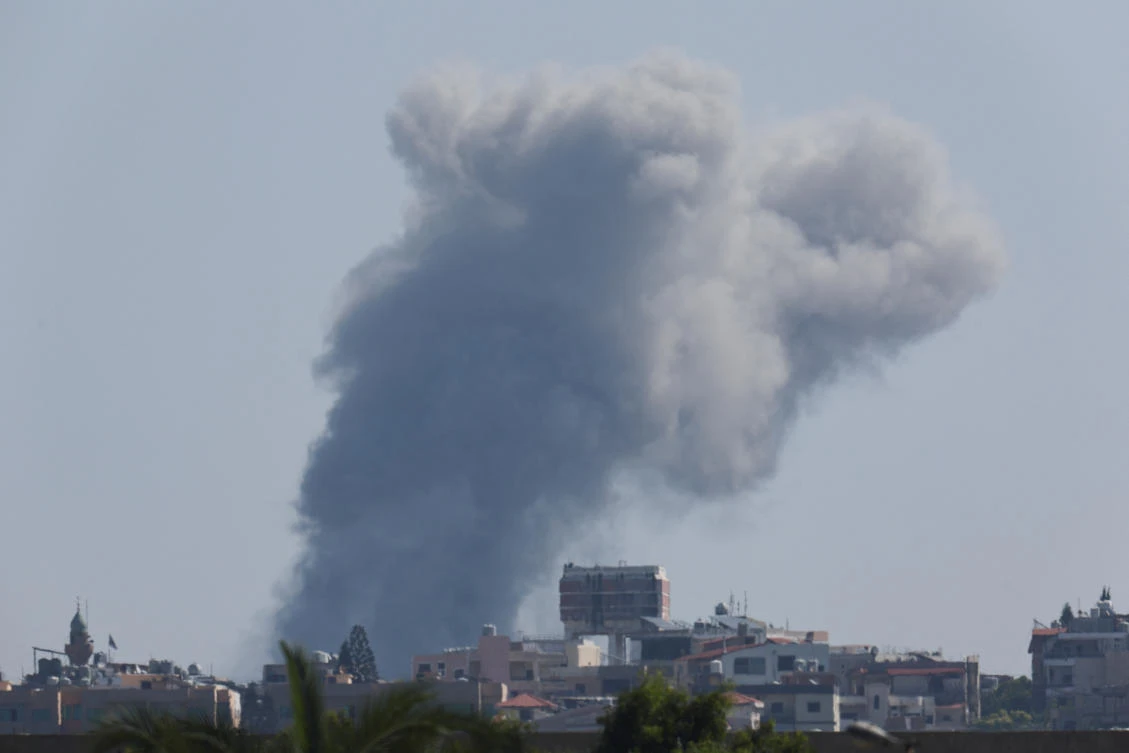
Smoke billows over southern Lebanon following an Israeli strike as seen from Tyre, on Sept. 27, 2024. (Reuters)
Short Url
Updated 28 September 2024
Follow

Lebanon facing deadliest period ‘in a generation’: UN

  • “The recent escalations in Lebanon are nothing short of catastrophic,” said Imran Riza, the UN humanitarian coordinator in Lebanon
  • “We are witnessing the deadliest period in Lebanon in a generation, and many express their fear that this is just the beginning“

GENEVA: The UN said Friday that a “catastrophic” intensification of Israeli attacks targeting Hezbollah militants had left Lebanon facing its deadliest period in years, with its hospitals overwhelmed by casualties.
“The recent escalations in Lebanon are nothing short of catastrophic,” said Imran Riza, the United Nations humanitarian coordinator in Lebanon.
Hezbollah and Israel have been locked in a deadly exchange of cross-border fire since the Iran-backed group’s Palestinian ally, Hamas, attacked Israel on October 7.
Nearly a year into the war with Hamas in Gaza, Israel has shifted its focus to its northern front with Lebanon.
Since Monday, Israeli warplanes have bombarded Hezbollah strongholds around the country, killing more than 700 people and injuring nearly 6,000, according to the health ministry.
Hundreds of pagers and walkie-talkies detonated across Lebanon last week also killed at least 39 people and wounded nearly 3,000 in an attack widely blamed on Israel, which has refused to comment.
“We are witnessing the deadliest period in Lebanon in a generation, and many express their fear that this is just the beginning,” Riza told reporters in Geneva via video link from Beirut.
He pointed out that on Monday alone, the death toll was equal to around half of the 1,200 killed during 34 days of war between Israel and Hezbollah in 2006.
“The level of displacement, the level of trauma, the level of panic, has been huge,” he said.
At the same time, Riza warned that Lebanon’s “health sector is completely overrun.”
“The events of last week, including the explosions of communication devices, have nearly depleted health supplies,” he said.
“With the recent escalations and hospitals reaching capacity, the system is struggling with limited resources to meet the growing demands.”
The hospitals in Lebanon “are overwhelmed,” agreed Margaret Harris, spokeswoman for the World Health Organization.
She pointed out that the pager and walkie-talkie blasts had caused large numbers of serious injuries, especially to eyes and hands, which require specialized treatment.
A full 777 injured remain in hospitals after those blasts, “and 152 of those are critical cases,” Harris said.
“That means they’re not leaving the hospital for quite some time, and so every day of bombing and blasts fills up beds that can’t be unfilled.”
At the same time, she said, 37 health facilities had been closed across Lebanon due to events.
Harris stressed that aid agencies had done a lot to prepare for possible mass-casualty events in Lebanon in case the past year of cross-border fire were to escalate.
The WHO had helped “train most of the health workers in most of the hospitals for mass casualty,” she said. But “in our planning scenarios, we didn’t have anything like the numbers that have actually been affected.”
“It was way beyond anything that normal planning, even for a horrific event like this, would have expected.”
Military drone attack on Sudan oil field kills dozens and threatens South Sudan’s economic lifeline

Updated 7 sec ago
Follow

Military drone attack on Sudan oil field kills dozens and threatens South Sudan’s economic lifeline

  • RSF said the oil field in Heglig was attacked a day after they seized the facility near the border with South Sudan
  • South Sudanese soldiers were among the dead in the attack by an Akinci drone

JUBA: Dozens of people were killed Tuesday evening in a drone strike near Sudan’s largest oil processing facility carried out by the Sudanese Armed Forces, according to the paramilitary Rapid Support Forces.
The RSF, which has been fighting Sudan’s military since 2023, said the oil field in Heglig was attacked a day after the RSF seized the facility near the border with South Sudan.
Both sides told The Associated Press that the exact number of dead and wounded could not immediately be confirmed. Local news outlets reported seven tribal leaders and “dozens” of RSF troopers were killed.
South Sudanese soldiers were among the dead in the attack by an Akinci drone, according to the RSF, which condemned the attack as a violation of international law.
Two Sudanese military officials confirmed the drone strike, which they said targeted RSF fighters.
The government of South Sudan’s Unity State confirmed three South Sudanese soldiers were killed. A South Sudanese solider, who witnessed the strike and spoke on condition of anonymity because he was not authorized to speak, estimated 25 people were killed.
South Sudanese commander Johnson Olony said in a statement that South Sudanese forces may have been sent to secure Heglig after its capture. South Sudan’s military spokesperson declined to comment.
South Sudan relies entirely on Sudanese pipelines to export its oil and has seen production repeatedly disrupted by the conflict, worsening its economic crisis.
Sudanese soldiers and oil workers began evacuating Heglig on Monday and the RSF took control of the facility without resistance. By Tuesday, about 3,900 Sudanese soldiers had surrendered their weapons to South Sudanese forces after crossing into Rubkona County, according to Unity State’s information ministry.
Video from South Sudan’s state broadcaster showed tanks, armored personnel carriers and artillery among the weapons handed over.
Thousands of civilians from Sudan began crossing the border into South Sudan on Sunday and were still arriving Wednesday, the South Sudan government said, adding that the exact number was not yet known. South Sudan insists it remains neutral in the conflict despite accusations of siding with the RSF.
Heglig’s capture is the latest in a string of RSF territorial gains, including the October fall of el-Fasher, the capital of North Darfur and the Sudanese army’s last stronghold in Darfur. The war, which began in April 2023, has killed an estimated 150,000 people, displaced millions and triggered multiple famines. Both sides face allegations of atrocities.
The capture of Heglig, a vital state asset, could be a significant bargaining chip for the RSF, analysts said. But the opaque nature of oil finances makes it difficult to determine how much the SAF, RSF or South Sudan will be impacted economically over the short term.