

‘Echoes of Time’ exhibition: An artistic exploration of Saudi Arabia’s archaeology

1 / 4
The Goethe-Institut in Riyadh, in partnership with the German Embassy and the German Archaeological Institute, or DAI, in Berlin, recently opened “Echoes of Time,” an exhibition marking the 20th anniversary of DAI excavations in Saudi Arabia. (AN photo by Rahaf Jambi)
2 / 4
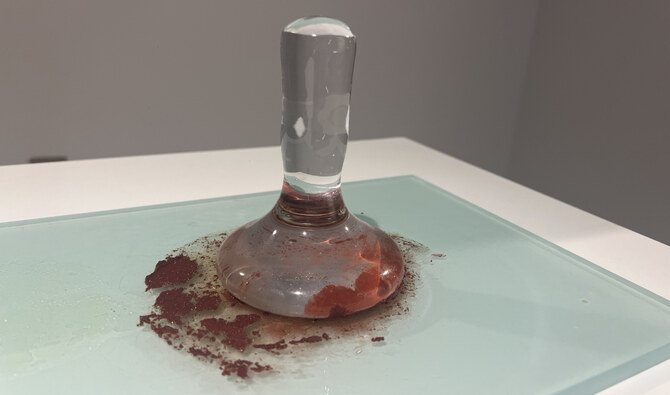
Some of Saudi artist Daniah Al-Saleh’s artwork exhibited at the ‘Echoes of Time’ exhibition in Riyadh. (AN photo by Rahaf Jambi)
3 / 4
The Goethe-Institut in Riyadh, in partnership with the German Embassy and the German Archaeological Institute, or DAI, in Berlin, recently opened “Echoes of Time,” an exhibition marking the 20th anniversary of DAI excavations in Saudi Arabia. (AN photo by Rahaf Jambi)
4 / 4
The Goethe-Institut in Riyadh, in partnership with the German Embassy and the German Archaeological Institute, or DAI, in Berlin, recently opened “Echoes of Time,” an exhibition marking the 20th anniversary of DAI excavations in Saudi Arabia. (AN photo by Rahaf Jambi)
Short Url
Updated 26 September 2024
Follow

‘Echoes of Time’ exhibition: An artistic exploration of Saudi Arabia’s archaeology

  • The event marks the 20th anniversary of German Archaeological Institute’s excavations in Saudi Arabia

RIYADH: A new art exhibition inspired by early archaeological exploration in Saudi Arabia has opened in Riyadh.

The Goethe-Institut in Riyadh, in partnership with the German Embassy and the German Archaeological Institute, or DAI, in Berlin, recently opened “Echoes of Time,” an exhibition marking the 20th anniversary of DAI excavations in Saudi Arabia.

Curated by Salma Al-Khalidi, the exhibition displays work from Saudi artist Daniah Al-Saleh and German artist Susanne Kriemann.

“The Saudi art scene is fantastic,” Al-Saleh told Arab News. “It’s alive and expanding, with numerous opportunities for artists thanks to the support of the Ministry of Culture and the government.

“It’s an amazing time to be an artist, especially with the backing of the German Archaeological Institute and the German Embassy. This exhibition is a wonderful opportunity to showcase our work and collaborate with fellow artists.”

The opening reception was held on Sept. 24 at 6:00 p.m. and was attended by Michael Kindsgrab, the German ambassador to Saudi Arabia, along with several members from the German Embassy and DAI.

Set against the archaeological landscapes of Tayma and AlUla, the exhibition encourages viewers to perceive the desert as a place where history and modernity intersect, emphasizing the significance of environmental stewardship in global discussions about history and ecology.

Al-Saleh’s artwork, “A Stone’s Palette,” utilizes carnelian beads from ancient sites like Rujum Sa’sa’ and Tell Saq, blending ancient materials with contemporary techniques to create mixed-media pieces.

“Initially, my proposal focused on the Nabatean queens, but the German archaeologists were more interested in the Bronze Age. In our discussions, I discovered that carnelian beads were consistently found at various sites. In Tayma, there’s a carnelian bead factory that dates back about 5,000 years, leading me to shift my focus to these beads,” Al-Saleh explained.

Susanne Kriemann’s work, “Datadust Skin on Sand,” contrasts ancient artifacts with modern waste found in Qurh and Tayma. Her photographic prints combine archaeological discoveries with microplastics, shedding light on the environmental impact of plastic pollution in desert landscapes and offering a nuanced perspective on contemporary ecological issues.

Kriemann described her process: “I began early one morning when it was still dark, taking photos of a mountain every 10 minutes, capturing a hidden watchtower. I selected about 12 images depicting the slowly rising sun mirrored in the tower’s colors. I used Datadust textile, which is employed in archaeological sites, to create layers in my work.”

The exhibition is running at the Ahlam Gallery in Riyadh from Sept. 24 to Oct. 7, 2024.


Riyadh to host final of Global Minerals Innovation Competition

Updated 23 sec ago
Follow

Riyadh to host final of Global Minerals Innovation Competition

  • 350 people in 70 teams to attend ‘boot camp’ next month
  • Competition attracted more than 1,800 people from 57 countries

JEDDAH: More than 350 people will take part in the final stage of the inaugural Global Minerals Innovation Competition, to be held next month in Riyadh.

The closing event, titled Future Minerals Pioneers, marks the end of a nationwide tour that began in October to find the best talent in the industry, the Saudi Press Agency reported.

The tour was sponsored by Saudi Mining Services Co. and attracted more than 1,800 people from 57 countries. Just over two-thirds of the members of the 70 teams that made it through to the final stage are from Saudi Arabia.

The so-called final boot camp will take place from Jan. 8-10, with the winners announced during the fifth edition of the Future Minerals Forum on Jan. 14.

The camp will comprise workshops and mentoring sessions, after which the teams will make their final presentations to the judges.

Held under the patronage of Minister of Industry and Mineral Resources Bandar Alkhorayef and led by Vice Minister for Mining Affairs Khalid bin Saleh Al-Mudaifer, the contest was organized by the National Industrial Development and Logistics Program in partnership with the Ministry of Industry and Mineral Resources and Saudi Arabian Mining Co.

It features three main tracks: smart technologies, security and safety, and resource sustainability, with the focus on creating practical solutions to challenges across the mining value chain and fostering an integrated innovation ecosystem, the report said.

According to a report by the Canada-based Fraser Institute, the Kingdom rose to 23rd place on the Mining Investment Attractiveness Index in 2024, up from 104th a year earlier. It also rose to 20th (from 82nd) on the Policy Perceptions Index and to 24th (from 58th) on the Geological Potential Index, indicating growing global confidence in the sector.

The indicators also align with national efforts to unlock the country’s vast mineral wealth, estimated at SR9.4 trillion ($2.5 trillion).

That work is being driven by the General Program for Geological Surveying, which aims to stimulate investment and enhance competitiveness through the creation of a national geological database. About two-thirds of the first phase of the program, covering 630,000 sq. km. of the Arabian Shield, has been completed.