

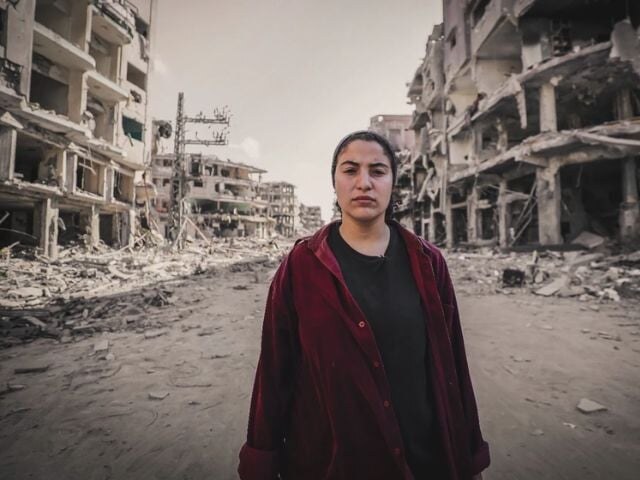
Palestinian journalist Bisan Owda wins Emmy Award despite nomination controversy

The 25-year-old filmmaker gained social media fame following Israel’s military actions in Gaza, after she began documenting life under the siege, which has killed more than 40,000 Palestinians since Oct. 7. (IG/File)
Short Url
Updated 26 September 2024
Follow

Palestinian journalist Bisan Owda wins Emmy Award despite nomination controversy

  • ‘It’s Bisan from Gaza and I’m Still Alive’ chronicles life under siege in Gaza
  • Jewish nonprofit Creative Community for Peace requested her nomination be rescinded after accusing Owda of having ties to the Popular Front for the Liberation of Palestine

LONDON: Palestinian journalist Bisan Owda has won an Emmy Award despite a lobbying campaign that sought to have her nomination rescinded.

Owda was awarded the Emmy for Outstanding Hard News Feature: Short Form for her ongoing project, “It’s Bisan from Gaza and I’m Still Alive.”

“This award is testimony to the power of one woman, armed only with an iPhone, who survived almost a year of bombardment,” said senior executive producer Jon Laurence, who accepted the award on Owda’s behalf as she remains trapped in Gaza.

Produced with AJ+, the feature chronicles Owda’s experience as her family fled the bombardment of their home in Beit Hanoun in the Gaza Strip.

The announcement came shortly after the National Academy of Television Arts & Sciences (NATAS) determined that there were no grounds for rescinding her nomination.

This decision followed accusations from Jewish nonprofit Creative Community for Peace, which claimed Owda had ties to the Popular Front for the Liberation of Palestine (PFLP), a US-designated terrorist organization.

NATAS stated that documented links between Owda and the PFLP occurred “between six and nine years ago” when Owda was still a teenager. It added that it was “unable to corroborate” claims of more recent connections and had found no “evidence of contemporary or active involvement” with the PFLP.

“The content submitted for award consideration was consistent with competition rules and NATAS policies. Accordingly, NATAS has found no grounds, to date, upon which to overturn the editorial judgment of the independent journalists who reviewed the material,” the group also said.

The 25-year-old filmmaker gained social media fame following Israel’s military actions in Gaza, after she began documenting life under the siege, which has killed more than 40,000 Palestinians since Oct. 7.

With 4.7 million Instagram followers and nearly 200,000 TikTok followers, Owda has spent the last year chronicling the humanitarian crisis in Gaza.

Her reports highlight the blockade on essential supplies, the spread of diseases, and the forced displacement of Palestinians, including her own experience.

“It’s Bisan from Gaza and I’m Still Alive” also won the Peabody Award in the news category earlier this year.


Foreign press group welcomes Israel court deadline on Gaza access

Updated 22 December 2025
Follow

Foreign press group welcomes Israel court deadline on Gaza access

  • Supreme Court set deadline for responding to petition filed by the Foreign Press Association to Jan. 4
  • Since the start of the Gaza war in October 2023, Israeli authorities have prevented foreign journalists from independently entering the Strip

JERUSALEM: The Foreign Press Association in Jerusalem on Sunday welcomed the Israeli Supreme Court’s decision to set January 4 as the deadline for Israel to respond to its petition seeking media access to Gaza.
Since the start of the Gaza war in October 2023, sparked by Palestinian militant group Hamas’s attack on Israel, Israeli authorities have prevented foreign journalists from independently entering the devastated territory.
Israel has instead allowed, on a case-by-case basis, a handful of reporters to accompany its troops into the blockaded Palestinian territory.
The Foreign Press Association (FPA), which represents hundreds of foreign journalists in Israel and the Palestinian territories, filed a petition to the supreme court last year, seeking immediate access for international journalists to the Gaza Strip.
On October 23, the court held a first hearing on the case, and decided to give Israeli authorities one month to develop a plan for granting access.
Since then the court has given several extensions to the Israeli authorities to come up with their plan, but on Saturday it set January 4 as a final deadline.
“If the respondents (Israeli authorities) do not inform us of their position by that date, a decision on the request for a conditional order will be made on the basis of the material in the case file,” the court said.
The FPA welcomed the court’s latest directive.
“After two years of the state’s delay tactics, we are pleased that the court’s patience has finally run out,” the association said in a statement.
“We renew our call for the state of Israel to immediately grant journalists free and unfettered access to the Gaza Strip.
“And should the government continue to obstruct press freedoms, we hope that the supreme court will recognize and uphold those freedoms,” it added.
An AFP journalist sits on the board of the FPA.