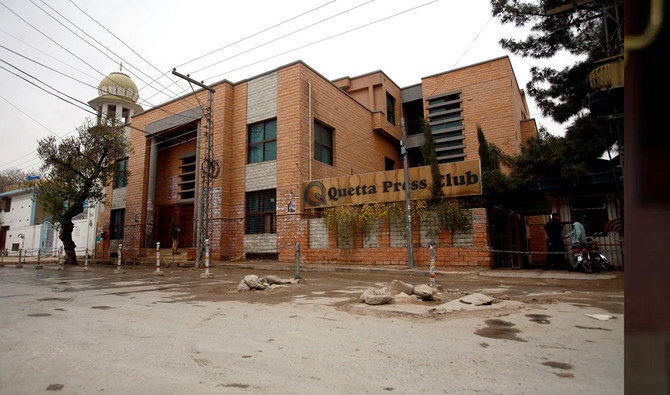
QUETTA: Journalist bodies in Pakistan’s southwestern Balochistan province on Wednesday criticized a decision by authorities to restrict the Quetta Press Club from holding “long-form events and seminars” without the government’s permission, amid a deteriorating law-and-order situation in the restive province.
The decision was announced by the Quetta deputy commissioner days after deadly assaults by an ethnic Baloch separatist group, the Baloch Liberation Army (BLA), killed more than 50 people, including 19 security officials, in several districts across Balochistan.
Balochistan, which borders Iran and Afghanistan, has been the site of a low-level insurgency for the last two decades, with separatist militants intensifying attacks on Pakistanis from neighboring provinces working in the region as well as foreigners, including Chinese citizens, in recent years.
Journalist bodies strongly condemned the restriction on the Quetta Press Club, describing the directives as an attempt to “curb free speech and press freedom” in the province and demanding its immediate withdrawal.
“The law-and-order situation has not been created due to speeches and freedom of expression, but rather is a result of denial of rights, injustice in the society and authoritarian behavior of the establishment and crippled state machinery,” Afzal Butt, president of the Pakistan Federal Union of Journalists (PFUJ), said in a statement.
Similar statements were issued by the Karachi and Lahore press clubs, calling the decision a “blatant attack” on fundamental rights.
The Quetta Press Club and the Balochistan Union of Journalists (BUJ) have also summoned a joint meeting today, Thursday, to deliberate over the move. “The QPC and BUJ will sit together to decide a future plan,” Banaras Khan, the QPC secretary-general, told Arab News on Wednesday.
Quetta Deputy Commissioner Saad bin Asad told Arab News the decision does not apply to press conferences, and was only meant for “long-form events and seminars.”
“The decision was not made for press conferences, but we have put new restrictions on long-form events and seminars. This is a similar practice being implemented in other cities of Pakistan,” he said.
“Before holding any event or seminar in Quetta Press Club, Non-Government Organizations (NGOs) or political parties have to get government’s permission and we will review the content before allowing them.”
In May, authorities had also locked down the gate of the Quetta Press Club and stopped members of an ethnic Baloch rights organization, the Baloch Yakjehti Committee (BYC), from entering it after BYC leader Dr. Mahrang Baloch was invited to address a seminar there on human rights abuses in Balochistan.
Balochistan is also currently in the grips of civil rights protests by young ethnic Baloch who are calling for an end to what they describe as a pattern of enforced disappearances and other human rights abuses by security forces, who deny the charge.

Journalist bodies criticize restriction on Quetta Press Club from holding events without government permission
https://arab.news/yv2v5
Journalist bodies criticize restriction on Quetta Press Club from holding events without government permission
- The decision came days after deadly attacks claimed by a Baloch separatist group killed over 50 people in Pakistan’s Balochistan
- Quetta deputy commissioner says decision doesn’t apply to pressers, only ‘long-form events and seminars’ have been restricted
Imran Khan’s party shutdown draws mixed response; government calls it ‘ineffective’
- Ex-PM Khan’s PTI party had called for a ‘shutter-down strike’ to protest Feb. 8, 2024 general election results
- While businesses reportedly remained closed in Khyber Pakhtunkhwa, they continued as normal elsewhere
ISLAMABAD: A nationwide “shutter-down strike” called by former prime minister Imran Khan’s party drew a mixed response in Pakistan on Sunday, underscoring political polarization in the country two years after a controversial general election.
Khan’s Pakistan Tehreek-e-Insaf (PIT) opposition party had urged the masses to shut businesses across the country to protest alleged rigging on the second anniversary of the Feb. 8, 2024 general election.
Local media reported a majority of businesses remained closed in the Khyber Pakhtunkhwa (KP) province, governed by the PTI, while business continued as normal in other provinces as several trade associations distanced themselves from the strike call.
Arab News visited major markets in Islamabad’s G-6, G-9, I-8 and F-6 sectors, as well as commercial hubs in Rawalpindi, which largely remained operational on Sunday, a public holiday when shops, restaurants and malls typically remain open in Pakistan.
“Pakistan’s constitution says people will elect their representatives. But on 8th February 2024, people were barred from exercising their voting right freely,” Allama Raja Nasir Abbas Jafri, the PTI opposition leader in the Senate, said at a protest march near Islamabad’s iconic Faisal Mosque.
Millions of Pakistanis voted for national and provincial candidates during the Feb. 8, 2024 election, which was marred by a nationwide shutdown of cellphone networks and delayed results, leading to widespread allegations of election manipulation by the PTI and other opposition parties. The caretaker government at the time and the Election Commission of Pakistan (ECP) both rejected the allegations.
Khan’s PTI candidates contested the Feb. 8 elections as independents after the party was barred from the polls. They won the most seats but fell short of the majority needed to form a government, which was made by a smattering of rival political parties led by Prime Minister Shehbaz Sharif. The government insists the polling was conducted transparently and that Khan’s party was not denied a fair chance.
Authorities in the Pakistani capital deployed a heavy police contingent on the main road leading to the Faisal Mosque on Sunday. Despite police presence and the reported arrest of some PTI workers, Jafri led local PTI members and dozens of supporters who chanted slogans against the government at the march.
“We promise we will never forget 8th February,” Jafri said.
The PTI said its strike call was “successful” and shared videos on official social media accounts showing closed shops and markets in various parts of the country.
The government, however, dismissed the protest as “ineffective.”
“The public is fed up with protest politics and has strongly rejected PTI’s call,” Pakistan’s Information Minister Attaullah Tarar said on X.
“It’s Sunday, yet there is still hustle and bustle.”
Ajmal Baloch, All Pakistan Traders Association president, said they neither support such protest calls, nor prevent individuals from closing shops based on personal political affiliation.
“It’s a call from a political party and we do not close businesses on calls of any political party,” Baloch told Arab News.
“We only give calls of strike on issues related to traders.”
Khan was ousted from power in April 2022 after what is widely believed to be a falling out with the country’s powerful generals. The army denies it interferes in politics. Khan has been in prison since August 2023 and faces a slew of legal challenges that ruled him out of the Feb. 8 general elections and which he says are politically motivated to keep him and his party away from power.
In Jan. 2025, an accountability court convicted Khan and his wife in the £190 million Al-Qadir Trust land corruption case, sentencing him to 14 years and her to seven years after finding that the trust was used to acquire land and funds in exchange for alleged favors. The couple denies any wrongdoing.


