

Philippines to launch first nuclear power plant by 2032 

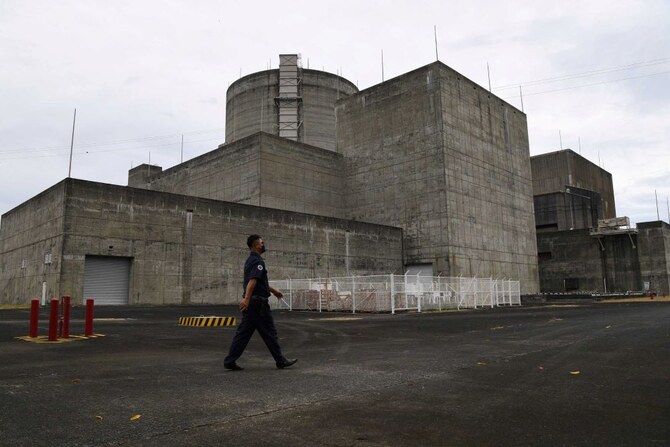
A security guard walks in front of the main gate of the Bataan Nuclear Power Plant in the town of Morong in Bataan province, north of Manila, April 5, 2022. (AFP)
Short Url
Updated 26 September 2024
Follow

Philippines to launch first nuclear power plant by 2032 

  • Under national energy plan, Manila aims to have 4,800 MW of nuclear capacity by 2050
  • Philippine energy demand is expected to increase fourfold from 2020 to 2040

MANILA: The Philippines is planning for its first nuclear facility to be operational by 2032 and aims to add at least 1,200 megawatts of atomic power to the country’s grid, the Department of Energy has announced.

The government is exploring nuclear as an alternative energy option to reduce the Philippines’s dependency on coal, which is mostly imported and accounts for over half its power generation. 

“We aim to have commercially operational nuclear power plants by 2032, with at least 1,200 MW initially entering the country’s power mix, gradually increasing to 4,800 MW by 2050,” Undersecretary of Energy Sharon Garin said in a statement on Wednesday. 

As part of the Philippine Energy Plan, the government will establish an independent nuclear regulatory authority to oversee the safe and secure development of the Philippines’ nuclear energy program. It will prioritize legislation focused on nuclear safety, covering aspects of public health, environmental protection and national security, according to the Department of Energy. 

“The beneficial uses of nuclear technology have been extensive across sectors, leading to improved quality of life. These uses span the fields of health and medical, agriculture, industrial and energy,” Garin said. 

The Philippines joins other Asian countries, including Vietnam and Indonesia, which are considering nuclear power in order to meet rapidly rising power demands and reduce dependence on fossil fuels. 

Manila stopped accepting new proposals for coal-based power projects in 2020 to encourage investment in other energy sources. 

Under the national energy plan, the government aims to increase the share of renewable energy sources in the energy mix from 22 percent currently to 50 percent by 2040.

Philippine authorities expect the country’s power demand to increase almost fourfold from 2020 to 2040, especially as it remains dependent on imported fossil fuels and has insufficient renewables.

“The Philippines energy mix is precarious — 60 percent imported coal, 20 percent from depleting Malampaya gas,” Carlo Arcilla, director of the Philippine Nuclear Research Institute, told Arab News, referring to a gas field in the western Philippines that is expected to run dry by 2027.

“We actually need more nuclear because most of the Philippines’ electricity comes from coal ... Coal and gas, which are base load, are polluting and expensive. No choice (for the Philippines) but clean and dependable nuclear as base load support for renewables.”

The Philippines is home to Southeast Asia’s first nuclear power plant, which was completed in 1986 but has never produced electricity. It was never used and was closed due to safety concerns following the Chernobyl disaster in Ukraine in April 1986.


EU should consider forming combined military force: defense chief

Updated 4 sec ago
Follow

EU should consider forming combined military force: defense chief

  • Kubilius floated creating a “powerful, standing ‘European military force’ of 100,000 troops” that could eventually replace US forces
  • Trump has heightened fears among NATO allies over Washington’s reliability by insisting he wants to take over Greenland

BRUSSELS: EU countries should weigh whether to set up a combined military force that could eventually replace US troops in Europe, the bloc’s defense chief said Sunday.
EU defense commissioner Andrius Kubilius floated creating a “powerful, standing ‘European military force’ of 100,000 troops” as a possible option to better protect the continent.
“How will we replace the 100,000-strong American standing military force, which is the back-bone military force in Europe?” he asked in a speech in Sweden.
The suggestion comes as US President Donald Trump has heightened fears among NATO allies over Washington’s reliability by insisting he wants to take over Greenland.
Worries over Trump’s commitment to Europe have already spurred countries to step up efforts to bolster their militaries in the face of the threat posed by Russia.
Ideas about establishing a central European army have floated around for years but have largely failed to gain traction as nations are wary of relinquishing control over their militaries.
The US has pushed its European allies to increasingly take over responsibility for their own security, and raised the prospect it could shift forces from Europe to focus on China.
“In such times, we should not run away from the most pressing questions on our institutional defense readiness,” said Kubilius, a former Lithuanian prime minister.
In his speech Kubilius also advocated for the creation of a “European Security Council” of key powers — including potentially Britain — that could help the continent take decisions over its own defense quicker.
“The European Security Council could be composed of key permanent members, along with several rotational members,” he said.
“In total around 10-12 members, with the task to discuss the most important issues in defense.”
He said the first focus of such a body should be trying to change the dynamics in the war in Ukraine to ensure that Kyiv does not end up losing.
“We need to have a clear answer — how is the EU going to change that scenario?,” he said.
“This is the reason why we need to have a European Security Council now!“