

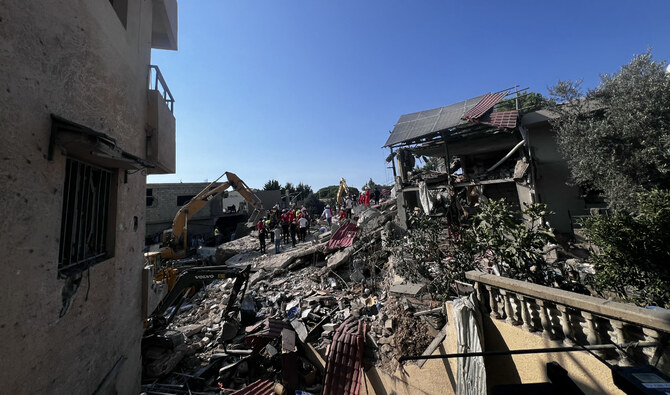

GAZA STRIP: As Israeli bombs flattened buildings and sent smoke billowing skywards over Lebanon this week, Gazans looked on with both empathy and fear over how the widening war might affect them.
Israel carried out a third day of airstrikes against Lebanon on Wednesday.
In a dramatic escalation after nearly a year of cross-border violence, Israeli air raids on Monday killed at least 558 people in Lebanon in the country’s deadliest day since the 1975-1990 civil war.
After the unprecedented Oct. 7 attack by militants against southern Israel, Hezbollah said it began striking Israel in solidarity with Hamas, another Iran-backed group.
The Oct. 7 attack sparked the ongoing war in the Gaza Strip, marked by relentless Israeli bombardment that has devastated much of the Palestinian territory.
Chadi Nawfal, a 24-year-old resident of Gaza City who said he lost his home in an Israeli strike, said footage from Lebanon was hard to watch.
“The bloody scenes from Lebanon that we see on our television screens are very harsh images,” he said.
“We people in the Gaza Strip are the only ones who can currently feel the pain that the Lebanese people are experiencing.”
The sustained Israeli aerial assault on Lebanon is the latest in a series of attacks that began last week with coordinated blasts of Hezbollah pagers and walkie-talkies.
The explosions killed 39 people and wounded almost 3,000, and were followed by a deadly strike on Friday on south Beirut, with leading Hezbollah commander Ibrahim Aqil among the dead.
Another strike on the Lebanese capital on Tuesday killed Hezbollah rocket forces commander Ibrahim Kobeissi.
Taken together, Israel’s onslaught confirmed its Defense Minister Yoav Gallant’s claim a week ago that the war’s “center of gravity” was moving northward.
Ayman Al-Amreiti, another displaced resident of Gaza City, said he was worried the fighting in Lebanon would mean the ongoing war in Gaza gets less global attention.
“The military weight is now shifting to Lebanon, so even the media attention on the Gaza Strip has become secondary,” the 42-year-old said.
“This encourages the appetite of the occupation (Israel) to commit more crimes.”
Hamas’s attack on Israel nearly a year ago resulted in the deaths of 1,205 people.
Of the 251 hostages seized by militants that day, 97 are still being held in Gaza, including 33 the Israeli military says are dead.
Israel’s retaliatory military offensive has killed at least nearly 41,500 people in Gaza, mostly civilians.
There are obvious differences in time frame and scale, but Umm Munzir Naim, 52, said she could not help but see similarities between the fighting in Lebanon and in Gaza.
“The war against Lebanon and Hezbollah is a war like in Gaza. The victims are the people,” she said.
“The small, the big, the properties, everything is targeted — humans, trees ... they say it’s against Hamas and Hezbollah, but on the ground it’s people who die.”
Amreiti said he hoped the fighting would end soon in both places, and that their fates could even be linked given Hezbollah’s past pledges to stop fighting once a Gaza ceasefire comes about.
“The outcome, the hope is that any settlement with Hezbollah will also involve Gaza,” he said.
“Right now, that is the hope that the children of the Palestinian people are turning to.”


