Pakistan defense chief discusses regional security, counterterrorism cooperation with Rubio in Germany

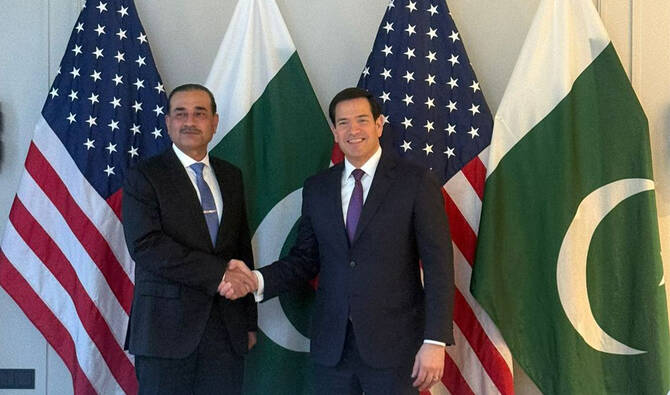
Pakistan's Army Chief Field Marshal Asim Munir (left) meets US Secretary of State Marco Rubio in Munich on February 14, 2026. (PTV News)
Short Url
Updated 15 February 2026
Follow

Pakistan defense chief discusses regional security, counterterrorism cooperation with Rubio in Germany

  • Field Marshal Syed Asim Munir attended 62nd Munich Security Conference from Feb. 12-14, says Pakistani military’s media wing
  • Munir discusses global peace, defense cooperation with military leaderships of Germany, Brazil, Lebanon at sidelines of conference

Islamabad: Pakistan’s Chief of Defense Forces Field Marshal Syed Asim Munir met US Secretary of State Marco Rubio in Germany this week to discuss regional security and counterterrorism cooperation, the Pakistani military said on Sunday. 

Munir visited Germany from Feb. 12-14 to attend meetings on the sidelines of the 62nd Munich Security Conference, the Inter-Services Public Relations (ISPR), the military’s media wing, said in a statement. 

The Conference describes itself as the world’s leading forum for debating international security policy. The annual event features ministers, leading personalities of international and non-governmental organizations, high-ranking representatives of industry, media, academia and civil society from around the world. 

“COAS & CDF interacted with a number of dignitaries,” the ISPR said. “He met with the US Secretary of State Marco Rubio and discussed matters of mutual interest, including global and regional security dynamics and counterterrorism cooperation.”

Munir’s meeting with the senior American diplomat takes place as Islamabad and Washington strengthen efforts to improve bilateral relations. 

Pakistan announced last month it would be a member of the global body formed by US President Donald Trump to resolve conflicts worldwide and promote international peace, particularly in Gaza. Islamabad frequently credits Trump for ending a brief military confrontation between India and Pakistan last year after Washington brokered a ceasefire between the two neighbors. 

Since mid-2025, the two nations have stepped up diplomatic contacts, which have included meetings between Prime Minister Shehbaz Sharif, Pakistan’s military leadership and US officials, alongside bilateral discussions on trade, minerals, security cooperation and regional stability.

In July 2025, Islamabad and Washington agreed to a bilateral trade deal that included reciprocal tariff reductions and frameworks for US investment in Pakistan’s energy and mineral sectors, a step Islamabad has hailed as opening new avenues for economic collaboration.

During his trip to Germany, Munir also met Alexander Dobrindt, Germany’s interior minister, Günter Sautter, the country’s foreign and security policy adviser to the chancellor, and General Carsten Breuer, the chief of defense of the German Armed Forces, the Pakistani military said.

Both sides discussed contemporary security issues, bilateral defense cooperation and the importance of promoting global peace and security through bilateral and multilateral dialogue, the ISPR said. 

Munir also met Admiral Renato Rodrigues de Aguiar Freire, chief of joint staff of the Brazilian Armed Forces and discussed bilateral military cooperation. The Pakistani army chief met General Rodolph Haykal, commander of the Armed Forces of the Lebanese Republic.

“During the interaction, global and regional security situation and measures to enhance bilateral defense collaboration were discussed,” the statement concluded. 


Pakistan engages Saudi Arabia, China in bid to ease surging Middle East tensions 

Updated 10 March 2026
Follow

Pakistan engages Saudi Arabia, China in bid to ease surging Middle East tensions 

  • Pakistan’s foreign minister stresses need for de-escalation in conversations with Chinese, Saudi counterparts
  • Tensions in the Middle East continue to remain high as conflict between US, Israel and Iran intensifies

ISLAMABAD: Pakistan’s Deputy Prime Minister Ishaq Dar spoke to the foreign ministers of Saudi Arabia and China on Tuesday, stressing the importance of diplomatic engagement to de-escalate tensions in the Middle East as the Iran war intensifies. 

Pakistan has constantly engaged regional countries in efforts to broker a ceasefire in the Middle East, after the US and Isreal launched coordinated strikes against Iran on Feb. 28. 

Iran launched fresh attacks on Gulf countries on Tuesday morning, where it has targeted US military bases in recent weeks. In addition to firing missiles and drones at Israel and American bases in the region, Iran has also been targeting energy infrastructure which, combined with its stranglehold on the Strait of Hormuz, has sent oil prices soaring worldwide. 

Dar spoke to Saudi Foreign Minister Prince Faisal bin Farhan to discuss developments in the Middle East and ongoing deliberations at the UN Security Council, Pakistan’s foreign office said in a statement. 

“DPM/FM shared Pakistan’s perspective, underscoring the importance of continued coordination and diplomatic engagement to support de-escalation and promote peace and stability across the region and beyond,” the statement said. 

Dar, who also serves as Pakistan’s foreign minister, spoke to Chinese foreign minister Wang Yi over the telephone separately. The two discussed the evolving regional situation and broader global developments.

Dar underscored the need to ease tensions in the Middle East and the wider region during the conversation, the foreign office said. 

Yi appreciated Pakistan’s constructive efforts aimed at promoting de-escalation and stability in the region, it added. 

“The two leaders stressed the importance of de-escalation and emphasized the need to pursue dialogue and diplomacy in accordance with the principles of the UN Charter,” the foreign office’s statement said. 

The conflict in the Middle East has hit Pakistan hard as well, forcing Islamabad to hike petrol and diesel prices by Rs55 per liter last Friday. 

Pakistan’s government has also announced a set of austerity measures, which include closing schools and cutting down on government expenditures, as it evaluates petrol stocks and looks for alternative supply routes.