13 migrants found dead off Tunisia: official

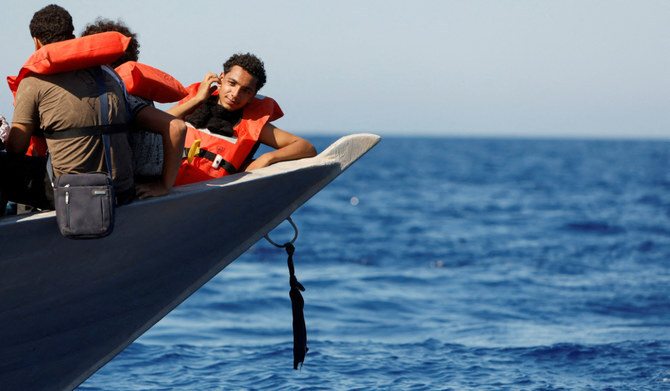
Thirteen bodies believed to be of sub-Saharan African migrants have been found dead off Tunisia's eastern coast, a judicial official told AFP on Wednesday. (Reuters/File)
Short Url
Updated 25 September 2024
Follow

13 migrants found dead off Tunisia: official

  • The bodies were found Tuesday and Wednesday off the coastal towns of Salakta and Chebba
  • Since January 1, at least 103 makeshift boats have capsized, and 341 bodies have been recovered off Tunisia’s coast

TUNIS: Thirteen bodies believed to be of sub-Saharan African migrants have been found dead off Tunisia’s eastern coast, a judicial official told AFP on Wednesday.
The bodies were found Tuesday and Wednesday off the coastal towns of Salakta and Chebba, said Farid Ben Jha, the spokesman for the public prosecution in the Monastir and Mahdia governorates.
He added that an investigation has been opened but provided no further details.
Tunisia and neighboring Libya have become key departure points for migrants, often from other countries, who risk perilous Mediterranean Sea journeys in the hopes of reaching better lives in Europe.
Each year, tens of thousands of people attempt to make the crossing, with Italy — whose Lampedusa island is only 150 kilometers (90 miles) from Tunisia — often their first port of call.
Since January 1, at least 103 makeshift boats have capsized, and 341 bodies have been recovered off Tunisia’s coast, according to the interior ministry.
More than 1,300 people died or disappeared last year in shipwrecks off the North African country, according to the Tunisian FTDES rights group.
The International Organization for Migration has said that more than 30,309 migrants have died in the Mediterranean in the past decade, including more than 3,000 last year.


UN chief condemns Israeli law blocking electricity, water for UNRWA facilities

Updated 01 January 2026
Follow

UN chief condemns Israeli law blocking electricity, water for UNRWA facilities

  • The agency provides education, health and aid to millions of Palestinians in Gaza, the West Bank, Jordan, Lebanon and Syria

United Nations Secretary General Antonio Guterres condemned on Wednesday a move by Israel to ban electricity or water to facilities owned by the UN Palestinian refugee agency, ​a UN spokesperson said.
The spokesperson said the move would “further impede” the agency’s ability to operate and carry out activities.
“The Convention on the Privileges and Immunities of the United Nations remains applicable to UNRWA (United Nations Relief and Works Agency for Palestine Refugees in the Near East), its property and assets, and to its officials and other personnel. Property used ‌by UNRWA ‌is inviolable,” Stephane Dujarric, spokesman for the ‌secretary-general, ⁠said ​while ‌adding that UNRWA is an “integral” part of the world body.
UNRWA Commissioner General Phillipe Lazzarini also condemned the move, saying that it was part of an ongoing “ systematic campaign to discredit  UNRWA and thereby obstruct” the role it plays in providing assistance to Palestinian refugees.
In 2024, the Israeli parliament passed a law banning the agency from operating in ⁠the country and prohibiting officials from having contact with the agency.
As a ‌result, UNRWA operates in East Jerusalem, ‍which the UN considers territory occupied ‍by Israel. Israel considers all Jerusalem to be part ‍of the country.
The agency provides education, health and aid to millions of Palestinians in Gaza, the West Bank, Jordan, Lebanon and Syria. It has long had tense relations with Israel but ties have deteriorated ​sharply since the start of the war in Gaza and Israel has called repeatedly for UNRWA to ⁠be disbanded, with its responsibilities transferred to other UN agencies.
The prohibition of basic utilities to the UN agency came as Israel also suspended of dozens of international non-governmental organizations working in Gaza due to a failure to meet new rules to vet those groups.
In a joint statement, Canada, Denmark, Finland, France, Iceland, Japan, Norway, Sweden, Switzerland and the United Kingdom said on Tuesday such a move would have a severe impact on the access of essential services, including health care. They said one in ‌three health care facilities in Gaza would close if international NGO operations stopped.