

Houthis not weakened by US and UK strikes, says Yemeni government official

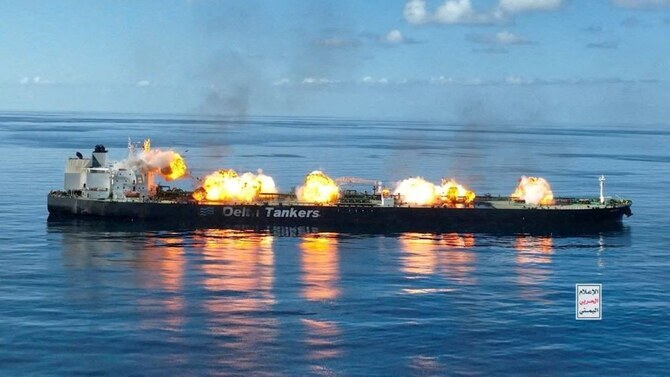
Explosions take place on the deck of the Greek-flagged oil tanker Sounion, Red Sea, Aug. 29, 2024. (Reuters/File Photo)
Short Url
Updated 24 September 2024
Follow

Houthis not weakened by US and UK strikes, says Yemeni government official

  • Aidarous Al-Zubaidi called for better coordination between PLC and Western powers to combat threat Houthis pose to regional security

LONDON: Airstrikes on Houthi targets by the US and UK have not damaged the group’s capabilities, an official in the internationally recognized Yemeni administration said on Tuesday.

Aidarous Al-Zubaidi, who heads the Southern Transitional Council within the Presidential Leadership Council under Rashad Al-Alimi, told The Guardian newspaper that he believed the Houthis were using the strikes to garner sympathy and support by portraying the Western powers as aggressors.

He called for better coordination between the PLC and Western powers to combat the threat the Houthis pose to regional security and said it was time to accept that a power-sharing agreement offered to the Houthis last year was dead in the water.

The militia has carried out drone and missile strikes on commercial shipping in the Red Sea since November in retaliation for Israel’s military campaign against Hamas in Gaza and in solidarity with the Palestinians suffering during the conflict.

The US and the UK launched Operation Prosperity Guardian in December to hit back at the Houthis in an attempt to protect shipping routes through the region’s waters.

“The airstrikes, instead of deterring the Houthis, are having the opposite effect. In a way, it is helping the Houthis and making them stronger,” Al-Zubaidi told The Guardian.

“The local popular perception is that the Houthis occupy the high ground because they are mobilising people around the idea they are being attacked by the UK and the US, and the Houthis are mounting a defense.

“What is more, these operations are not really effective militarily. The Arab coalition, one way or another, has been attacking Houthi rocket launchers for the past eight years, but the Houthis have been able to adapt and find new solutions on how to hide their capabilities. They have built up resilience.

“The problem is (there is) no joined-up approach involving the region and Presidential Leadership Council. It is a US-British operation alone,” he added.

“It’s clear that at the Red Sea ports of Hodeidah and Salif, ships have been arriving without inspection containing high quality weapons from both the Iranians and Russians,” he said,  adding that these shipments of weaponry have helped the Houthis to target Israel.


Russian forces begin pulling out of bases in northeast Syria

Updated 4 sec ago
Follow

Russian forces begin pulling out of bases in northeast Syria

  • Despite having been on opposite sides of the battle lines during the civil war, the new rulers in Damascus have taken a pragmatic approach to relations with Moscow

QAMISHLI, Syria: Russian forces have begun pulling out of positions in northeast Syria in an area still controlled by the Kurdish-led Syrian Democratic Forces after the group lost most of its territory in an offensive by government forces.
Associated Press journalists visited one base next to the Qamishli airport Tuesday and found it guarded by SDF fighters who said the Russians had begun moving their equipment out in recent days.
Inside what had been living quarters for the soldiers was largely empty, with scattered items left behind, including workout equipment, protein powder and some clothing.
Ahmed Ali, an SDF fighter deployed at the facility, said the Russian forces began evacuating their positions around the airport five or six days ago, withdrawing their equipment via a cargo plane.
“We don’t know if its destination was Russia or the Hmeimim air base,” he said, referring to the main Russian base on Syria’s coast. “They still have a presence in Qamishli and have been evacuating bit by bit.”
A UN humanitarian convoy from Damascus reached Qamishli on Tuesday, UN spokesman Stéphane Dujarric said.
“It delivered food, warm clothes and blankets, among other supplies,” he told UN reporters. “More convoys are planned in the coming days.”
Dujarric said the UN is also continuing to distribute food, bread and cash elsewhere including displacement sites.
There has been no official statement from Russia about the withdrawal of its forces from Qamishli.
Russia has built relations with the new central Syrian government in Damascus since former President Bashar Assad was ousted in December 2024 in a rebel offensive led by now-interim President Ahmad Al-Sharaa — despite the fact that Moscow was a close ally of Assad.
Moscow’s scorched-earth intervention in support of Assad a decade ago turned the tide of Syria’s civil war at the time, keeping Assad in his seat. Russia didn’t try to counter the rebel offensive in late 2024 but gave asylum to Assad after he fled the country.
Despite having been on opposite sides of the battle lines during the civil war, the new rulers in Damascus have taken a pragmatic approach to relations with Moscow. Russia has retained a presence at its air and naval bases on the Syrian coast.
Al-Sharaa is expected to visit Moscow on Wednesday and meet with Putin.
Fighting broke out early this month between the SDF and government forces after negotiations over a deal to merge their forces together broke down. A ceasefire is now in place and has been largely holding.
After the expiration of a four-day truce Saturday, the two sides announced the ceasefire had been extended by another 15 days.
Syria’s defense ministry said in a statement that the extension was in support of an operation by US forces to transfer accused Daesh militants who had been held in prisons in northeastern Syria to detention centers in Iraq.