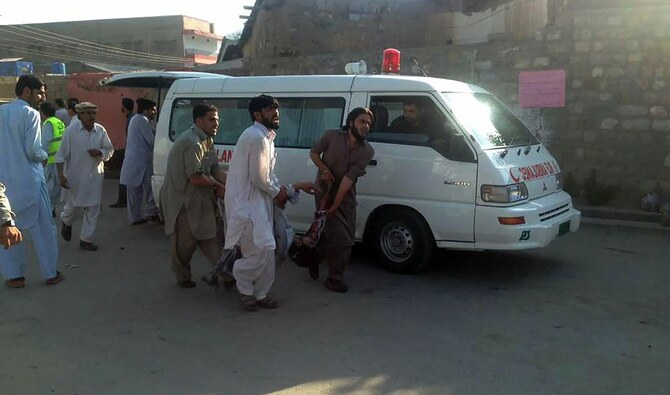
PESHAWAR: At least 15 people have been killed in clashes between two tribes in northwestern Pakistan, a local official said Tuesday, as a deadly feud over land is reignited.
With heavy weapons including mortar shells, the violence hit Kurram district near the border with Afghanistan where the same tribes fought in July.
“The conflict, initially over land, involves two tribes — one Sunni and the other Shia — which has turned the dispute into a sectarian clash,” a senior administrative official stationed in Kurram told AFP on condition of anonymity.
He said 15 people had been killed since Saturday.
The Associated Press of Pakistan, the official news agency, reported around twenty other people had been wounded.
The Kurram district, formerly a semi-autonomous area, has a history of bloody clashes between tribes belonging to the Sunni and Shiite sects of Islam that have claimed hundreds of lives over the years.
The last clashes in July killed 35 people and ended only after a jirga (tribal council) called a ceasefire, with officials attempting to broker a new truce.
Tribal and family feuds are common in Pakistan.
However, they can be particularly protracted and violent in the mountainous northwestern region of Khyber Pakhtunkhwa, where communities abide by traditional tribal honor codes.
In Pakistan, a predominantly Sunni Muslim country, the Shiite community says they have long suffered discrimination and violence.

15 killed in Pakistan sectarian tribal clashes
https://arab.news/bskux
15 killed in Pakistan sectarian tribal clashes
- Violence hit Kurram district near border with Afghanistan where same tribes fought in July
- The last clashes in July had killed 35 people and ended only after a jirga called a ceasefire
UAE President arrives in Pakistan on first official visit, receives 21-gun salute
- Shehbaz Sharif receives the UAE president at Nur Khan Airbase as Islamabad was decorated with Emirati flags
- Talks are set to focus on strengthening bilateral cooperation in trade, investment, energy and regional affairs
ISLAMABAD: Sheikh Mohamed bin Zayed Al Nahyan, President of the United Arab Emirates, arrived in Pakistan on Friday on his first official visit since assuming office, receiving a 21-gun salute as Islamabad and Abu Dhabi seek to deepen cooperation in trade, investment, energy and regional affairs.
The UAE president landed at Nur Khan Airbase in Rawalpindi, where he was welcomed by Prime Minister Shehbaz Sharif, Deputy Prime Minister and Foreign Minister Ishaq Dar, Chief of Army Staff Field Marshal Asim Munir and members of the federal cabinet, according to a statement issued by the Prime Minister’s Office.
The national anthems of Pakistan and the UAE were played, and a guard of honor was presented by contingents of the Pakistani armed forces. State-run broadcasters and private television channels aired video footage of the UAE president’s arrival and ceremonial reception.
“During his visit, the President of the United Arab Emirates will meet the Prime Minister of Pakistan, during which bilateral relations as well as regional and international issues will be discussed,” an official statement circulated after Al Nahyan’s arrival said.
Earlier, the foreign office said the visit would provide an important opportunity to further strengthen the longstanding relations between the two countries.
It added the discussions between the two sides would explore ways to deepen cooperation in trade, investment, energy and development.
Islamabad was decorated with Pakistani and Emirati flags and large billboards carrying images of the visiting UAE president alongside President Asif Ali Zardari and Prime Minister Sharif ahead of the visit.
The Islamabad administration declared a public holiday in the capital, while traffic police announced an extensive plan to manage vehicular movement during the visit.
Pakistan considers the UAE one of its closest regional and economic partners. The Gulf state is Islamabad’s third-largest trading partner after China and the United States and remains a major source of foreign investment.
Over the past two decades, Emirati investment in Pakistan has exceeded $10 billion, according to the UAE’s foreign ministry.
Pakistani policymakers also view the UAE as an important export destination due to its geographical proximity, which reduces transportation and freight costs.


