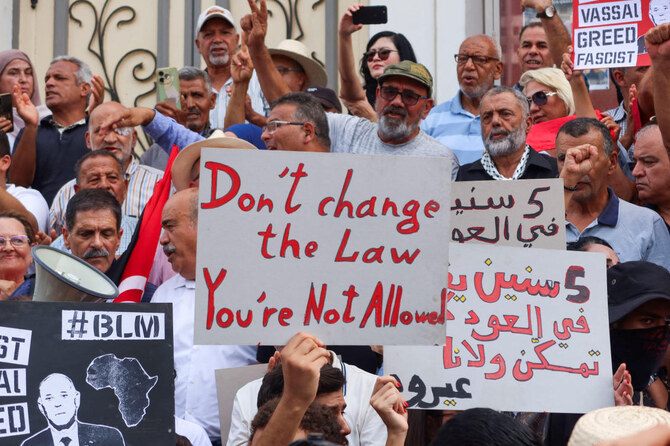
THE HAGUE, Netherlands: Lawyers and families of jailed Tunisian opposition leaders called on the International Criminal Court on Tuesday to investigate a crackdown on political opposition and the abuse of Black African migrants in the North African country, which has been offered European Union financial support to help rein in migration.
It is the second time Tunisian opposition members have sought an ICC probe. Last year, the families of seven imprisoned politicians asked the court to investigate claims of political persecution and human rights violations by President Kais Saied’s administration.
Lawyers now say they are filing a second request for an investigation following new claims of abuse of migrants and persecution of opposition leaders. The request comes less than two weeks before Oct. 6 elections in which Saied is seeking a second term.
“The new evidence shows that Black African migrants are facing brutal and heartless treatment at the hands of the Tunisian authorities. The ICC has the jurisdiction to investigate these alleged crimes against humanity and should act with the full force of international law to protect those most vulnerable,” lawyer Rodney Dixon said in a statement.
“Countless migrants report similar experiences of arbitrary arrest on land or at sea followed by collective expulsion to desert regions along the border with Algeria and Libya, while being beaten, mistreated, and suffering psychological abuse,” the statement said.
For many sub-Saharan Africans — who don’t need a visa to travel to Tunisia — the North African country serves as a stepping stone to Europe, while others come from Libya, which shares a border with Tunisia.
The ICC’s prosecution office did not immediately respond to an email seeking confirmation that it had received the request. The court’s prosecutors are already investigating allegations of crimes against migrants in Libya including arbitrary detention, unlawful killing, enforced disappearances, torture and sexual and gender-based violence.
Tunisia is a member state of the Hague-based court.
One of the family members seeking ICC action is Elyes Chaouachi, the son of Ghazi Chaouchi, who is the detained former secretary general of the social democratic political party Attayar.
“In Tunisia, the pillars of democracy and human rights are under siege, as autocracy, racism, antisemitism and hate speech rise unchecked. We urge the ICC and the international community to take a stand — support humanity, uphold justice and restore dignity. Our voices for freedom and equality must not go unheard,” Chaouachi said in a statement released by the legal team that filed the request to the court.
Last year, European leaders held out the promise of more than 1 billion euros in financial aid to rescue its teetering economy and better police its borders, in an effort to restore stability to the North African country — and to stem migration from its shores to Europe.


![]()

Lawyers ask the ICC to investigate Tunisia opposition crackdown and migrant abuse
Short Url
https://arab.news/g6d5m
Lawyers ask the ICC to investigate Tunisia opposition crackdown and migrant abuse
- It is the second time Tunisian opposition members have sought an ICC probe
- he request comes less than two weeks before Oct. 6 elections in which Saied is seeking a second term


Latest updates


Recommended


© 2026 SAUDI RESEARCH & PUBLISHING COMPANY, All Rights Reserved And subject to Terms of Use Agreement.