Iran president says Hezbollah ‘cannot stand alone’ against Israel

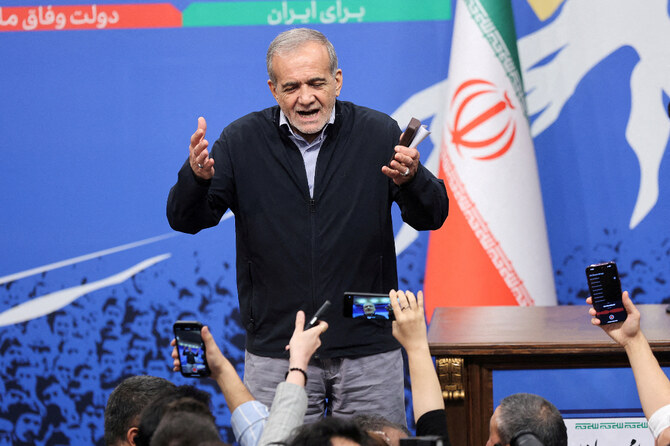
Iran's President Masoud Pezeshkian attends a press conference in Tehran, Iran (File/West Asia News Agency/Reuters)
Short Url
Updated 24 September 2024
Follow

Iran president says Hezbollah ‘cannot stand alone’ against Israel

  • He called on the international community to “not allow Lebanon to become another Gaza”

TEHRAN: Iran’s President Masoud Pezeshkian said Tuesday that its ally Hezbollah “cannot stand alone” against Israel which carried out its deadliest day of air strikes on Lebanon since 2006.
“Hebzollah cannot stand alone against a country that is being defended and supported and supplied by Western countries, by European countries and the United States,” Pezeshkian said in an interview with CNN translated from Farsi to English.
He called on the international community to “not allow Lebanon to become another Gaza,” in response to a question if Iran would use its influence with Hezbollah to urge restraint.
On Monday, nearly 500 people, including 35 children, were killed in Israeli strikes in Lebanon, according to the country’s health ministry.
The Israeli military said it had hit about 1,600 Hezbollah targets on Monday, killing a “large number” of militants, and had carried out more on Tuesday morning.
Iran called on the UN Security Council to “take immediate action” against the “insane” Israeli escalation.
“Iran will NOT remain indifferent,” Foreign Minister Abbas Araghchi said in a post on X late Monday.
“We stand with the people of Lebanon and Palestine.”
The Israeli strikes came less than a week after coordinated sabotage attacks targeting Hezbollah’s communication devices killed 39 people and wounded almost 3,000.
Iranian media blamed Israel for the apparent slide toward all-out war.
“The Zionist regime has pressed the all-out war button,” said the ultraconservative Javan newspaper, while its rival Kayhan asked: “Has the big war begun?“
Government daily Iran warned “the region is on the verge of a massive explosion.” Reformist newspaper Etemad said “peace in Lebanon is hanging by a thread.”
Pezeshkian, who has been in New York for the annual UN General Assembly, accused Israel of warmongering.
“We know better than anyone that if a larger war erupts in the Middle East, it will benefit no one globally,” Pezeshkian told journalists at a roundtable.
“It is Israel that seeks to create this wider conflict.”
He said Iran had “never started a war in the last 100 years” and was “not looking to cause insecurity.”
But he insisted that Iran “will never allow a country to force us into something and threaten our security and territorial integrity.”


Israel fires mortar into Gaza residential area, wounding at least 10

Updated 18 December 2025
Follow

Israel fires mortar into Gaza residential area, wounding at least 10

  • The attack is the latest Israeli attack since the Oct. 10 ceasefire took effect
  • Palestinian health officials have reported over 370 deaths from Israeli fire since the truce

JERUSALEM: Israeli troops fired a mortar shell over the ceasefire line into a Palestinian residential area in the Gaza Strip, in the latest incident to rock the tenuous ceasefire with Hamas. Health officials said at least 10 people were wounded, and the army said it was investigating.
The military said the mortar was fired during an operation in the area of the “Yellow Line,” which was drawn in the ceasefire agreement and divides the Israeli-held majority of Gaza from the rest of the territory.
The military did not say what troops were doing or whether they had crossed the line. It said the mortar had veered from its intended target, which it did not specify.
Fadel Naeem, director of Al-Ahli Hospital, said the hospital received 10 people wounded in the strike on central Gaza City, some critically.
It was not the first time since the ceasefire took effect on Oct. 10 that Israeli fire has caused Palestinian casualties outside the Yellow Line. Palestinian health officials have reported over 370 deaths from Israeli fire since the truce.
Israel has said it has opened fire in response to Hamas violations, and says most of those killed have been Hamas militants. But an Israeli military official, speaking on condition of anonymity in line with military protocol, said the army is aware of a number of incidents where civilians were killed, including young children and a family traveling in a van.
Palestinians say civilians have been killed in some cases because the line is poorly marked. Israeli troops have been laying down yellow blocks to delineate it, but in some areas the blocks have not yet been placed.
Ceasefire’s next phase
The Israel-Hamas ceasefire is struggling to reach its next phase, with both sides accusing each other of violations. The first phase involved the exchange of hostages for Palestinian prisoners. The second is supposed to involve the deployment of an international stabilization force, a technocratic governing body for Gaza, the disarmament of Hamas and further Israeli troop withdrawals from the territory.
The remains of one hostage, Ran Gvili, are still in Gaza, and the militants appear to be struggling to find it. Israel is demanding the return of Gvili’s remains before moving to the second phase.
Hamas is calling for more international pressure on Israel to open key border crossings, cease deadly strikes and allow more aid into the strip. Recently released Israeli military figures suggest it hasn’t met the ceasefire stipulation of allowing 600 trucks of aid into Gaza a day, though Israel disputes that finding.
Humanitarian groups say the lack of aid has had harsh effects on most of Gaza’s residents. Food remains scarce as the territory struggles to bounce back from famine, which affected parts of Gaza during the war.
The toll of war
The vast majority of Gaza’s 2 million people have been displaced. Most live in vast tent camps or among the shells of damaged buildings.
The initial Hamas-led Oct. 7, 2023, attack on southern Israel killed around 1,200 people and took 251 hostages. Almost all hostages or their remains have been returned in ceasefires or other deals.
Israel’s two-year campaign in Gaza has killed more than 70,660 Palestinians, roughly half of them women and children, according to the territory’s Health Ministry, which does not distinguish between militants and civilians in its count. The ministry, which operates under the Hamas-run government, is staffed by medical professionals and maintains detailed records viewed as generally reliable by the international community.