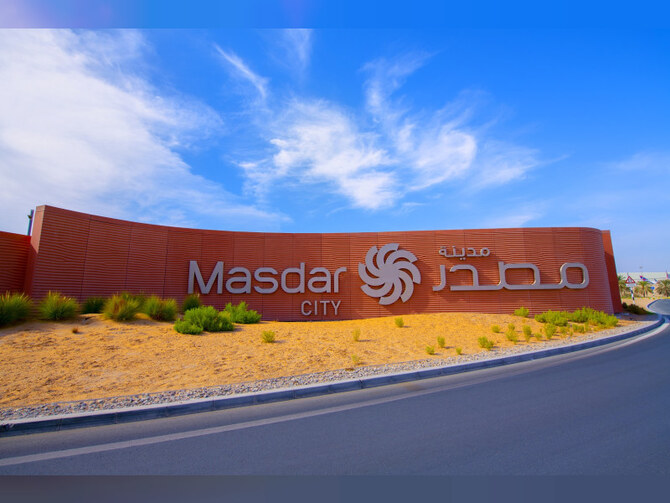
UAE’s Masdar buys Brookfield’s Saeta Yield in $1.4bn deal

Brookfield acquired and delisted Saeta, founded by Spanish construction company ACS, in 2018 for 1 billion euros. WAM
Short Url
Updated 24 September 2024
Follow

UAE’s Masdar buys Brookfield’s Saeta Yield in $1.4bn deal

  • Closing of the deal is expected around the end of the year
  • Agreement with Brookfield includes 538 MW of wind assets in Spain and 144 MW of wind assets in Portugal

MADRID: UAE’s renewable energy company Masdar said on Tuesday it has reached an agreement to buy green energy firm Saeta Yield from Canada’s Brookfield’s in a deal valuing the company at $1.4 billion.
Under the deal, Masdar is acquiring 745 megawatts of mostly wind assets and 1.6 gigawatts of projects under development in Spain and Portugal, marking one of the largest such deals in the Iberian region.
This is Masdar’s second big green energy deal in recent months in Spain, one of Europe’s largest wind and solar markets. It follows the agreement to buy a minority stake in 48 solar plants controlled by Endesa — a unit of Italy’s Enel for 817 million euros.
Higher interest rates brought about a “normalization” of asset prices, Masdar’s CFO told Reuters after the deal with Endesa, adding that the company was seeking more opportunities in the region.
The agreement with Brookfield includes 538 MW of wind assets in Spain and 144 MW of wind assets in Portugal, with the remaining being solar power assets in Spain. Some solar thermal plants controlled by Saeta are not part of the sale process and will remain under Brookfield’s control.
Closing of the deal is expected around the end of the year.
“Saeta is the perfect complement to Masdar’s portfolio in Europe, especially after the recent partnership with Endesa,” Masdar CEO Mohamed Jameel Al Ramahi said.
Spain and Portugal’s abundant solar and wind resources have drawn both domestic and foreign firms eager to leverage the growing demand for renewable energy.
Controlled by UAE’s power and water firm TAQA, its national oil company ADNOC and sovereign wealth fund Mubadala Investment Company, Masdar aims to grow its capacity to 100 GW of renewable energy by 2030.
Brookfield acquired and delisted Saeta, founded by Spanish construction company ACS, in 2018 for 1 billion euros.


Saudi non-oil trade surplus with GCC jumps 102% in November  

Updated 08 February 2026
Follow

Saudi non-oil trade surplus with GCC jumps 102% in November  

RIYADH: Saudi Arabia’s non-oil trade surplus with Gulf Cooperation Council countries more than doubled in November, driven by a surge in exports, preliminary government data showed. 

The surplus reached about SR6.6 billion ($1.76 billion), up 102 percent from SR3.3 billion a year earlier, according to the General Authority for Statistics. 

Total non-oil trade with GCC countries rose 30 percent to SR20.4 billion from SR15.7 billion, as exports outpaced import growth. Non-oil goods exports climbed to SR13.5 billion in November from SR9.5 billion a year earlier, while imports increased to SR6.9 billion from SR6.2 billion. 

Re-exports made up the bulk of outbound trade, rising to SR9.76 billion in November from SR6.56 billion a year earlier, while national exports increased to SR3.75 billion from SR2.92 billion. 

The UAE remained Saudi Arabia’s largest GCC trading partner on a non-oil basis. Exports to the Emirates totaled SR10.48 billion in November versus SR7.18 billion a year earlier, comprising SR8.38 billion in re-exports and SR2.10 billion in national exports.   

Imports from the UAE were SR4.79 billion, up from SR3.95 billion, lifting the non-oil trade surplus with the UAE to about SR5.69 billion from SR3.23 billion.  

Trade with Kuwait also expanded, with exports rising to SR769.9 million from SR610.6 million, including SR199.2 million in re-exports and SR570.7 million in national exports. Imports from Kuwait fell to SR176.4 million from SR333.3 million, pushing the trade surplus to SR593.5 million from SR277.3 million.  

With Bahrain, exports edged down to SR900.7 million from SR929.7 million, reflecting a decline in re-exports to SR380.3 million from SR572.7 million, while national exports increased to SR520.4 million from SR356.9 million. Imports rose to SR862.4 million from SR662.4 million, reducing the surplus to SR38.3 million from SR267.2 million.  

Saudi Arabia narrowed its non-oil trade deficit with Oman, as exports increased to SR666.7 million from SR356.5 million, supported by re-exports of SR259.6 million versus SR39.3 million and national exports of SR407.0 million versus SR317.3 million.   

Imports from Oman declined to SR873.2 million from SR1.11 billion, bringing the trade balance to a deficit of SR206.6 million compared with a deficit of SR749.1 million in November 2024.  

Trade with Qatar strengthened, with exports rising to SR691.1 million from SR395.8 million, including re-exports of SR536.2 million versus SR253.9 million and national exports of SR155.0 million versus SR141.9 million. Imports increased to SR199.3 million from SR148.9 million, resulting in a surplus of SR491.8 million, up from SR246.9 million.