



QUETTA: Ali Gohar fished in the pencil case for several minutes, looking for the right tool to sketch on a black chart paper spread out on the ground below him. He then picked out a small pencil and started scribbling — with his feet.
Tragedy struck Gohar in 2015 when, as a nine-year-old in Pakistan’s southwestern Quetta city, the kite he was flying got stuck in a high voltage electricity transmission tower as it started to rain. Gohar was electrocuted and was subsequently treated for over two weeks in Quetta and Karachi before doctors recommended amputating both his arms.
The tragedy, though it made his life difficult in many respects, also helped him acquire an extraordinary dexterity of his feet and learn to sketch and paint with them.
“Before losing my arms, I was not good at drawing at my school,” Gohar, 19, told Arab News. “But after that incident, when I started using my mobile phone with my feet, my sister helped me hold a paintbrush and pencil between my feet’s big toe and index toe.”
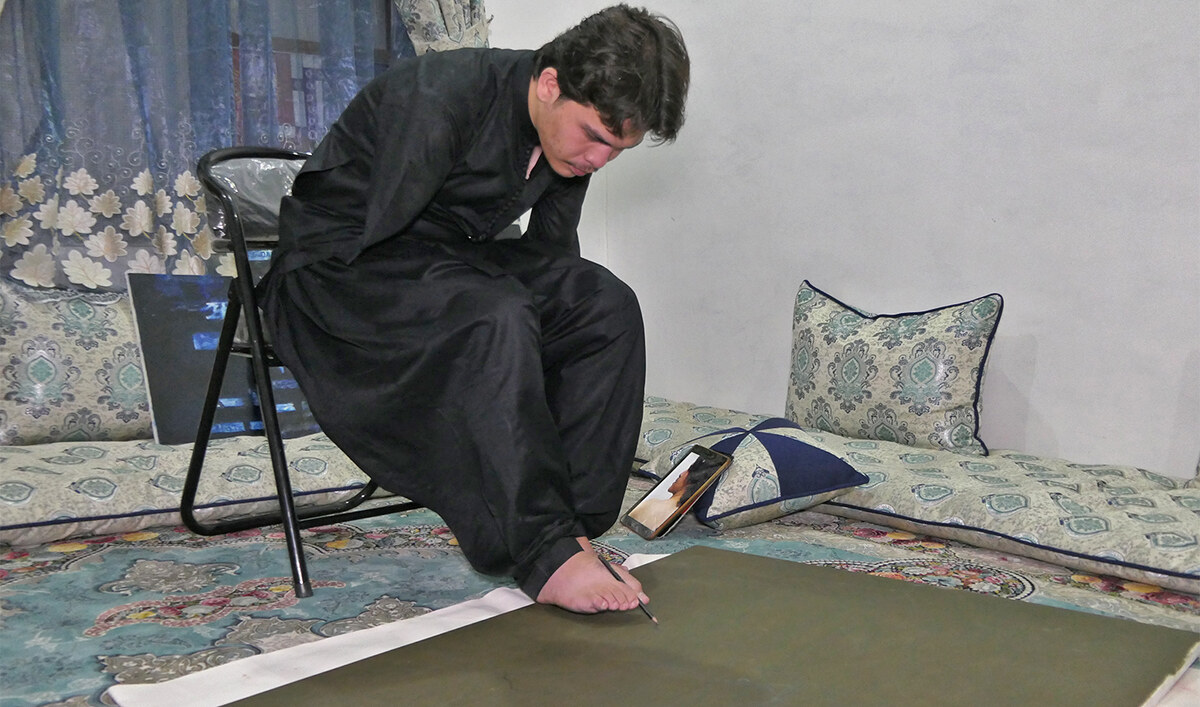
Pakistani artist Ali Gohar (right) is seen holding a pencil with his foot in Quetta, Pakistan, on September 22, 2024. (AN photo)
And the rest is history. Art has since become Gohar’s outlet, and he has finished about 25-30 paintings in the last four years, often taking months to complete a single work of art.
“In sketching, I create images. I also do conceptual art, which reflects my thoughts,” Gohar explained, saying art helped best put his thoughts and feelings onto a canvas and make sense of a “life full of tragedies.”
“I have seen a lot of agony in my life and have gone through an accident, and I want to show that to people,” he said.
And his work has gained recognition. According to Gohar, he has participated in three local art competitions held in Marriabad and Hazara town neighborhoods in Quetta between 2021 to 2023 and secured the first position in all three.
Gohar also has an intermediate qualification in computer sciences from a local college in Quetta and now wants to go to university to study software engineering.
“My focus is on computers, and artwork is a hobby,” he said.
But it wasn’t easy getting here. Gohar’s mother and other family members help him out with daily tasks such as eating and wearing clothes. When his studies resumed following the amputation, Gohar still hadn’t learned how to write. While other students gave written exams, he had no choice but to give his answers orally till the eighth standard, when Gohar finally learned how to write with his feet.
“After writing with my feet, I remained a bright student in my class with the highest marks in all exams,” he said.
Shazia Batool, Gohar’s first art teacher who also has a disability that requires her to use a wheelchair, described him as a “brilliant” student who had developed “astonishing skills” in a short time due to his determination.
“During the initial days, it was difficult for Gohar to hold a pencil with his feet because he was afraid of using his feet for artwork but I taught him how to use his feet on the canvas, shaping and lining,” Batool said.
“Anyone else might have gotten nervous and said, ‘I can’t do it.’ But I saw Gohar, and he did it. He didn’t have that ‘I can’t do it’ mindset.”
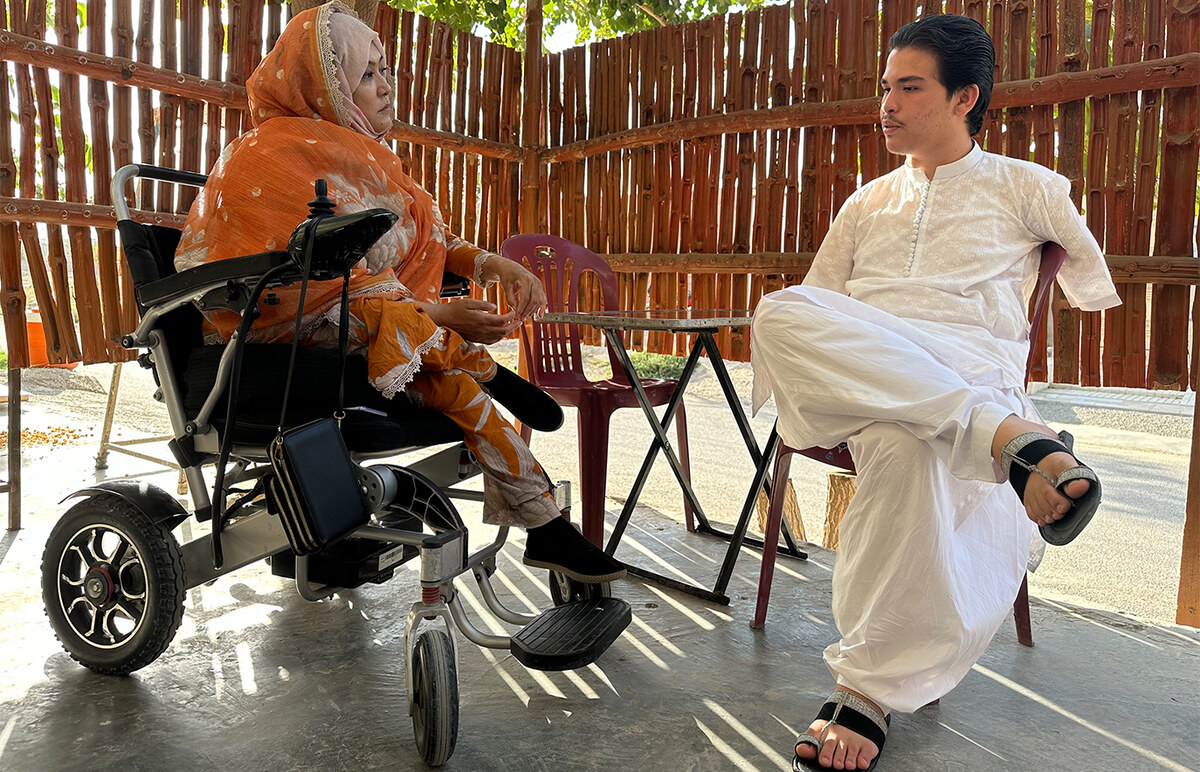
Pakistani artist Ali Gohar (right) talks with his teacher Shazia Batool in Quetta, Pakistan, on September 22, 2024. (AN photo)
Gohar has considered prosthetic arms but says his family cannot afford them.
“There is a surgery of hand transplantation which is yet to be introduced in Pakistan,” he said. “But I am very much looking for hand transplantation from abroad.”
Gohar said he gets his strength from the belief that God blesses everyone with the skills and talents they need to survive.
“Yes, I may not have hands, but I have a skill that I can perform with my feet,” he said. “Perhaps those who work with their hands cannot do it with their feet, and that’s why I don’t lose hope.”


