Family of doctor accused of blasphemy in Pakistan say police killed him in fake encounter

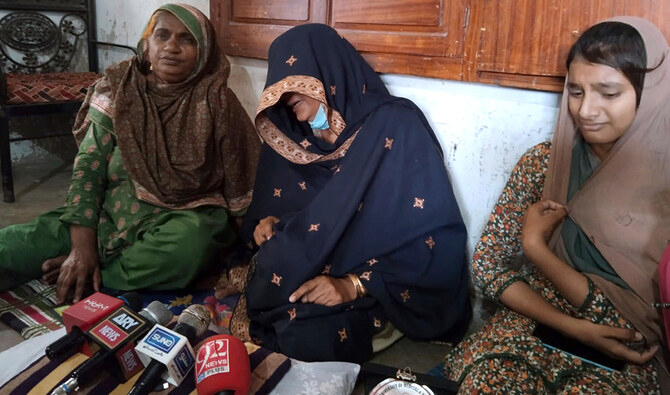
Family of Shah Nawaz, a doctor who was accused of blasphemy, from left, mother Rehmat Kunbhar, wife Niamat Bibi, and daughter Hareem Nawaz, speak to media at their residence in Umerkot, a district in the Pakistan's Sindh province, on September 21, 2024. (AP)
Short Url
Updated 24 September 2024
Follow

Family of doctor accused of blasphemy in Pakistan say police killed him in fake encounter

  • Shah Nawaz was arrested last week and later killed in an encounter, with his body burnt by a mob
  • Police suspend officers who killed Nawaz, who were applauded and showered with rose petals by locals

MULTAN: The family of a doctor accused of blasphemy said Monday he was killed by police while in custody in southern Pakistan after he voluntarily surrendered following assurances that he would be given a chance to prove his innocence, denying a police account that he was accidentally killed in a shootout.

If true, it would be the second extra-judicial killing in a week, drawing condemnation from human rights groups.

Shah Nawaz, a doctor in Umerkot district of Sindh province, had gone into hiding last week after being accused of insulting Islam’s Prophet Muhammad (PBUH) and sharing blasphemous content on Facebook. Nawaz said someone had hacked his account and that he had not posted anything against Islam.

His family said he was arrested last Wednesday and killed hours later in a fake encounter with police. A mob also burned Nawaz’s clinic on Wednesday, officials said.

Police said Nawaz was killed unintentionally when officers in the city of Mirpur Khas signalled for two men on a motorcycle to stop. Instead of stopping, the men opened fire and tried to flee, prompting police to shoot, killing one of them, police said.

They said it was only after the shootout that officers learned that the slain man was the doctor being sought by them for alleged blasphemy.

“I want justice for my son who was killed when he was in the custody of police,” said Rehmat Kunbhar, Nawaz’s mother.

“We asked him to face an investigation after police assured us that he would be given protection,” she said by telephone. “I did not know that police would kill him,” she said, sobbing.

She said the posts on Facebook had continued after his arrest, showing that someone had hacked it.

Nawaz’s father, Mohammad Saleh, said a mob had snatched his son’s body after his death and burned it in front of him. “They sprinkled petrol on the body of my son and burned it, as I watched helplessly,” he said.

Police said they arrested nine people on charges of taking the body and burning it. Noor Mohammad, a police official who is investigating the case, said officers are seeking the arrest of more than 100 people who were involved in the violence that erupted before and after Nawaz’s arrest.

On Friday, authorities suspended the policemen who had opened fire and killed Nawaz, who were applauded and showered with rose petals by local residents after the killing.

Members of civil society visited Nawaz’s village on Thursday and met with his family and put flowers on his grave in a sign of respect and support.

“We are terrified and we cannot send our children to school,” said Niamat Bibi, Nawaz’s widow.

Accusations of blasphemy — sometimes even just rumors — can spark riots and mob rampages in Pakistan. Although killings of blasphemy suspects by mobs are common, extra-judicial killings by police are rare.

A week before Nawaz’s killing, an officer opened fire inside a police station in the southwestern Pakistani city of Quetta, killing Syed Khan, another suspect held on accusations of blasphemy.

Khan was arrested after officers rescued him from an enraged mob that claimed he had insulted Islam’s prophet. The police officer who killed him, Mohammad Khurram, was quickly arrested. However, the family of the slain man later said they pardoned the officer.

Under Pakistan’s controversial blasphemy laws, anyone found guilty of insulting Islam or Islamic religious figures can be sentenced to death — though authorities have yet to carry out a death sentence for blasphemy.


Police lodge case over Karachi mall blaze under mischief, negligence and murder clauses

Updated 4 sec ago
Follow

Police lodge case over Karachi mall blaze under mischief, negligence and murder clauses

  • The fire broke out at the densely packed Gul Plaza in the heart of Karachi on Jan. 17 and has so far claimed 71 lives
  • Traders have estimated losses at $53.6 million, while the government has announced $35,720 for family of each victim

ISLAMABAD: Police in Pakistan’s southern port city of Karachi have registered a case over a deadly blaze at Gul Blaza, which has so far claimed 71 lives, under mischief, negligence and murder clauses, a senior police official said on Saturday.

The fire broke out at the densely packed commercial complex in the heart of Karachi on Jan. 17, trapping workers and shoppers inside. It burnt for over 24 hours before being brought under control, leaving the building structurally unsafe.

Authorities have not yet confirmed the cause of the fire. Police said preliminary indications pointed to a possible electrical short circuit, though officials stress conclusions will only be drawn after investigations are completed.

A week after the incident, police have registered the first information report (FIR) of the incident under sections 427, 436, 337-H (i) and 322 of the Pakistan Penal Code, according to Deputy Inspector General (DIG) Karachi South Asad Raza.

“The FIR of the Gul Plaza tragedy has been registered under the government’s prosecution, with case number 08/2026 at Nabi Bux police station,” Raza told Arab News.

Section 427 relates to mischief causing damage, 436 concerns mischief by fire or explosive substance, 337-H (i) details punishment for rash or negligent act, and 322 details punishment for homicide.

Deadly fires are a recurring problem in Karachi, a city of more than 20 million people, where overcrowded markets, aging infrastructure, illegal construction and weak enforcement of safety regulations frequently contribute to disasters. Officials say a blaze of this scale is rare.

Identification has been significantly slowed by the condition of the remains recovered from the site, Syed said, noting that many bodies were found in fragments, complicating DNA analysis and prolonging the process for families waiting for confirmation.

Traders have estimated total losses from the fire at up to Rs15 billion ($53.6 million). The Sindh provincial government this week announced compensation of Rs10 million ($35,720) for the family of each person killed in the blaze and said affected shopkeepers would also receive financial assistance.

Separately on Saturday, the Muttahida Qaumi Movement-Pakistan (MQM-P) party urged Prime Minister Shehbaz Sharif to constitute an inquiry commission to hold those accountable whose negligence led to the Gul Plaza inferno.

“Incapability, mistake, apathy, shamelessness, impudence — these should be exposed,” MQM-P’s Farooq Sattar said, calling for an “independent judicial inquiry” into the Gul Plaza tragedy to ensure the truth comes to light.

LAHORE HOTEL FIRE

Meanwhile, a fire erupted at a hotel in the eastern city of Lahore in Pakistan’s most populous Punjab province, according to Rescue 1122 service.

Six people were injured due to the blaze at the hotel in the city’s Gulberg area who were shifted to hospital.

“All necessary steps be taken to quickly control the fire, instructions,” Deputy Commissioner Muhammad Ali Aijaz directed authorities. “Immediate evacuation of all people from the building be ensured.”