Leaders at climate meetings in New York warn of growing mistrust between nations

1 / 3
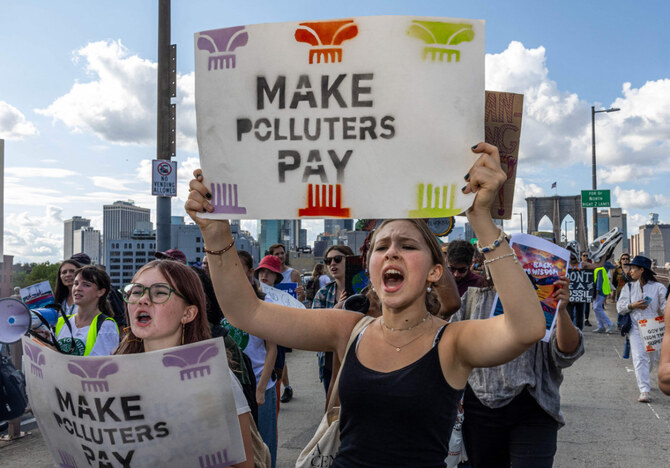
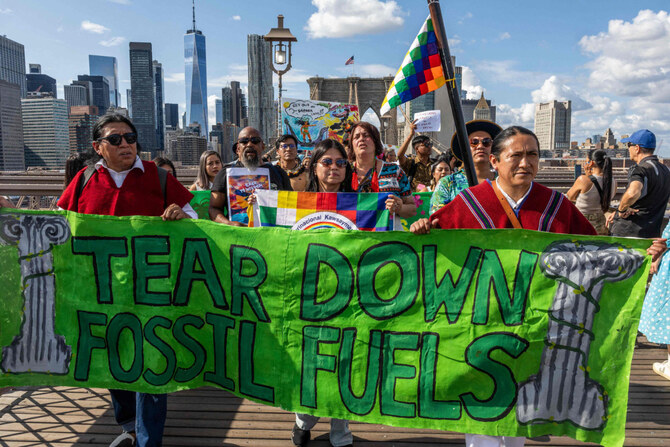
Activists cross the Brooklyn Bridge during a Youth Global Climate demonstration ahead of the UN Climate week and General Assembly in New York City on September 20, 2024. (AFP)
2 / 3
Activists cross the Brooklyn Bridge during a Youth Global Climate demonstration ahead of the UN Climate week and General Assembly in New York City on September 20, 2024. (AFP)
3 / 3
Activists cross the Brooklyn Bridge during a Youth Global Climate demonstration ahead of the UN Climate week and General Assembly in New York City on September 20, 2024. (AFP)
Short Url
Updated 23 September 2024
Follow

Leaders at climate meetings in New York warn of growing mistrust between nations

  • Climate Week kicks off in New York City
  • Organizers count some 900 Climate Week events

NEW YORK: UN Secretary General António Guterres launched a two-day, climate-themed “Summit for the Future” on Sunday as part of the UN General Assembly, where some leaders warned of growing mistrust between nations as climate-fueled disasters mount.
National leaders addressed the group after adopting a “Pact for the Future” aimed at ensuring and increasing cooperation between nations, with many calling for urgent access to more climate finance.
“International challenges are moving faster than our ability to solve them,” Guterres told leaders at the summit. “Crises are interacting and feeding off each other – for example, as digital technologies spread climate disinformation, that deepens distrust and fuels polarization.”
Prime Minister Mia Mottley of Barbados echoed Guterres’ warning and urged a “reset” in how global institutions are governed so they can better respond to crises and serve those most in need.
“The distress in our institutions of governance, the mistrust between the governors and the governed, will continue to foster social alienation the world over at the very time that we need to find as many people as possible to shape a new world,” Mottley said.
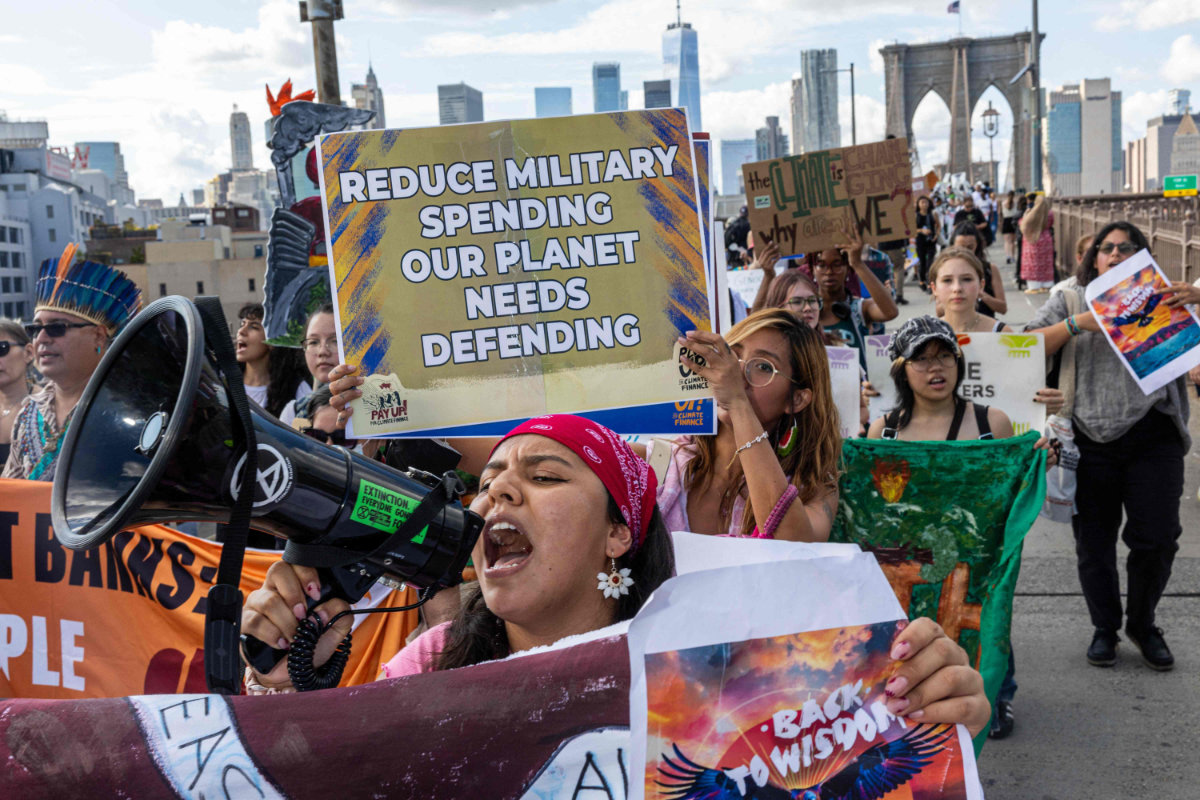


Activists cross the Brooklyn Bridge during a Youth Global Climate demonstration ahead of the UN Climate week and General Assembly in New York City on September 20, 2024. (AFP)

The UN climate summit continues on Monday with speeches from China, India, and the United States.
Elsewhere during the week, US President Joe Biden is expected to deliver a speech at an event also attended by actress and climate activist Jane Fonda and World Bank President Ajay Banga, among others. Another event hosted by the Clinton Foundation features speeches by Prince Harry, Duke of Sussex, and actor and water activist Matt Damon.
The Climate Group, which is coordinating Climate Week, counted some 900 climate-related events planned across the city this week, hosted by multinational corporations, international non-profits, governments and activists.

Big agenda
Climate summits and events like Climate Week, held alongside the UN General Assembly, have taken on a more urgent tone in recent years as rising temperatures fuel increasingly extreme disasters like heatwaves and storms.
Some observers to climate negotiations regretted that the global pact adopted Sunday morning by the General Assembly did not go further than last year’s COP28 summit in Dubai in affirming a commitment to transition away from fossil fuel use.
Countries are showing “collective amnesia” about the need to tackle these polluting fuels, said Alden Meyer, a senior associate at the climate think tank E3G.
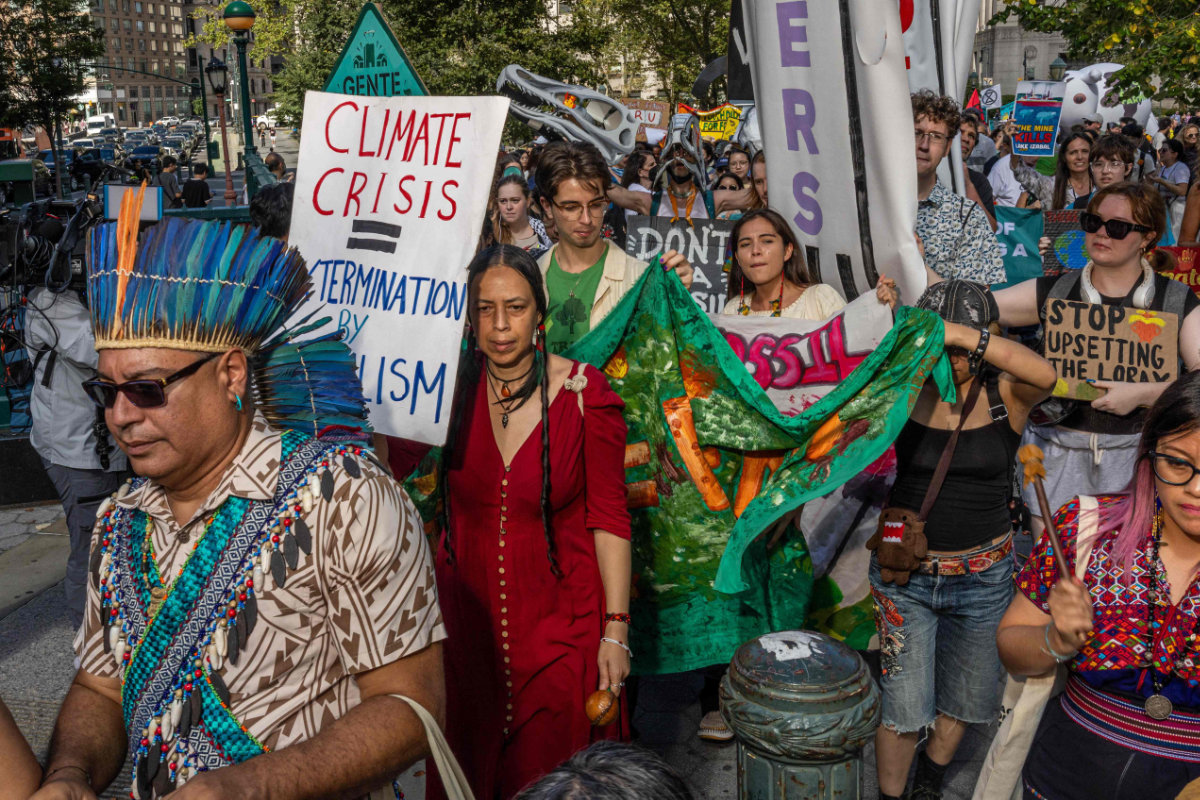


Activists cross the Brooklyn Bridge during a Youth Global Climate demonstration ahead of the UN Climate week and General Assembly in New York City on September 20, 2024. (AFP)

Leaders have also been grappling with a more urgent challenge on the climate agenda. There are just two months left until the UN’s COP29 climate summit in Baku, Azerbaijan, leaving little time for agreeing on a new global finance target to replace the annual $100 billion pledge that expires in 2025.
With some UN agencies estimating the annual financing need in the trillions, leaders are looking beyond their own budgets for ways to boost climate cash.
The World Bank and other multilateral development banks are undergoing reform processes this year, which could see them making more funding available or taking on more climate-related risk.
Under an initiative led by Barbados, France and Kenya, countries also continue to discuss imposing new global taxes to help pay for climate finance, such as a financial transaction tax or a shipping tax.
Commonwealth Secretary General Patricia Scotland noted that some of the world’s poorest countries were now facing climate-fueled disasters along with an increased debt burden.
“We have to do more to understand the fundamental unfairness of the debt crisis that most of our developing countries are going through,” Scotland told Reuters. “The development banks and the World Bank have to step up to that reality.”
(Reporting by Simon Jessop and Valerie Volcovici; Additional reporting by Michelle Nichols; Editing by Chris Reese and Stephen Coates)


Two high-speed trains derail in Spain, police sources say 21 people killed

Updated 19 January 2026
Follow

Two high-speed trains derail in Spain, police sources say 21 people killed

  • The accident happened near Adamuz, in Cordoba province. So far, 21 people ​have been confirmed dead by police

MADRID: A high-speed train derailed and smashed into another oncoming train in southern Spain on Sunday, pushing the second train off the tracks in a collision that police sources confirmed to Reuters had killed at least 21 people.
The accident happened near Adamuz, in Cordoba province. So far, 21 people ​have been confirmed dead by police, with state broadcaster Television Espanola adding that 100 people had been injured, 25 seriously. The driver of one of the trains, which was traveling from Madrid to Huelva, was among those who died, the TV station added.
“The Iryo 6189 Malaga — (to Madrid) train has derailed from the track at Adamuz, crashing onto the adjacent track. The (Madrid) to Huelva train which was traveling on the adjacent track has also derailed,” said Adif, which runs the rail network, in a social media post.
Adif said the accident happened at 6:40 p.m. (1740 GMT), about 10 minutes after the Iryo train left Cordoba heading toward Madrid.
Iryo is a private rail operator, majority-owned by Italian state-controlled railway group Ferrovie dello Stato. The train involved was a Freccia 1000 train which was traveling between ‌Malaga and Madrid, ‌a spokesperson for Ferrovie dello Stato said.
The company said in a statement that it ‌deeply ⁠regretted what ​had happened ‌and had activated all emergency protocols to work closely with the relevant authorities to manage the situation.
The second train was operated by Renfe, which also did not respond to a request for comment.
Adif has suspended all rail services between Madrid and Andalusia.

HORRIFIC SCENE
The Iryo train had more than 300 passengers on board, while the Renfe train had around 100.
Paco Carmona, Cordoba fire chief, told TVE the first train heading to Madrid from Malaga had been evacuated.
The other train’s carriages were badly damaged, he said, with twisted metal and seats. “There are still people trapped. We don’t know how many people have died and the operation is concentrating on getting people out of areas which are very narrow,” he ⁠said. “We have to remove the bodies to reach anyone who is still alive. It is proving to be a complicated task.”
Transport Minister Oscar Puente said he was following events ‌from rail operator Adif’s headquarters in Madrid.
“The latest information is very serious,” ‍he posted on X. “The impact was terrible, causing the first two ‍carriages of the Renfe train to be thrown off the track. The number of victims cannot be confirmed at this time. ‍The most important thing now is to help the victims.”
The mayor of Adamuz, Rafael Moreno, told El Pais newspaper that he had been among the first to arrive at the scene of the accident alongside the local police and saw what he believed to be a badly lacerated body several meters from the accident site.
“The scene is horrific,” he said. “I don’t think they were on the same track, but it’s not clear. Now ​the mayors and residents of the area are focused on helping the passengers.”

CALLS FOR MEDICS
Images on local television showed a reception center set up for passengers in the town of Adamuz, population 5,000, with locals coming ⁠and going with food and blankets amid nighttime temperatures of around 42 degrees Fahrenheit (6 degrees Celsius).
A woman named Carmen posted on X that she had been on board the Iryo train to Madrid. “Ten minutes after departing (from Cordoba) the train started to shake a lot, and it derailed from coach 6 behind us. The lights went out.”
Footage posted by another Iryo train passenger, also on X, showed an Iryo staffer in a fluorescent jacket instructing passengers to remain in their seats in the darkened carriages, and those with first aid training to keep watch over fellow passengers. He also urged people to maintain mobile phone batteries to be able to use their torches when they disembarked.
Salvador Jimenez, a journalist for RTVE who was on board the Iryo train, shared images showing the nose of the rear carriage of the train lying on its side, with evacuated passengers sitting on the side of the carriage facing upwards.
Jimenez told TVE by phone from beside the stricken trains that passengers had used emergency hammers to smash the windows and climb out, and they had seen two people taken ‌out of the overturned carriages on stretchers.
“There’s a certain uncertainty about when we’ll get to Madrid, where we’ll spend the night, we’ve had no message from the train company yet,” he said. “It’s very cold but here we are.”