

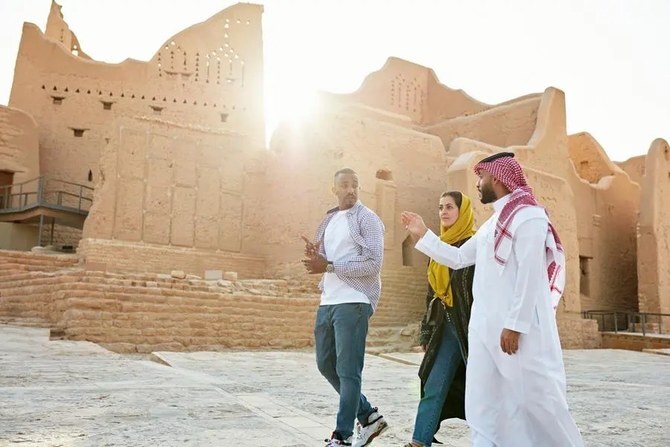
Saudi Arabia leads G20 in tourism growth with 73% rise in international visitors

The UN World Tourism Barometer reports that the Kingdom welcomed 17.5 million international tourists during this timeframe, showcasing its growing allure as a global travel destination. File
Short Url
Updated 22 September 2024
Follow

Saudi Arabia leads G20 in tourism growth with 73% rise in international visitors

RIYADH: Saudi Arabia has emerged as a leader in tourism growth among G20 nations, experiencing a remarkable 73 percent increase in international visitors in the first seven months of 2024 compared to 2019.

The UN World Tourism Barometer reports that the Kingdom welcomed 17.5 million international tourists during this timeframe, showcasing its growing allure as a global travel destination.

This surge is part of Saudi Arabia’s Vision 2030 initiative, which aims to diversify the economy and reduce dependence on oil revenues. The National Tourism Strategy targets attracting 150 million visitors by 2030 and boosting tourism’s contribution to the gross domestic product from 6 percent to 10 percent. These goals reflect the Kingdom’s commitment to strengthening its tourism sector and enhancing its global appeal.

“Saudi Arabia cements its global leadership and takes the first spot among G20 countries in international tourist arrivals growth, with a 73 percent increase in the first seven months of 2024 compared to the same period in 2019,” stated the Saudi Tourism Ministry on X.

During the G20 tourism ministers’ meeting in Brazil on Sept. 21, Saudi Tourism Minister Ahmed Al-Khateeb emphasized the Kingdom’s dedication to fostering cultural connections worldwide while promoting sustainable growth in the sector. The report also highlighted a 207 percent surge in Saudi Arabia’s international tourism revenues during the same timeframe compared to 2019.

Global outlook

The UN Tourism report noted that international tourism has rebounded to 96 percent of pre-pandemic levels in the seven months through July 2024, driven by strong demand in Europe and the reopening of markets in Asia and the Pacific. Approximately 790 million tourists traveled internationally during this period, reflecting an 11 percent increase compared to 2023 and just 4 percent below 2019 levels.

“International tourism is on track to consolidate its full recovery from the biggest crisis in the sector’s history. The ongoing rebound comes despite a range of economic and geopolitical challenges, highlighting the strong demand for international travel as well as the effectiveness of boosting air connections and easing visa restrictions,” said UN Tourism Secretary-General Zurab Pololikashvili.

He emphasized the importance of thoughtful tourism planning to ensure that the significant socio-economic benefits of tourism are matched with inclusive and sustainable policies.

The report also indicated that the Middle East has led the sector’s growth, with international arrivals increasing by 26 percent above 2019 levels in the first seven months of 2024.

Africa welcomed 7 percent more tourists in the first seven months, compared to the same period in 2019. 

“Europe and the Americas recovered 99 percent and 97 percent of their pre-pandemic arrivals respectively during these seven months. Asia and the Pacific recorded 82 percent of its pre-pandemic tourist numbers,” said UN Tourism. 


Saudi Arabia set to attract $500bn in private investment, Al-Falih tells conference

Updated 09 December 2025
Follow

Saudi Arabia set to attract $500bn in private investment, Al-Falih tells conference

RIYADH: Sustainability, technology, and financial models were among the core topics discussed by financial leaders during the first day of the Momentum 2025 Development Finance Conference in Riyadh.

The three-day event features more than 100 speakers and over 20 exhibitors, with the central theme revolving around how development financial institutions can propel economic growth.

Speaking during a panel titled “The Sustainable Investment Opportunity,” Saudi Investment Minister Khalid Al-Falih elaborated on the significant investment progress made in the Kingdom.

“We estimate in the midterm of 2030 or maybe a couple of years more or so, about $1 trillion of infrastructure investment,” he said, adding: “We estimate, as a minimum, 40 percent of this infrastructure is going to be financed by the private sector, so we’re talking in the next few years $400 (billion) to $500 billion.”

The minister drew a correlation between the scale of investment needs and rising global energy demand, especially as artificial intelligence continues to evolve within data processing and digital infrastructure in global spheres.

“The world demand of energy is continuing to grow and is going to grow faster with the advent of the AI processing requirements (…) so our target of the electricity sector is 50 percent from renewables, and 50 percent from gas,” he added.

Al-Falih underscored the importance of AI as a key sector within Saudi Arabia’s development and investment strategy. He made note of the scale of capital expected to go into the sector in coming years, saying: “We have set a very aggressive, but we believe an achievable target, for AI, and we estimate in the short term about $30 billion immediately of investments.”

This emphasis on long-term investment and sustainability targets was echoed across panels at Momentum 2025, during which discussions on essential partnerships between public and private sectors were highlighted.

The shared ambition of translating the Kingdom’s goals into tangible outcomes was particularly essential within the banking sector, as it plays a central role in facilitating both projects and partnerships.

During the “Champions of Sectoral Transformation: Development Funds and Their Ecosystems” panel, Saudi National Bank CEO Tareq Al-Sadhan shed light on the importance of partnerships facilitated via financial institutions.

He explained how they help manage risk while supporting the Kingdom’s ambitions.

“We have different models that we are working on with development funds. We co-financed in certain projects where we see the risk is higher in terms of going alone as a bank to support a certain project,” the CEO said.

Al-Sadhan referred to the role of development funds as an enabler for banks to expand their participation and support for projects without assuming major risk.

“The role of the development fund definitely is to give more comfort to the banking sector to also extend the support … we don’t compete with each other; we always complement each other” he added.