RIYADH: While Saudi Arabia’s Special Olympics federation serves to combat the isolation, inactivity and stigma experienced by people with disabilities, its teams have also gone on to prove their dominance on the world stage.
The Kingdom took home the gold medal for football after defeating Romania at the 2022 Special Olympics Unified Cup in Detroit in the US.
In the most recent Games in Berlin 2023, the Special Olympics Saudi Arabia delegation won nine gold medals, six silver and nine bronze.
Football coach Sara Al-Otaibi helped the women’s team to achieve a bronze in Berlin.
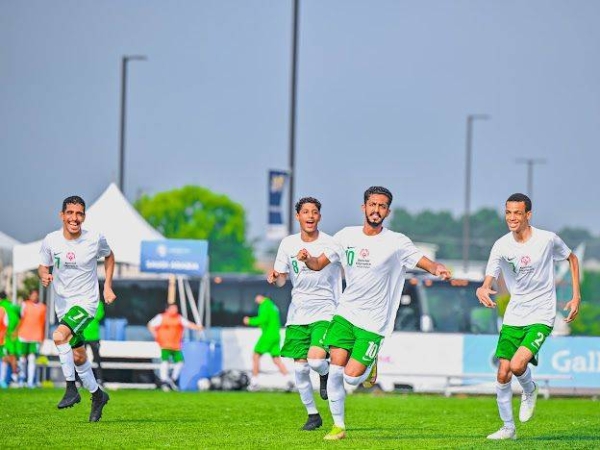
The Saudi Arabian team made history by winning the gold medal in the Special Olympics Unified Cup 2022 on Saturday. (Supplied)
“The focus was on visual training to develop some aspects of attention through concentration: Passing, shooting, defensive movements, as sight plays an important role in sports activities, especially football, which requires a high level of sensory-motor awareness to complete the motor requirements,” she told Arab News.
Since its establishment in 1994, Special Olympics Saudi Arabia has participated in more than eight World Games organized by the Special Olympics in Ireland, China, the US, and the UAE.
“Sports is one of the most important factors to be introduced in a child or adolescence’s routine to keep his life balanced and healthy, as well as help release energy positively and develop his skills and talents,” said Mohammed Al-Shareefi, an applied behavioral analyst and vocational rehabilitation specialist with experience working with players in the SOSA.
Mohammed Al-Mutairi, a 17-year-old cyclist, told Arab News that through training with the Special Olympics: “I changed a lot, gradually. All thanks to someone named Fahad Al-Wethlan. It was at the beginning, when I wasn’t capable. He saw me and told me you’re going to go high, and indeed, I did very well.” Al-Mutairi went on to score fifth place at the 2023 Special Olympics World Games in Berlin.
These athletes don’t just play for fun, they play to win. Two of the social and academic teachings Al-Shareefi is adamant about are recognizing the difference between winning and losing, and the value of skill mastery.
“If (the athlete) learns to win, then he has mastered one of the skills listed for him. Every step presented to them is meticulously studied, specified and measurable,” Al-Shareefi said.
“I was so happy,” said gold medal judo player, Sara Al-Wazeenani, on her historic win in Berlin, “when I saw that… I was the first girl to represent Saudi internationally.”
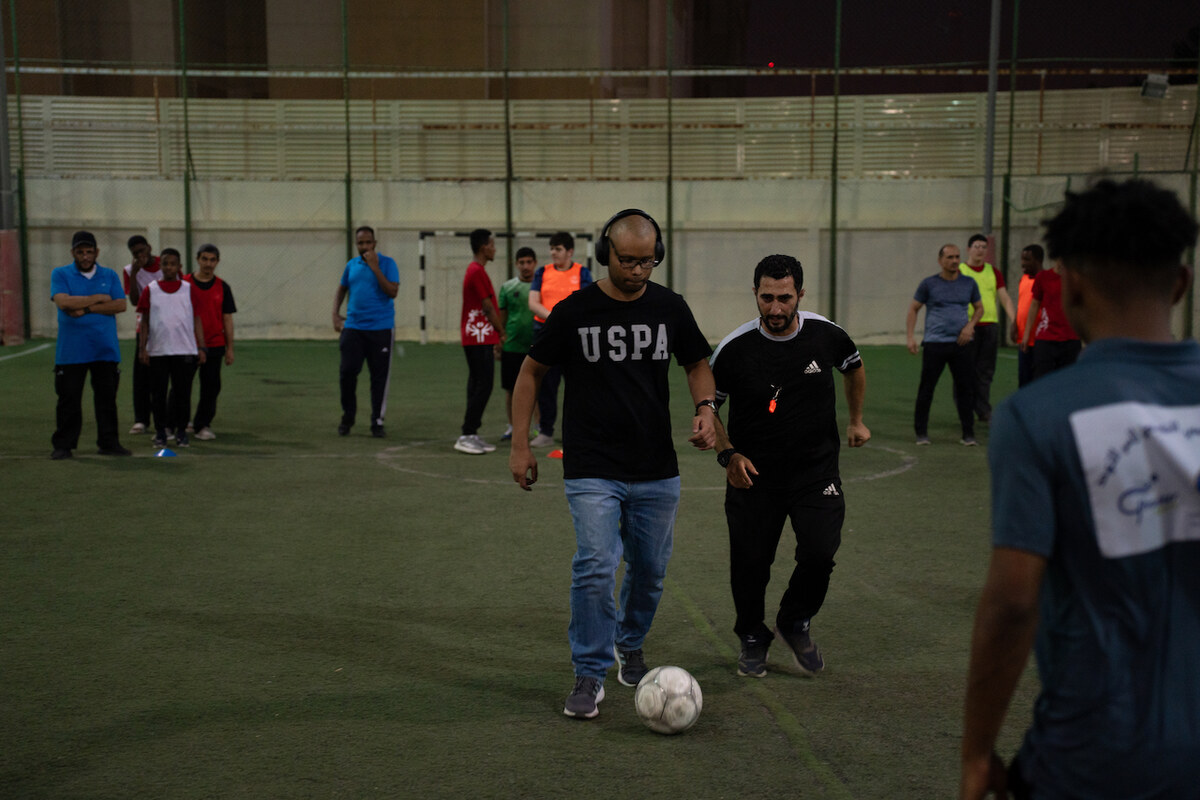
Football practice with Special Olympics Saudi Arabia players at the Prince Faisal bin Fahd Youth Hostels. (AN/Abdulrahman Bin Shalhoub)
Female Saudi players participated for the first time at the Berlin Games in several other sports as well, including football, swimming, weightlifting and equestrianism. The percentage of female representation in the delegation reached 59 percent.
Arab News also spoke to former basketball player and now Special Olympics coach, Ibrahim Bin Besais, who has more than 20 years of experience working with players with intellectual and developmental disabilities.
Bin Besais said that the relationship between a player and his coach was a special one that extended beyond the sport. “You start to discover personalities,” he said.
“You treat him like he’s your own child,” bin Besais said. “You are a father to him before a coach.”
As a young player with an intellectual or developmental disability begins to learn a new skill, it is important that they be introduced to it step by step, along with the reasoning behind those steps.

Football practice with Special Olympics Saudi Arabia players at the Prince Faisal bin Fahd Youth Hostels (AN/Abdulrahman Bin Shalhoub)
First, bin Besais explained, a specific goal is set so that the players have a clear target in mind. Then, it is important to simplify the intended skill as much as possible without giving too much unnecessary information.
Despite the challenges, “working with this group is a very beautiful thing,” Al-Shareefi said. “The feeling you get when you see any achievement or positive progression is indescribable.”
The Special Olympics was founded in the 1950s and early 1960s by American philanthropist Eunice Kennedy Shriver, after she saw the unjust treatment of people with intellectual disabilities.
Starting as a US summer day camp in the 1950s and eventually growing into a worldwide movement, the Special Olympics found its home in Saudi Arabia in 1994 under the chairmanship of Prince Faisal bin Fahd bin Abdulaziz Al-Saud, Al-Mudayhish said.
It was officially declared a federation in 2019 by Minister of Sports Abdulaziz bin Turki Al-Saud.
In addition to overseeing athletic programs across the country, SOSA also has health programs that provide the awareness and support to adopt a sustainably healthy lifestyle.
“I tell them that they have to eat healthy and take care of their bodies, exercise and stay fit so that they can be like the champions, like me,” says runner and health spokesperson, Ghazal Al-Khuzaiem.
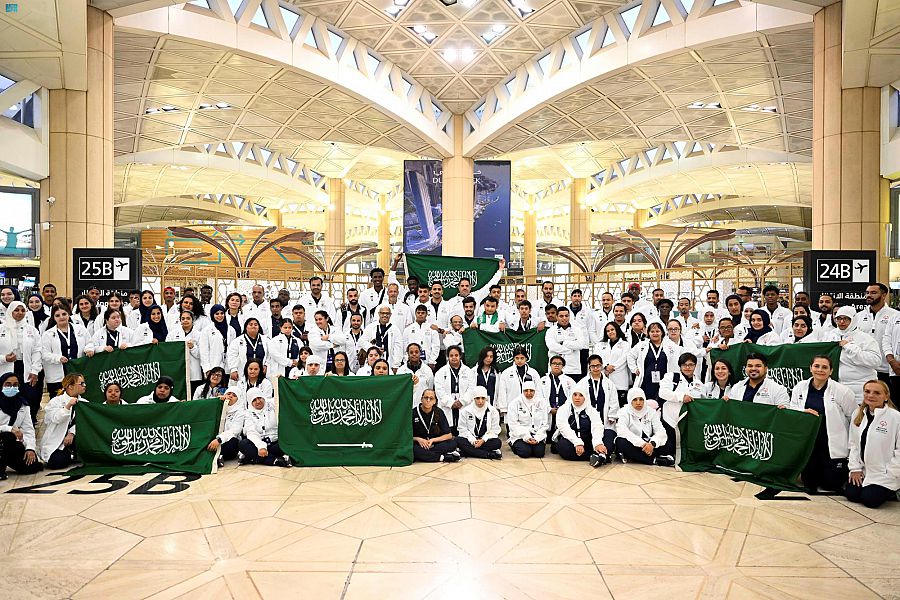
Saudi Special Olympics team arrives in Germany to participate — for the first time — in 15 Olympic sports, with 85 male and female players. (Twitter/@saudiarabiaso)
Whether it is intellectual growth, exposure to other cultures, or forging strong relationships, bin Besais emphasized that athletics positively impacted every aspect of life, and should be part of every Saudi’s daily routine.
“The Kingdom’s direction and goal in raising the ceiling of women’s sports and in disability in particular, makes the pride and joy in the souls of the players clear with every kick,” Al-Otaibi said.
Bin Besais added: “We all love football, it is our first game. Though I am a basketball player, I started out as a football player in school. Most of the people (in the Kingdom) love this sport and consistently watch it.
“For those who have kids, I tell them this — grab the opportunity and gain the time, because every day that goes by that you don’t train, that you don’t work on yourself, is an opportunity for others to surpass you.”