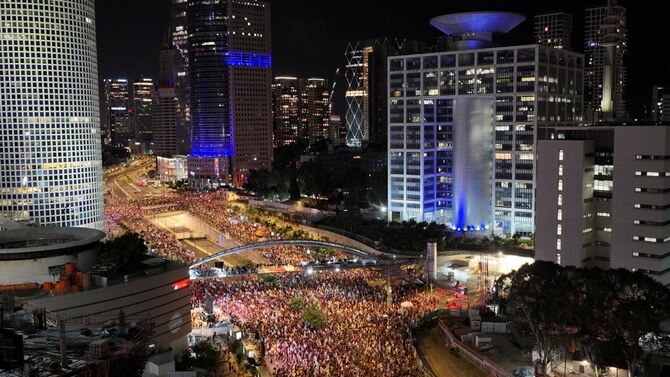
TEL AVIV: Thousands of Israelis again took to the streets of Israel’s commercial hub Tel Aviv on Saturday to press for a Gaza truce deal that could free dozens of hostages.
Weekly rallies in Tel Aviv throughout the war, which was triggered by Hamas’s October 7 attack, have become more critical of the Israeli government since the military announced earlier this month that six dead captives had been recovered from a tunnel in the southern Gaza Strip.
Prime Minister Benjamin Netanyahu, accused by critics of stalling in truce negotiations and prolonging the war to appease far-right coalition partners, has said Hamas militants “executed” the six hostages by shooting them in the back of the head.
Netanyahu has also blamed Hamas leaders for rejecting terms of a possible truce and hostage release deal, while himself facing calls from Israeli critics to make concessions to secure the return of 97 people still held in Gaza, including 33 the military says are dead.
Actor Lior Ashkenazi told the crowd in Tel Aviv on Saturday that “there will be no redemption” if the government allows the Israeli captives to be “abandoned to murderers and rapists for coalition considerations.”
“No one will agree to live under a broken leadership. Cry out, beloved land, for your leaders abandon you.”
As in past weeks, relatives of captives addressed the crowd.
Eli Elbag, father of hostage Liri Elbag, said addressing his daughter: “It’s been a year since I last kissed you, a year since I last laughed with you.”
“We will continue to fight to bring everyone home,” said the father.
Saturday’s protest unfolded in the shadow of increasing cross-border attacks between Israel and Lebanese group Hezbollah, a Hamas ally.
Shahar Mor, nephew of slain hostage Avraham Munder, said he feared the fight against Hezbollah would again distract leaders from the plight of the hostages.
“Their goal is to focus on the illusion of ‘absolute victory’ that is always just around the corner,” said Mor.
But like during successive phases of intense fighting in Gaza over nearly a year of war, the “corner... always shifts according to specific interests,” he said.
“Yesterday it was Rafah (in southern Gaza), tomorrow it will be Beirut.”
The October 7 attack that triggered the war resulted in the deaths of 1,205 people, mostly civilians, on the Israeli side, according to an AFP tally based on Israeli official figures that include hostages killed in captivity.
Palestinians militants seized 251 hostages that day, scores of whom were released during a one-week truce in November.
Israel’s retaliatory military offensive has killed at least 41,391 people in Gaza, most of them civilians, according to figures provided by the Hamas-run territory’s health ministry. The UN has acknowledged the figures as reliable.

Israelis rally to pressure government on hostage release
https://arab.news/vch98
Israelis rally to pressure government on hostage release
- Prime Minister Benjamin Netanyahu is accused by critics of stalling in truce negotiations and prolonging the war
Israel says Hamas ‘will be disarmed’ after group proposes weapons freeze
- A top Hamas leader said on Wednesday that the militant group is open to a weapons “freeze,” but rejects the demand for disarmament
DOHA: Israel said on Thursday that Hamas “will be disarmed” as part of the US-sponsored peace plan for Gaza, after a top leader from the Islamist movement suggested a weapons freeze.
“There will be no future for Hamas under the 20-point plan. The terror group will be disarmed and Gaza will be demilitarised,” the Israeli official told AFP.
Hamas’s Khaled Meshaal told Qatari news channel Al Jazeera on Wednesday that the militant group is open to a weapons “freeze,” but rejects the demand for disarmament put forward in US President Donald Trump’s plan for Gaza.
A top Hamas leader told Qatari news channel Al Jazeera on Wednesday that the militant group is open to a weapons “freeze,” but rejects the demand for disarmament put forward in the US-sponsored peace plan for Gaza.
“The idea of total disarmament is unacceptable to the resistance (Hamas). What is being proposed is a freeze, or storage (of weapons)... to provide guarantees against any military escalation from Gaza with the Israeli occupation,” said Khaled Meshaal in an interview aired Wednesday.
“This is the idea we’re discussing with the mediators, and I believe that with pragmatic American thinking... such a vision could be agreed upon with the US administration,” he said.
The US-sponsored ceasefire deal, in effect since October 10, halted the war that began after Hamas’s deadly attack on Israel on October 7, 2023. But it remains fragile as Israel and Hamas accuse each other almost daily of breaches.
The agreement is composed of three phases. Israeli Prime Minister Benjamin Netanyahu recently indicated that it was about to enter the second phase.
Under that phase Israeli troops would further withdraw from their positions in Gaza and be replaced by an international stabilization force (ISF), while Hamas would lay down its weapons.
Netanyahu is expected to meet with US President Donald Trump in the US later this month to discuss the steps forward in the truce.
But the Palestinian militant group has indicated it would not agree to giving up its arsenal.
“Disarmament for a Palestinian means stripping away his very soul. Let’s achieve that goal another way,” Meshaal added.
In the first phase of the deal Palestinian militants committed to releasing the remaining 48 living and dead captives held in the territory. All of the hostages have so far been released except for one body.
In exchange, Israel has released nearly 2,000 Palestinian prisoners in its custody and returned the bodies of hundreds of dead Palestinians.
As for the international peacekeeping force, Meshaal said the group was open to its deployment along Gaza’s border with Israel, but would not agree to it operating inside the Palestinian territory, calling such a plan an “occupation.”
“We have no objection to international forces or international stabilization forces being deployed along the border, like UNIFIL,” he said, referring to the UN peacekeeping force deployed in southern Lebanon near the Israeli border.
“They would separate Gaza from the occupation,” he added, referring to Israel.
“As for the presence of international forces inside Gaza, in Palestinian culture and consciousness that means an occupying force.”
Mediators as well as Arab and Islamic nations, he said, could act as “guarantors” that there would be no escalation originating from inside Gaza.
“The danger comes from the Zionist entity, not from Gaza,” he added, referring to Israel.