

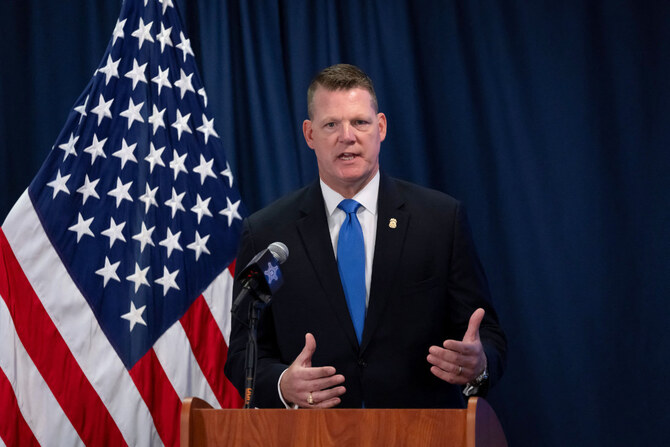
Acting Secret Service chief details a list of failures uncovered during a review of the attempted assassination of former president Donald Trump at a rally in July
Trump has sought political advantage by blaming — without evidence — Biden and Democratic election rival Kamala Harris for fueling motivation behind the plots
Updated 21 September 2024
AFP
WASHINGTON: The US Secret Service on Friday detailed a litany of failures uncovered by its review of the attempted assassination of former president Donald Trump at a rally in July.
Shooter Thomas Matthew Crooks was able to open fire from a nearby rooftop at the outdoor event held by Republican election candidate Trump, who narrowly escaped death and suffered a wound to his right ear.
The review “identified deficiencies in the advanced planning and its implementation,” Acting Director Ronald Rowe Jr. said at a press briefing.
“While some members of the advance team were very diligent, there was complacency on the part of others that led to a breach of security protocols.”
Among the failures identified by Rowe were poor communication with local law enforcement, an “over-reliance” on mobile devices “resulting in information being siloed” and line of sight issues, which “were acknowledged but not properly mitigated.”
“At approximately 18:10 local time, by a phone call, the Secret Service security room calls the countersniper response agent reporting an individual on the roof of the AGR building,” Rowe recounted.
“That vital piece of information was not relayed over the Secret Service radio network.”
Two attendees of the rally in Butler, Pennsylvania were injured from gunfire and a third, 50-year-old firefighter Corey Comperatore, died as a result.
Crooks was shot dead on the roof by Secret Service personnel.
Secret Service director Kimberly Cheatle resigned in the aftermath of the dramatic incident, and several Secret Service agents have been put on leave.
Rowe said the Secret Service needed additional funding, personnel and equipment to complete a “paradigm shift...from a state of reaction to a state of readiness.”
The Congressional task force investigating the attempted assassination of Trump issued a statement Friday encouraging Rowe to “follow through” on holding employees accountable and to cooperate with its independent investigation.
“Complacency has no place in the Secret Service,” the task force said.
The US House of Representatives unanimously passed a bill Friday to boost Secret Service protection for presidential candidates to the same level as sitting presidents and vice presidents.
The bill now awaits a vote in the Senate and a signature by President Joe Biden before it becomes law.
Rowe said that Trump is now being given the same levels of protection as the president.
The increased demand for security came into sharp focus again after a second apparent assassination attempt on Trump’s life at his golf course in West Palm Beach, Florida last weekend.
“What occurred on Sunday demonstrates that the threat environment in which the Secret Service operates is tremendous,” Rowe said.
The gunman in Florida did not have a line of sight on the former president and failed to fire a shot before he was discovered and arrested, officials say.
Trump has sought political advantage by blaming — without evidence — Biden and Democratic election rival Kamala Harris for fueling motivation behind the plots, citing their “rhetoric” about him endangering democracy.
Both Biden and Harris have repeatedly denounced the assassination bids and any political violence, with Biden calling for Congress to provide more resources for the Secret Service.
Brown University shooting leaves students, community frustrated with official response
On Sunday, officials released a person of interest without charges, leaving investigators scrambling for new leads
The FBI and Providence police have released footage but have not identified the suspect. Students and community members are frustrated by security gaps
Updated 5 sec ago
AP
PROVIDENCE: The ongoing effort to find a man who walked onto Brown University ‘s campus during a busy exam season and shot nearly a dozen students in a crowded lecture hall has raised questions about the school’s security systems and the urgency of the investigation itself. A day after Saturday’s mass shooting, officials said a person of interest taken into custody would be released without charges, leaving investigators with little actionable insight from the limited security video they had recovered and scrambling to develop new leads. Law enforcement officials were still doing the most basic investigative work two days after the shooting that killed two students and wounded nine, canvassing local residences and businesses for security camera footage and looking for physical evidence. That’s left students and some Providence residents frustrated at gaps in the university’s security and camera systems that helped allow the shooter to disappear. “The fact that we’re in such a surveillance state but that wasn’t used correctly at all is just so deeply frustrating,” said Li Ding, a student at the nearby Rhode Island School of Design who dances on a Brown University team. A petition for increased security Ding is among hundreds of students who have signed a petition to increase security at school buildings, saying that officials need to do a better job keeping the campus secure against threats like active shooters. “I think honestly, the students are doing a more effective job at taking care of each other than the police,” Ding said. Kristy dosReis, chief public information officer for the Providence Police Department, said that at no point did the investigation stand down even after officials appeared to have a breakthrough in the case, detaining a Wisconsin man who they now believe was not involved. “The investigation continued as the scenes were still active. Nothing was cleared,” said dosReis. Police and the FBI on Monday released new video and photographs of a man they believe carried out the attack. The man wore a mask in the footage captured before and after the attack. Investigation is ‘painstaking work’ FBI Boston Special Agent in Charge Ted Docks said a $50,000 reward was being offered for information that would lead to the identification, arrest and conviction of the shooter. Docks described the investigation, including documenting the trajectory of bullets at the shooting scene, as “painstaking work.” “We are asking the public to be patient as we continue to run down every lead so we can give victims, survivors, their families and all of you the answers you deserve,” Docks told reporters. A lack of campus security footage While Brown University is dotted with cameras, there were few in the Barus and Holley building, home of the engineering school that was targeted. “Reality is, it’s an old building attached to a new one,” Rhode Island Attorney General Peter Neronha told reporters about the lack of cameras nearby. The lack of campus footage left police seeking tips from the public. Katherine Baima said US marshals came to her door on Monday, seeking footage from a security camera pointing toward the street. “This is the first time any of us in my building, as far as I know, had heard from anyone,” Baima said. Students said the school’s emergency alert system kept them relatively well-informed about the presence of an active shooter. But they were uncertain what to do during a prolonged campus lockdown. Chiang-Heng Chien, a 32-year-old doctoral student in engineering, hid under desks and turned off the lights after receiving an alert about the shooting at 4:22 p.m. Saturday in a campus lab. “While I was hiding in the lab, I heard the police yelling outside but my friends and I were debating whether we should open the door, since at that moment the shooter was believed to be (nearby),” he said in a text. Experts say colleges can be at disadvantage when it comes to security Law enforcement experts say colleges are often at a disadvantage when responding to threats like an active shooter. Their security officers are typically less trained and paid less than in other law enforcement departments. They also don’t always have close partnerships with better-resourced agencies. Often, funding for campus police departments is not a top priority, even for schools with ample resources, said Terrance Gainer, a former Illinois law enforcement official who later served as the US Senate’s sergeant-at-arms. “They just aren’t as flush in law enforcement as you would think. They don’t like a lot of uniformed presence, they don’t like a lot of guns around,” said Gainer, who is now a consultant. “Whether it’s Brown or someone else, a key question is, what type of relationship do they have with the local police department?” At Utah Valley University, where conservative leader Charlie Kirk was assassinated by a shooter on a school building roof last summer, the undersized campus police department never asked neighboring agencies to assist with security at the outdoor Kirk event that attracted thousands, an Associated Press review found. Changes in Providence’s alert system Providence has an emergency alert system, but it switched from a mobile app to a web-based system in March. The new system requires someone to register online to receive alerts — something not all residents knew. Emely Vallee, 35, lives about a mile (1.6 kilometers) from Brown with her two young children. She said she received “absolutely nothing” in alerts. She relied instead on texts from friends and the news. Vallee had expected to be notified through the city’s 311 app, but hadn’t realized that Mayor Brett Smiley phased out the app in March. Smiley said his administration sent out multiple alerts the day of the shooting using the new 311 system and has continued to send them. Hailey Souza, 23, finished her shift at a smoothie shop just off-campus minutes before the shooting. Everything seemed normal and quiet, Souza said. But driving home, she saw a boy bleeding on the sidewalk. “Then everyone started running and screaming,” she said. Souza said she saw a bystander rip off his T-shirt to help. The shop Souza manages, In The Pink, is a block from the engineering building. One of the shooting victims, Ella Cook, was a regular at the store, Souza said. Cook had come in a few days earlier and said her last final was Saturday. Souza later learned that police came by the store to tell her co-workers about an active shooter. But Souza never received an emergency alert. “Nothing,” she said.