

Missing Kenyans freed as rights groups blame security forces

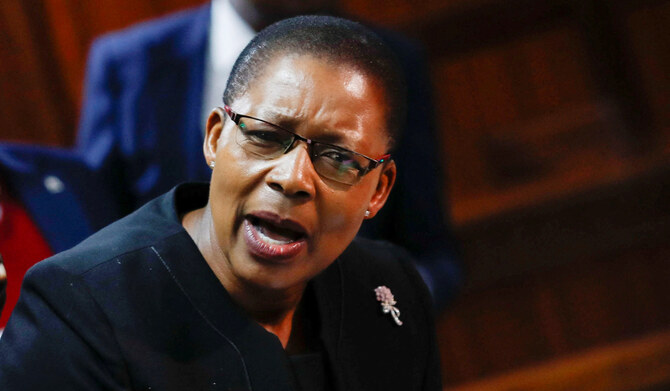
Kenya's Attorney General Dorcas Oduor gestures as the Deputy Inspector General of Police Gilbert Masengeli presented himself to court after he was sentenced to six months in prison for repeatedly defying orders to testify about the whereabouts of three men allegedly abducted by police officers, at the Milimani Law courts in Nairobi, Kenya, September 20, 2024. (REUTERS)
Short Url
Updated 20 September 2024
Follow

Missing Kenyans freed as rights groups blame security forces

  • The Independent Police Oversight Authority has said it was looking into multiple complaints of unlawful arrests and abductions in the wake of large-scale anti-government protests that broke out in Kenya in June

NAIROBI: Three Kenyans at the heart of a high-profile abduction case have been freed, rights groups said on Friday, accusing security forces of keeping them captive for weeks after they took part in anti-government protests.
The three were allegedly abducted by men identifying themselves as police on Aug. 19 in Kitengela, some 30 km south of the capital Nairobi.
Images on social media showed two of the men, looking shaken, following their release late Thursday.
“Our partners have confirmed their release,” said Cornelius Oduor, of the Kenyan Human Rights Commission, said.
“(The images) clearly shows that the men were in distress ... It points to the fact that they have been in captivity.”
There has been no confirmation of where Bob Njagi, Aslam Longton and his brother Jamil Longton were held.
But Oduor said: “We strongly believe that they were taken by security agents of Kenya.”
The two brothers were dropped near the capital, according to tweets from the Kenyan Law Society, while Njagi presented himself to a nearby police station.
The case has dominated the Kenyan news in recent days after a court in Nairobi held the acting police chief, Gilbert Masengeli, in contempt for failing to appear to answer questions about the disappearance of the three men.
Having been given seven days to attend court or face a six-month prison sentence, Masengeli made a last-minute appearance on Friday and apologized for his absence, thus avoiding the conviction.
“We believe (the men’s release) was intended to provide immediate grounds for (Masengeli) to challenge his conviction,” said Oduor.
While the contempt charge against Masengeli was dropped, the case into the men’s disappearance was set to continue.
The Independent Police Oversight Authority has said it was looking into multiple complaints of unlawful arrests and abductions in the wake of large-scale anti-government protests that broke out in Kenya in June.
More than 60 people died during the protests themselves, leading to the resignation of police chief Japhet Koome.
Previous abduction cases have sparked furious protests in Kenya.
In February 2023, three police officers were handed sentences ranging from 24 years in jail to the death penalty for the brutal murder of rights lawyer Willie Kimani and two other people.
Their bodies were found wrapped in sacks and dumped in a river outside Nairobi in June 2016.


India, Arab League target $500bn in trade by 2030

Updated 6 sec ago
Follow

India, Arab League target $500bn in trade by 2030

  • It was the first such gathering of India–Arab FMs since the forum’s inauguration in 2016
  • India and Arab states agree to link their startup ecosystems, cooperate in the space sector

NEW DELHI: India and the Arab League have committed to doubling bilateral trade to $500 billion by 2030, as their top diplomats met in New Delhi for the India–Arab Foreign Ministers’ Meeting. 

The foreign ministers’ forum is the highest mechanism guiding India’s partnership with the Arab world. It was established in March 2002, with an agreement to institutionalize dialogue between India and the League of Arab States, a regional bloc of 22 Arab countries from the Middle East and North Africa.

The New Delhi meeting on Saturday was the first gathering in a decade, following the inaugural forum in Bahrain in 2016.

India’s Foreign Minister S. Jaishankar said in his opening remarks that the forum was taking place amid a transformation in the global order.

“Nowhere is this more apparent than in West Asia or the Middle East, where the landscape itself has undergone a dramatic change in the last year,” he said. “This obviously impacts all of us, and India as a proximate region. To a considerable degree, its implications are relevant for India’s relationship with Arab nations as well.”

Jaishankar and his UAE counterpart co-chaired the talks, which aimed at producing a cooperation agenda for 2026-28.

“It currently covers energy, environment, agriculture, tourism, human resource development, culture and education, amongst others,” Jaishankar said.

“India looks forward to more contemporary dimensions of cooperation being included, such as digital, space, start-ups, innovation, etc.”

According to the “executive program” released by India’s Ministry of External Affairs, the roadmap agreed by India and the League outlined their planned collaboration, which included the target “to double trade between India and LAS to US$500 billion by 2030, from the current trade of US$240 billion.”

Under the roadmap, they also agreed to link their startup ecosystems by facilitating market access, joint projects, and investment opportunities — especially health tech, fintech, agritech, and green technologies — and strengthen cooperation in space with the establishment of an India–Arab Space Cooperation Working Group, of which the first meeting is scheduled for next year.

Over the past few years, there has been a growing momentum in Indo-Arab relations focused on economic, business, trade and investment ties between the regions that have some of the world’s youngest demographics, resulting in a “commonality of circumstances, visions and goals,” according to Muddassir Quamar, associate professor at the School of International Studies, Jawaharlal Nehru University.

“The focus of the summit meeting was on capitalizing on the economic opportunities … including in the field of energy security, sustainability, renewables, food and water security, environmental security, trade, investments, entrepreneurship, start-ups, technological innovations, educational cooperation, cultural cooperation, youth engagement, etc.,” Quamar told Arab News.

“A number of critical decisions have been taken for furthering future cooperation in this regard. In terms of opportunities, there is immense potential.”