

Ukraine joins NATO drill to test anti-drone systems

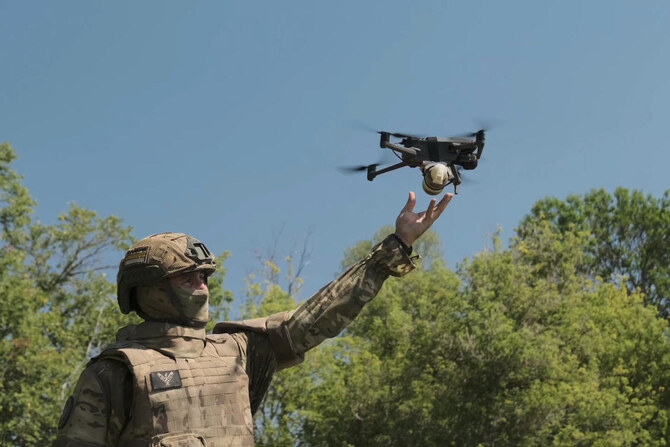
In this photo taken from video released by Russian Defense Ministry press service on Sept. 19, 2024, a Russian serviceman launches a drone at an undisclosed location in Ukraine. (AP)
Short Url
Updated 20 September 2024
Follow

Ukraine joins NATO drill to test anti-drone systems

  • The drills at a Dutch military base tested cutting-edge systems to detect and counter drones and assessed how they work together
  • The 11-day exercise ended with a demonstration of jamming and hacking drones in a week when their critical role in the Ukraine war was demonstrated once again

VREDEPEEL, Netherlands: NATO concluded a major anti-drone exercise this week, with Ukraine taking part for the first time as the Western alliance seeks to learn urgently from the rapid development and widespread use of unmanned systems in the war there.
The drills at a Dutch military base, involving more than 20 countries and some 50 companies, tested cutting-edge systems to detect and counter drones and assessed how they work together.
The 11-day exercise ended with a demonstration of jamming and hacking drones in a week when their critical role in the Ukraine war was demonstrated once again.
On Wednesday, a large Ukrainian drone attack triggered an earthquake-sized blast at a major Russian arsenal. The following day, Russian President Vladimir Putin said Moscow was ramping up drone production tenfold to nearly 1.4 million this year.
The proliferation of drones in the war – to destroy targets and survey the battlefield – has prompted NATO to increase its focus on the threat they could pose to the alliance.
“NATO takes this threat very, very seriously,” said Matt Roper, chief of the Joint Intelligence, Surveillance and Reconnaissance Center at the alliance’s technology agency.
“This is not a domain we can afford to sit back and be passive on,” he said at the exercise site, Lt. Gen. Best Barracks in the east of The Netherlands.
Experts have warned NATO that it needs to catch up quickly on drone warfare.
“NATO has too few drones for a high-intensity fight against a peer adversary,” a report from the Center for European Policy Analysis think tank declared last September.
“It would be severely challenged to effectively integrate those it has in a contested environment.”

THREAT EVOLUTION
The drills that wrapped up on Thursday — complete with ice cream for onlookers provided by a radar company — were the fourth annual iteration of the exercise.
Claudio Palestini, the co-chair of a NATO working group on unmanned systems, said the exercise had adapted to trends such as the transformation of FPV (first-person view) drones — originally designed for civilian racers – into deadly weapons.
“Every year, we see an evolution of the threat with the introduction of new technology,” he said. “But also we see a lot of capabilities (to counter drones) that are becoming more mature.”
In a demonstration on Thursday, two small FPV drones whizzed and whined at high speed through the blue sky to dart around a military all-terrain vehicle before their signal was jammed.
Such electronic warfare is widespread in Ukraine. But it is less effective against long-range reconnaissance drones, a technology developer at Ukraine’s defense ministry said.
The official, giving only his first name of Yaroslav for security reasons, said his team had developed kamikaze drones to destroy such craft – a much cheaper option than firing missiles, which Ukraine had previously done.
“You need to run fast,” he said of the race to counter the impact of drones. “Technology which you develop is there for three months, maybe six months. After, it’s obsolete.”



India hosts global leaders, tech moguls at AI Impact Summit

Updated 5 sec ago
Follow

India hosts global leaders, tech moguls at AI Impact Summit

  • 20 heads of state scheduled to attend event which runs until Feb. 20
  • Summit expected to speed up adoption of AI in India’s governance, expert says

NEW DELHI: A global artificial intelligence summit opened in New Delhi on Monday, with representatives of more than 60 countries scheduled to discuss the use and regulation of AI with the industry’s leaders and investors.

The India AI Impact Summit 2026 is hosted by the Indian government’s IndiaAI Mission — an initiative worth in excess of $1 billion and launched by the Ministry of Electronics and Information Technology in 2024 to develop the AI ecosystem in the country.

After five days of sessions and an accompanying exhibition of 300 companies at Bharat Mandapam  — the venue of the 2023 G20 summit  — participating leaders are expected to sign a declaration which, according to the organizer, will outline a “shared road map for global AI governance and collaboration.”

Prime Minister Narendra Modi, who will attend the summit on Friday with French President Emmanuel Macron, said on X it was a “matter of great pride for us that people from around the world are coming to India” for the event, which is evidence that the country is “rapidly advancing in the fields of science and technology and is making a significant contribution to global development.”

Among the 20 heads of state that the Indian Ministry of External Affairs has announced as scheduled to attend are Macron, Brazilian President Luiz Inacio Lula da Silva, Spanish Prime Minister Pedro Sanchez, Finnish Prime Minister Petteri Orpo, and Sheikh Khaled bin Mohamed bin Zayed Al-Nahyan, Abu Dhabi’s crown prince.

Also expected are tech moguls such as OpenAI CEO Sam Altman and Google’s chief Sundar Pichai.

The summit will give India, the world’s most populous country, a platform to try to steer cooperation and AI regulation between the West and the Global South, and to present to the global audience its own technological development.

“India is leveraging its position as a bridge between emerging and developed economies to bring together not just country leaders and technologists, but also delegates, policy analysts, media, and others … to explore the facets of AI, multilateral collaborations, and the direction that large-scale development of AI should take,” said Anwesha Sen, assistant program manager for technology and policy at Takshashila Institution.

“India is trying to do three things through the AI Impact Summit. One, India is advocating for sovereign AI and the development of inclusive, population-scale solutions. Two, establishing international collaborations that prioritize AI diffusion in sectors like healthcare and agriculture. And three, showcasing how Indian startups and organizations are using frameworks such as that of digital public infrastructure as a model to bridge the two.”

It is the fourth such gathering dedicated to the development of AI. The first one was held in the UK in 2023, a year after the debut of ChatGPT; the 2024 meeting in South Korea; and last year’s event took place in France.

The summit is likely to help the Indian government in speeding up the adoption of AI, according to Nikhil Pahwa, digital rights activist and founder of MediaNama, a mobile and digital news portal, who likened it to the Digital India initiative launched in 2015 to provide digital government services.

“A summit like this, with this much bandwidth allocated to it by the government, even if the agenda is flat, ends up making AI a priority focus for ministries and state governments,” Pahwa told Arab News.

“It encourages diffusion of AI execution-specific thinking and ends up increasing adoption of AI in governance and by both central and state-level ministries. That reduces time for adoption of AI.

“We saw this play out with the government’s Digital India focus: it increased digitization and the adoption of digital technology. The agenda and India’s role in AI globally is less important than speeding up adoption.”