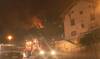
KYIV: Ukrainian drones struck a large military depot in a town deep inside Russia overnight, causing a huge blaze and prompting the evacuation of some local residents, a Ukrainian official and Russian news reports said Wednesday.
Meanwhile, a senior US diplomat said that Ukrainian President Volodymyr Zelensky recently said he has a plan for winning the war that “can work” and help end the conflict, which is now in its third year. But the Ukrainian leader hasn’t publicly spelled out the plan.
Ukraine claimed the strike destroyed Russian military warehouses in Toropets, a town in Russia’s Tver region about 380 kilometers (240 miles) northwest of Moscow and about 500 kilometers (300 miles) from the border with Ukraine.
The attack was carried out by Ukraine’s Security Service, along with Ukraine’s Intelligence and Special Operations Forces, a Kyiv security official told The Associated Press, speaking on condition of anonymity because he was not authorized to discuss the operation.
According to the official, the depot housed Iskander and Tochka-U missiles, as well as glide bombs and artillery shells. He said the facility caught fire in the strike and was burning across an area 6 kilometers (4 miles) wide.
Among the destroyed ammunition were North Korean KN-23 short-range ballistic missiles, another official, in Ukraine’s Intelligence Office, told The AP. He was not authorized to comment publicly and didn’t provide evidence to support his claim.
Russia and North Korea signed a landmark pact last June that envisioned mutual military assistance between Moscow and Pyongyang.
More than 100 domestically-produced kamikaze drones were deployed in the attack on the depot, the Ukrainian Intelligence Office official added.
Russian state news agency RIA Novosti quoted regional authorities as saying air defense systems were working to repel a “massive drone attack” on Toropets, which has a population of around 11,000. The agency also reported a fire and the evacuation of some local residents.
There was no immediate information about whether the strikes had caused any casualties.
Successful Ukrainian strikes on targets deep inside Russia have become more common as the war has progressed and Kyiv developed its drone technology.
Zelensky is also seeking approval from Western nations for Ukraine to use the sophisticated weapons they are providing to hit targets inside Russia. Some Western leaders have balked at that possibility, fearing they could be dragged into the conflict.
Ukraine’s targeting of Russian military equipment, ammunition and infrastructure deep inside Russia, as well as making Russian civilians feel some of the consequences of the war that is being fought largely inside Ukraine, is part of Kyiv’s strategy.
The swift push by Ukrainian forces into Russia’s Kursk border region last month fits into that plan, which apparently seeks to compel Russian President Vladimir Putin to back down.
Putin, however, has shown no signs of backing down, and has been trying to grind down Ukraine’s resolve through attritional warfare and also sap the West’s support for Kyiv by drawing out the conflict. That has come at a price, however, as the UK Defense Ministry estimates that the war has likely killed and wounded more than 600,000 Russian troops.
On Tuesday, Putin ordered the country’s military to increase its number of troops by 180,000 to a total of 1.5 million by Dec. 1.
Zelensky last month said his plan for victory includes not only battlefield goals but also diplomatic and economic wins. The plan has been kept under wraps but the US Ambassador to the United Nations, Linda Thomas-Greenfield, said during a news conference Tuesday that Washington officials have seen it.
“We think it lays out a strategy and a plan that can work,” she said, adding that the United States will bring it up with other world leaders at the UN General Assembly in New York next week. She did not comment on what the plan contained.

Ukrainian drones strike a major military depot in a Russian town northwest of Moscow
https://arab.news/4btnf
Ukrainian drones strike a major military depot in a Russian town northwest of Moscow
- Ukraine claimed the strike destroyed Russian military warehouses in Toropets about 380 kilometers northwest of Moscow
- The attack was carried out by Ukraine’s Security Service, along with Ukraine’s Intelligence and Special Operations Forces
EU leaders work into the night to ease Belgian fears of Russian retaliation over a loan to Ukraine
BRUSSELS: European Union leaders worked into the night on Thursday, seeking to reassure Belgium that they would provide guarantees to protect it from Russian retaliation if it backs a massive loan for Ukraine. Ukraine’s Volodymyr Zelensky meanwhile pleaded for a quick decision to keep Ukraine afloat in the new year.
At a summit in Brussels with high stakes for both the EU and Ukraine, leaders of the 27-nation bloc discussed how best to use tens of billions of euros in frozen Russian assets to underwrite a loan to meet Ukraine’s military and financial needs over the next two years.
The bulk of the assets — some 193 billion euros as of September — are held in the Brussels-based financial clearing house Euroclear. Russia’s Central Bank launched a lawsuit against Euroclear last week.
“Give me a parachute and we’ll all jump together,” Belgian Prime Minister Bart De Wever told lawmakers ahead of the summit. “If we have confidence in the parachute that shouldn’t be a problem.”
Belgian concerns over Russian pressure
Belgium fears that Russia will strike back and wants the bloc to borrow the money on international markets. It says frozen assets held in other European countries should be thrown into the pot as well, and that its partners should guarantee that Euroclear will have the funds it needs should it come under legal attack.
An estimated 25 billion euros in Russian assets are frozen in banks and financial institutions in other EU countries, including France, Germany and Luxembourg.
The Russian Central Bank’s lawsuit ramped up pressure on Belgium and its EU partners ahead of the summit.
The “reparations loan” plan would see the EU lend 90 billion euros to Ukraine. Countries like the United Kingdom, which said Thursday it is prepared to share the risk, as well as Canada and Norway would help make up any shortfall.
Russia’s claim to the assets would still stand, but the assets would remain locked away at least until the Kremlin ends its war on Ukraine and pays for the massive damage it caused.
In mapping out the loan plan, the European Commission set up safeguards to protect Belgium, but De Wever remained unconvinced and EU envoys were working late on Thursday to address his concerns.
Zelensky describes it as a moral question
Soon after arriving in Brussels, the Ukrainian president sat down with the Belgian prime minister to make his case for freeing up the frozen funds. The war-ravaged country is at risk of bankruptcy and needs new money by spring.
“Ukraine has the right to this money because Russia is destroying us, and to use these assets against these attacks is absolutely just,” Zelensky told a news conference.
In an appeal to Belgian citizens who share their leader’s worries about retaliation, Zelensky said: “One can fear certain legal steps in courts from the Russian Federation, but it’s not as scary as when Russia is at your borders.”
“So while Ukraine is defending Europe, you must help Ukraine,” he said.
Allies maintain support for Ukraine
Whatever method they use, the leaders have pledged to meet most of Ukraine’s needs in 2026 and 2027. The International Monetary Fund estimates that would amount to 137 billion euros .
“We have to find a solution today,” European Commission President Ursula von der Leyen told reporters. EU Council President António Costa, who is chairing the meeting, vowed to keep leaders negotiating until an agreement is reached, even if it takes days.
Polish Prime Minister Donald Tusk said it was a case of sending “either money today or blood tomorrow” to help Ukraine.
If enough countries object, the plan could be blocked. There is no majority support for a plan B of raising the funds on international markets, although that too was being discussed at the summit.
German Chancellor Friedrich Merz said that he hopes Belgium’s concerns can be addressed.
“The reactions of the Russian president in recent hours show how necessary this is. In my view, this is indeed the only option. We are basically faced with the choice of using European debt or Russian assets for Ukraine, and my opinion is clear: We must use the Russian assets.”
Hungary and Slovakia oppose a reparations loan. Apart from Belgium, Bulgaria, Italy and Malta are also undecided.
“I would not like a European Union in war,” said Hungarian Prime Minister Viktor Orbán, who sees himself as a peacemaker. He’s also Russian President Vladimir Putin’s closest ally in Europe. “To give money means war.”
Orbán described the loan plan as a “dead end.”
High stakes for the EU
The outcome of the summit has significant ramifications for Europe’s place in negotiations to end the war. The United States wants assurances that the Europeans are intent on supporting Ukraine financially and backing it militarily — even as negotiations to end the war drag on without substantial results.
The loan plan in particular also poses important challenges to the way the bloc goes about its business. Should a two-thirds majority of EU leaders decide to impose the scheme on Belgium, which has most to lose, the impact on decision-making in Europe would be profound.
The EU depends on consensus, and finding voting majorities and avoiding vetoes in the future could become infinitely more complex if one of the EU’s founding members is forced to weather an attack on its interests by its very own partners.
De Wever too must weigh whether the cost of holding out against a majority is worth the hit his government’s credibility would take in Europe.
Whatever is decided, the process does not end at this summit. Legal experts would have to convert any political deal into a workable agreement, and some national parliaments may have to weigh in before the loan money could start flowing to Ukraine.