

Speaker tells Pakistan election body to ‘honor’ parliament’s laws amid tensions with judiciary

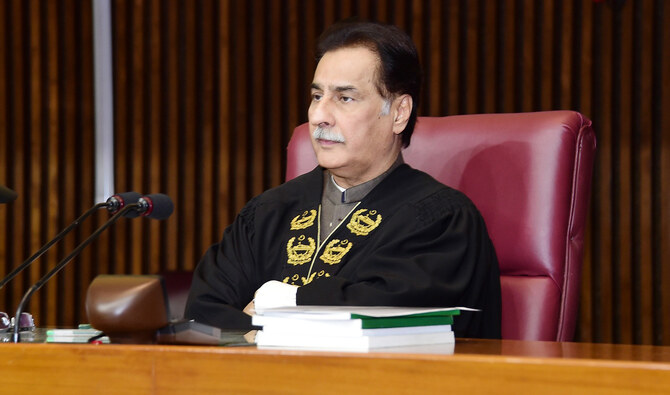
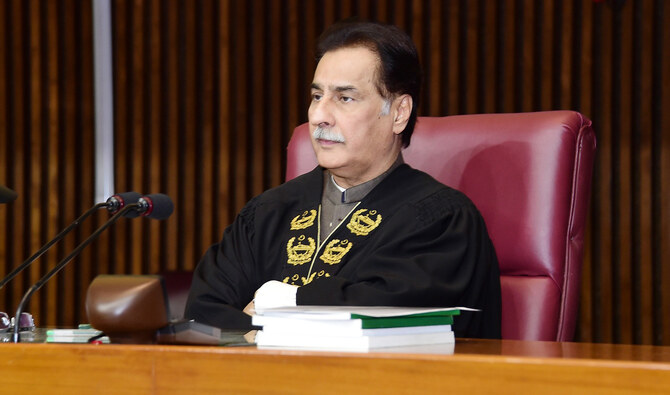
Pakistan’s National Assembly Speaker Sardar Ayaz Sadiq chairs a session of the lower house in Islamabad, Pakistan on September 16, 2024. (@NAofPakistan/X)
Short Url
Updated 19 September 2024
Follow

Speaker tells Pakistan election body to ‘honor’ parliament’s laws amid tensions with judiciary

  • Pakistan’s top court in July ruled that ex-PM Khan’s party is entitled to reserved seats in parliament for women and minorities
  • Sharif’s government last month amended country’s election law that restricts allottment of reserved seats to ex-PM Khan’s party 

ISLAMABAD: Pakistan’s National Assembly Speaker Sardar Ayaz Sadiq on Thursday told the country’s electoral body that amendments made to Pakistan’s election laws last month would supersede a prior ruling of the top court related to reserved seats in parliament, raising fears of a standoff with the Supreme Court. 

Sadiq’s letter to the Election Commission of Pakistan (ECP) came after the Supreme Court censured the election regulatory authority last week for what it said were “dilatory tactics” to avoid implementing a judgment on reserved seats for women and minorities in the national and provincial legislatures that favored the opposition Pakistan Tehreek-e-Insaf (PTI) party. 

In a verdict on July 12, a 13-member bench of the court declared the PTI of Pakistan’s jailed former prime minister Imran Khan eligible for reserved seats after the ECP forced the party’s candidates to contest the February 8 polls as independents. After the election, the PTI-backed candidates were forced to join Sunni Ittehad Council (SIC) party to claim a share of the reserved seats as independents are not eligible for the extra seats.

The Supreme Court overturned the ECP’s decision, saying it had misconstrued an earlier verdict related to the party’s election symbol by depriving the PTI of the reserved seats. The verdict was a blow to the ruling coalition government led by Prime Minister Shehbaz, which could lose its two-thirds majority if the verdict is implemented. 

In August, Pakistan’s parliament passed the Elections (Second Amendment) Bill, 2024, which restricted granting the reserved seats in parliament to the PTI. The bill says that if a candidate does not submit a declaration of his affiliation with a political party to the returning officer before seeking the allotment of an election symbol, he or she shall be “deemed to be considered as an independent candidate and not a candidate of any political party.” 

“As the judgment of the SC was rendered based on the law prior to the enactment of the amendment, the said judgment is now incapable of implementation,” Sadiq wrote in a letter to the ECP. 

“Instead, it is the Amended Election Act that shall prevail and supersede the prior ruling.”

He pointed out that the consistent jurisprudence of the Supreme Court also held the view that the parliamentary law was superior to the court’s order. 

“It is also brought to your kind notice that the Amended Election Act is in the field, therefore, it is the statutory obligation of the ECP to honor the laws made by Parliament and uphold the principles of democracy and parliamentary supremacy,” the letter said. 

He warned that actions perceived to be undermining parliament’s sovereignty can “erode public trust and confidence in our institutions.”

CONSTITUTIONAL AMENDMENTS

The development takes place at a time when Sharif’s coalition government is planning to get a constitutional amendment passed from parliament to allegedly give an extended term to the country’s top judge. 

The amendment requires a two-thirds majority in both houses of parliament, though the coalition can lose a portion of its existing number of seats after the Supreme Court’s July 12 ruling on reserved seats gets implemented. 

The package of reforms, widely believed to include as many as 22 amendments to the constitution, is expected to increase the retirement age of superior judges by three years and change the process by which the Supreme Court chief justice is appointed.

The amendments have raised widespread concerns among opposition parties and legal experts who say the moves are aimed at increasing the government’s power in making key judicial appointments and dealing with the defection of lawmakers during house votes. 



Pakistan rejects India’s ‘irresponsible assertions’ after FM Jaishankar’s ‘bad neighbors’ remarks

Updated 03 January 2026
Follow

Pakistan rejects India’s ‘irresponsible assertions’ after FM Jaishankar’s ‘bad neighbors’ remarks

  • Indian FM Jaishankar accused Pakistan of fomenting militancy, backed New Delhi’s decision to put Indus Waters Treaty in abeyance
  • Islamabad calls the remarks an attempt to deflect attention from India’s ‘troubling record as a neighbor,’ vows to safeguard rights

ISLAMABAD: Pakistan on Saturday rejected “irresponsible assertions” made by Indian External Affairs Minister S. Jaishankar after his remarks about “bad neighbors” and the 1960 Indus Waters Treaty (IWT) between the two countries.

Jaishankar mentioned about “bad neighbors” at an event in Madras on Friday and said that New Delhi had a right to defend itself. “When you have bad neighbors... if you look to the one to the West, if a country decides that they will deliberately, persistently, unrepentantly continue with terrorism, we have a right to defend our people,” he was quoted as saying by The Hindu newspaper.

The remarks came months after New Delhi blamed Pakistan for a militant attack in Indian-administered Kashmir and conducted missile strikes inside Pakistan. Islamabad, which denied involvement in the Kashmir attack, responded to the strikes, leading to a four-day military conflict that saw the use of armed drones, fighter jets and artillery between the neighbors in May.

In a statement, Pakistani foreign office spokesman Tahir Andrabi said Islamabad firmly rejects the irresponsible assertions made by the Indian external affairs minister, describing the remarks as an attempt to deflect attention from India’s own “troubling record as a neighbor that promotes terrorism and contributes to regional instability.”

“India’s documented involvement in promoting terrorist activities in the region, particularly in Pakistan, is well known. The case of Commander Kulbhushan Jadhav remains a stark example of organized, state-sponsored terrorism directed against Pakistan,” he said.

“Equally concerning are recurring instances of extraterritorial killings, sabotage through proxies, and covert support to terrorist networks.”

Jadhav, an Indian navy officer who Islamabad said had been working with Indian spy agency, RAW, when Pakistani agencies arrested him in Balochistan in 2016. He was later sentenced to death by a Pakistani military court for alleged espionage. India disputes the conviction and has challenged it at the International Court of Justice.

Pakistan and India routinely accuse each other of supporting militant groups waging attacks against the other. The two countries have fought multiple wars, including two of them over the disputed region of Kashmir, since their independence from British rule in 1947. Both rule the region in part but claim it in full.

Jaishankar also spoke on Friday about the IWT that divides control of the Indus basin rivers between the neighbors and ensures water for 80 percent of Pakistani farms. India announced in April, following the Kashmir attack, that it was putting the 1960 World Bank-mediated treaty in abeyance.

“Many years ago, we agreed to a water-sharing arrangement — the belief was it was gesture of goodwill — because of good neighborliness we were doing it … but if you have decades of terrorism, there is no good neighborliness and you don’t get the benefit of good neighborliness,” Jaishankar was quoted as saying.

Pakistan foreign office spokesman Andrabi said the IWT is an international agreement concluded in good faith and at a considerable cost.

“Any unilateral violation of the Treaty by India would undermine regional stability and call into question its credibility as a state that claims to respect international legal obligations,” he said.

“Pakistan will take all necessary measures to safeguard its legitimate rights under the Treaty.”