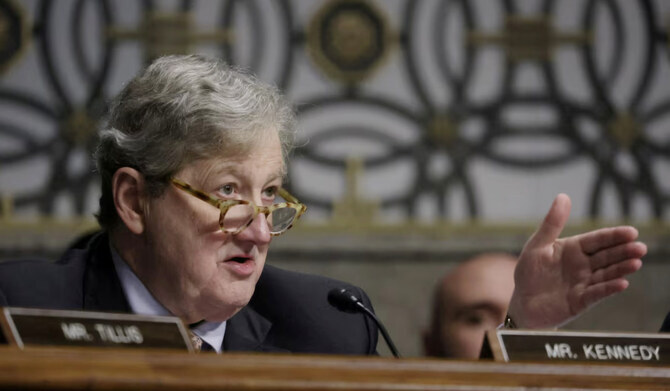
CHICAGO: John Kennedy, a US senator from Louisiana, is facing criticism for anti-Arab and anti-Muslim hate and name calling during a Senate hearing on the issue of hate crimes, after he accused the Muslim American head of a civil rights advocacy group of supporting Hamas and Hezbollah.
Illinois Sen. Dick Durbin convened the Senate Judiciary Committee hearing, titled “A Threat to Justice Everywhere: Stemming the Tide of Hate Crimes in America,” in Washington on Tuesday to discuss an alarming rise in such crimes against Arabs and Muslims and other minority and religious groups.
He began by highlighting the case of Wadee Alfayoumi, a 6-year-old Palestinian American boy who died on Oct. 14, 2023, when he was stabbed 26 times by the landlord of the building in which his family lived in Plainfield, Illinois. His mother, Hanaan Shahin, was severely injured in the attack.
The proceedings turned ugly, however, when Sen. Kennedy, a Republican member of the committee (who is not a member of the famous Kennedy political dynasty), accused an Arab American civil rights leader who was testifying at the hearing of being a supporter of Hamas, Hezbollah and Iran.
Maya M. Berry, the executive director of the Arab American Institute, had read a lengthy statement in which she detailed the increase in hate crimes in the US in recent years against not only Arabs and Muslims but against Jewish Americans as well.
Citing the most recent official data, she said that in 27 states and the District of Columbia, “law enforcement agencies reported a combined 10,881 hate crimes in 2023, up from 10,171 in 2022 and 9,304 in 2021. This total includes 180 anti-Arab hate crimes, up from 104 in 2022 and 98 in 2021; and 2,073 anti-Jewish hate crimes, up from 1,311 in 2022 and 1,029 in 2021.”
Rather than commenting on the figures, Kennedy told Berry, “You should hide your head in a bag,” after accusing her of being a supporter of Hamas, an allegation Berry immediately denied.
In response to Kennedy’s shocking personal attack, she said: “Hamas is a foreign terrorist organization that I do not support. But you, asking the executive director of the Arab American Institute that question, very much puts the focus on the issue of hate in our country.”
Kennedy nevertheless persisted, accusing Berry of also supporting Hezbollah and “Iran, which has a hatred of Jews.” He ignored her repeated responses that she did not support any of them.
“I find this line of questioning extraordinarily disappointing,” she said. “I don’t support violence, whether it is Hezbollah or Hamas or any other entity that involves it. As a Muslim woman, I do not support Iran, either.”
Kennedy ignored her protestations as he continued to repeat his accusations and told Berry: “You should hide your head in a bag.”
Arab and Muslim organizations in the US condemned Kennedy for his comments, including the Muslim Civic Coalition in Washington, which said: “The congressional hearing laid bare the state of the American political system and it is ugly, paid for by special interests and paved with bias and racism.
“Every resilient community has been marginalized, often dehumanized and regularly faces hateful rhetoric from our own government officials — African American, Chinese, Indigenous, Latino, Arab, Muslim, Jewish.
“This congressional hearing on hate was a reminder that we have come far and yet we have far to go. This congressional hearing revealed that we must be resolute and, yes, we will change hate into inclusion one day.”
The hearing was not the first occasion on which Kennedy has faced criticism for comments about members of other ethnic groups, races or nationalities.
On May 17 last year, Robert F. Kennedy Jr. (no relation), who ran as an independent candidate for US president this year before dropping out of the race in August, accused him of making racist comments, saying: “United States Sen. John Kennedy of Louisiana went on an irresponsible tirade that insulted the people and government of Mexico. He stated that if not for us, Mexicans ‘would be eating cat food out of a can and living in a tent behind an Outback.’ He also suggested that the US invade Mexico to subdue the drug cartels.”


![]()

US senator condemned over comments to Arab American during Senate hearing on hate crimes
Short Url
https://arab.news/pqsh6
US senator condemned over comments to Arab American during Senate hearing on hate crimes
- John Kennedy, a Republican from Louisiana, accuses leading civil rights activist of supporting terrorist organizations and tells her to ‘hide your head in a bag’
- Maya M. Berry tells Kennedy: ‘You, asking the executive director of the Arab American Institute that question, very much puts the focus on the issue of hate in our country’


Latest updates


© 2026 SAUDI RESEARCH & PUBLISHING COMPANY, All Rights Reserved And subject to Terms of Use Agreement.