


ALULA: Carved into sandstone cliffs and canyon walls, AlUla’s rock engravings form one of Saudi Arabia’s most enduring expressions of cultural heritage, preserving human memory across millennia.
More than decorative markings, these carvings document belief systems, daily life, and shifting power across civilizations that once converged in the northwest Arabian oasis.

AlUla’s rock engravings remain a living heritage that is rediscovered by new generations. (SPA)
For thousands of years AlUla lay along a vital caravan route linking the Arabian Peninsula to the Levant and beyond, Saudi Press Agency reported.
Hunters, traders, kings, and pilgrims all passed through the region, leaving behind depictions of animals, scenes of daily life, symbols, and inscriptions in different ancient scripts etched into the rocks.
FASTFACTS
• For thousands of years AlUla lay along a vital caravan route linking the Arabian Peninsula to the Levant and beyond.
• Specialized workshops and training programs are led by cultural and educational institutions such as Al-Deira School.
From the early Dadanite and Lihyanite kingdoms to the Nabataeans and later the Roman influence, each era contributed layers to what has become a vast historic record.

AlUla’s rock engravings remain a living heritage that is rediscovered by new generations. (SPA)
The craft of rock engraving in AlUla is among the most distinctive features of its cultural landscape. These rock carvings have formed a visual record that documents social structures, practices and territorial presence.
Their varied styles and scripts reflect both artistic skill and evolving systems of communication, turning the surrounding mountains into silent narrators of the region’s past, the SPA noted.

AlUla’s rock engravings remain a living heritage that is rediscovered by new generations. (SPA)
Across successive periods, rock engraving remained a key means of documentation and expression. Changes in symbols, techniques and content trace the development of communities that settled in AlUla, offering insight into how societies adapted to their environment and one another. The engravings form a continuous timeline carved directly into the land.
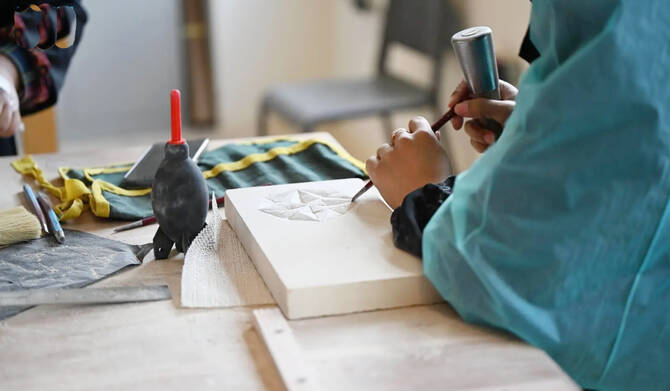
This heritage continues to resonate with AlUla’s residents today. Local interest in rock engraving has grown, with younger generations learning from ancient techniques while engaging with the craft through contemporary educational frameworks.
This transmission of knowledge reflects a broader effort to preserve tangible heritage alongside physical remains.
Specialized workshops and training programs support this work, led by cultural and educational institutions such as the Al-Deira School.
These initiatives focus on the history, methods and meanings behind the carvings, ensuring that skills and context are passed on accurately.
Through these efforts, AlUla’s rock engravings remain a living heritage that is rediscovered by new generations and continues to connect past with present.
Razan Abdullah Al-Saleh, a stone-carving artist and instructor, learned the craft through specialized training courses and now leads workshops in collaboration with the Royal Commission for AlUla at the Rock Inscriptions Academy in Jabal Ikmah, helping preserve and promote this traditional art.
Speaking to Arab News, Al-Saleh said stone carving is “one of the oldest artistic practices, and an essential part of our heritage because it carries forward the legacy of ancient civilizations.”
Historically, she explained, the craft relied on simple yet precise techniques, including striking stone with harder materials like basalt for carving, cutting, and abrasion, while volcanic pumice was used to smooth and finish surfaces.
Preserving the practice, Al-Saleh noted, delivers multiple cultural benefits, from safeguarding the craft itself and protecting the cultural identity linked to stone-carving traditions to supporting tourism and raising cultural awareness.
However, she added that the craft faces significant challenges today, including limited interest among learners, a shortage of workshops, and insufficient media and financial support.
To engage younger generations, Al-Saleh said the solution lies in expanding hands-on training opportunities and increasing visibility through media and social platforms, helping transform this heritage skill into both a cultural and economic opportunity.


