

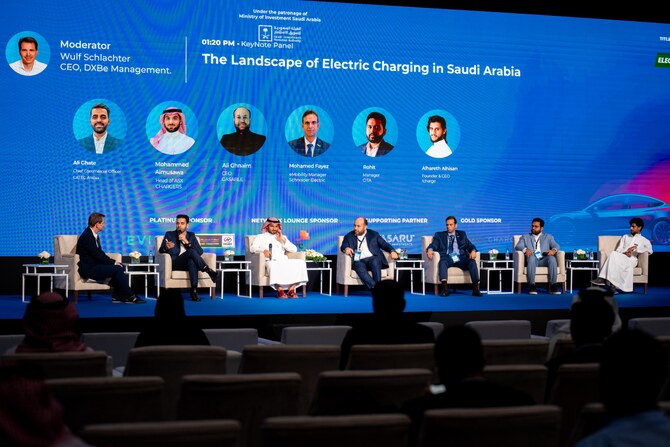
Saudi EV industry to advance significantly, top executives predict

Held in Riyadh on Sept. 18, the panel titled ‘The Landscape of Electric Charging in Saudi Arabia’ highlighted encouraging insights about the local community’s embrace of the Kingdom’s transition to EVs. AN photo
Short Url
Updated 18 September 2024
Follow

Saudi EV industry to advance significantly, top executives predict

RIYADH: Saudi Arabia’s electric vehicle industry is poised for substantial advancements in the coming years, according to officials during a panel discussion at the EV Auto Show.

Held in Riyadh on Sept. 18, the panel titled “The Landscape of Electric Charging in Saudi Arabia” featured Ali Ghnaim, CEO of Gasable, who shared encouraging insights about the local community’s embrace of the Kingdom’s transition to EVs.

“We find that the willingness to have an electric vehicle in Saudi Arabia at around 60 percent. Following our audience, and this is a very great percentage,” he noted.

During the same discussion, Mohammed Al-Musawa, head of ASX E-Mobility, emphasized the importance of collaboration among companies and dealerships. He stated: “The goal of this market is the dealership and then we complement the dealership with the charging infrastructure. So, everyone here plays a very vital role in just providing the facility or facilitating the infrastructure to the dealerships itself, to the end users, giving them the assurance that we will be there. We will give you the choices.”

Al-Musawa highlighted the Saudi government’s proactive stance on the future of EVs, saying, “From what I’ve seen, the push for the government, the money that is already on the table. We know that there will be a future for the EVs. So, dealerships here are trying to raise awareness, trying to set up the facilities. (The government is) trying to set up the infrastructure for the charging stations.”

Rohit Ramesh, manager at CITA EV and a panelist, spotlighted two of the Kingdom’s giga-projects, NEOM and The Red Sea, which are crucial to the EV sector. “So, the newer infrastructures, the new constructions that we are expecting from NEOM and Red Sea, all these sites already have these EV charger infrastructures in the development phase itself,” he said.

Saudi Arabia has already supported EV companies through its giga-project initiatives. In 2023, The Red Sea developed the largest off-grid EV charging network in the Kingdom, installing over 150 terminals to power 80 guest transport vehicles.

NEOM’s commitment to zero-carbon goals includes implementing shared autonomous and electric shuttles, which will enhance urban passenger mobility and feature a high-speed underground transit system.

The panel concluded with optimistic forecasts for the EV sector's future in Saudi Arabia. Ramesh remarked: “By 2030, the vision of Saudi Arabia would be seeing several charging stations across (the country), and it will be more seamless to travel within the region, and more electric vehicles will be coming into the market as well.”


RLC Global Forum helping retail experts exchange knowledge around new tech, industry leaders say

Updated 6 sec ago
Follow

RLC Global Forum helping retail experts exchange knowledge around new tech, industry leaders say

RIYADH: New technologies used to improve customer experience and day-to-day operations are driving Saudi Arabia’s retail transformation, industry leaders have told Arab News during a high-profile gathering in Riyadh.

On the sidelines of the RLC Global Forum, key players in the sector spoke to Arab News about how artificial intelligence is playing an increasingly important role as tech-savvy consumers look for integration between the virtual and physical worlds.

They also praised the role of the forum in bringing stakeholders together to exchange knowledge and ideas, which is driving forward retail offerings in the Kingdom and beyond.

The two-day RLC Global Forum started on Feb. 3 under the strategic theme “Growth Crossroads,” and brought together more than 2,000 global leaders, policymakers, and innovators from over 40 countries to define the next chapter of growth across retail, consumer, and lifestyle industries.

Speaking to Arab News, Majid Al-Gothmi, acting CEO of shopping centre management company Red Malls, said: “The Saudi retail sector is changing under Vision 2030. The transformation has helped our growth.”

He agreed that digital tools, AI, and new technologies are being used to improve customer experience and day-to-day operations.

“It’s helping us a lot in actually profiling our customers, understanding them, and providing better services to the younger generation,” said Al-Gothmi.

“Gen Z constitutes a major component of the retail market. We can see that 70 percent of the consumers are Gen-Z — they do most of their shopping online, over 60 percent of them,” he added, going on to say that his company’s focus is on “future proofing” shopping malls by integrating technology along with physical space that allows people to mingle comfortably and seamlessly.

Al-Gothmi described the RLC Global Forum as “an excellent platform gathering all the developers, retailers, brands, and most importantly, policymakers.”

He added: “This is a first, I think, where they share their insights, challenges, and exchange solutions, which helps the whole industry to move faster.”

Stefania Lazzaroni, CEO of Italian luxury brands association Altagamma Foundation, told Arab News that she expects steady growth for high-end products and experiences in the Kingdom.

She said: “There’s a new trend about hospitality, fine dining, longevity, and health spa beauty. These are the key factors that are growing. And we believe fine dining, hospitality and spa health as well will be a new trend even in this area. Honestly, they have been doing well for a couple of years.”

Stefania Lazzaroni, CEO of Altagamma Foundation. AN

Lazzaroni asserted that digital tools, AI and new technologies are being used to improve customer experience, as “the luxury client is very specific about what they want.”

She added: “Artificial intelligence is really perfect for us. We have a lot of counterfeiting all around the world, so technology can really support luxury brands in protecting their brands.

“So we are very pro artificial intelligence, which is changing the game and giving more strength and potential for luxury brands.”

The CEO explained that AI is also useful for talking to Gen Z, “which will be the clients of the future.”

She added: “So today with social media, TikTok, and so forth, there is an explosion of beauty, Gen Z is very much active on this.”

Abdel-Salam Bdeir, CEO at the Saudi Co. for Hardware, agreed that the retail sector is changing under Vision 2030 transformation.

He told Arab News: “We are building new technologies for AI to be used and demand planning and inventory optimization, marketing, and pricing optimization, margin, maximization.

“Even in security cameras, communication with customers, shopping behavior targeting certain sectors of customers, we are building all that as we speak.”

Bdeir believes technological progress brings both opportunities and challenges, among them the risk of fewer jobs.

He said: “With major international platforms entering the market, not only the jobs, but money goes to other markets. That’s why the United States, UK, France, Italy, Spain, and Germany put strict regulations on international platforms first to meet safety standards for the consumer and environmental standards, and second to secure jobs for locals.

“They also put higher tariffs, customs duties, on developing markets like India, Egypt, Turkiye, Brazil, Mexico, Vietnam, Indonesia, and Malaysia.”

Bdeir added: “So what is in my opinion, necessary is for the regulators to do what European countries and developing markets did to protect jobs, consumers and the economy.”