Saudi Arabia needs EV chargers every 100 km, says industry executive

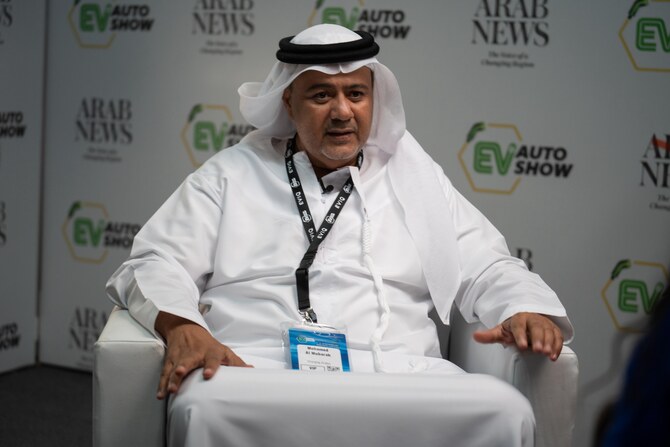
Mohamed Al-Mubarak, general manager of Charging Arabia. AN
Short Url
Updated 18 September 2024
Follow

Saudi Arabia needs EV chargers every 100 km, says industry executive

RIYADH: Saudi Arabia’s electric vehicle ecosystem requires charging stations every 100 km along highways to support its growth, said a senior executive.  

Speaking to Arab News at the EV Auto Show in Riyadh, Mohamed Al-Mubarak, general manager of Charging Arabia, emphasized that the widespread availability of refueling infrastructure is essential to reducing range anxiety, ultimately benefiting the e-mobility sector. 

This comes as Saudi Arabia aims to convert 30 percent of Riyadh’s vehicles to electric by 2030, as part of a broader strategy to cut emissions in the capital by 50 percent and achieve carbon neutrality by 2060.

Al-Mubarak said: “It is important to have it (EV charging stations) on highways, so people can travel with their cars. As you know, the electric car ranges between 300 to 400 km, now up to 500 km. At least every 100 km, there should be a charging station.”  

Charging Arabia, which operates in Europe, Asia, Africa, and Saudi Arabia, focuses on EV charging station operations, AC and DC charger installations, and mobile charging services. 

He said the company is concentrating on the Saudi market because “the government is helping people in the EV charging business.”  

Al-Mubarak added: “Although there are only 1,000 cars in the market, it is not a big number. But it’s on the right track, and I think it’s going with the vision. By 2030, I think there will be thousands of electric cars in Saudi.” 

He revealed that the company has partnered with Saudi-based charging manufacturer Alfanar to enhance the Kingdom’s EV infrastructure. 

“As a charging station operator, we need to have chargers everywhere — public places, petrol stations, shopping malls, and public parking — so people can charge their cars,” said Al-Mubarak. 

Currently, Charging Arabia operates two stations in Riyadh and plans to expand with over 100 facilities in the Eastern Province. Al-Mubarak also identified electricity load management as a challenge as the number of EVs grows. 

Al-Mubarak suggested that the government could implement a scheme to help individuals purchase home AC chargers, allowing them to charge their cars overnight and wake up with a fully charged vehicle. 


Egypt–Saudi power link set to boost regional energy integration, minister says 

Updated 22 February 2026
Follow

Egypt–Saudi power link set to boost regional energy integration, minister says 

RIYADH: Electricity interconnection projects between Egypt and Saudi Arabia will strengthen regional energy cooperation and economic integration, Egypt’s minister of electricity and renewable energy said during a visit to a key cross-border power facility. 

Mahmoud Esmat made the remarks while inspecting the Egypt–Saudi electricity interconnection station linking the two countries’ power grids, where he reviewed construction progress and equipment testing ahead of trial operations expected in the coming weeks, according to a statement from the Egyptian State Information Service. 

The project is described as the first of its kind in the Middle East in terms of scale, manufacturing technology, operation, and application in grid interconnection lines. 

The initiative supports the state’s broader vision to implement sustainable solutions aimed at ensuring the stability of the national unified grid and enhancing the reliability and quality of electricity supply. 

It also aligns with Egypt’s allocation of 136.3 billion Egyptian pounds ($2.8 billion) to the electricity and renewable energy sector in its 2025–26 development plan, nearly double the 72.6 billion pounds set aside the previous year. 

The plan focuses on diversifying energy sources, expanding renewable capacity, and strengthening the national grid to meet rising demand. 

The statement said: “The minister toured the station’s departments and control and operation center, following up on the completion of testing for all equipment and components in preparation for launching operations and synchronizing the project with the unified power grids of Egypt and Saudi Arabia in the coming weeks.” 

It added: “Esmat reviewed the implementation rate of the project and testing works, as well as the project’s timeline. He highlighted finalization of operational tests at the Badr transformer station and the Sakakin Taba 2 station, as well as the 500 kilovolts overhead transmission line extending approximately 320 km.”  

The minister said the project forms part of broader efforts to build an integrated power network connecting the two countries, facilitating efficient and flexible electricity exchange and laying the groundwork for a unified Arab electricity market. 

He added that the initiative reflects a clear vision and comprehensive strategy to strengthen the efficiency of the energy system while delivering both immediate and long-term solutions to safeguard grid stability and enhance service quality.