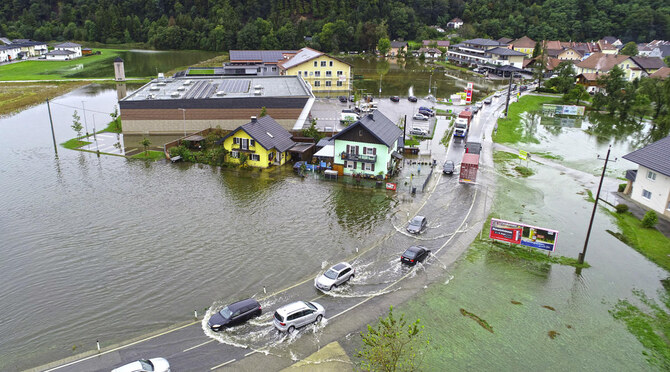
Rising rivers threaten southern Poland as flooding recedes elsewhere in Central Europe

High winds and unusually heavy rainfall have hit swathes of Austria, the Czech Republic, Hungary, Poland, Romania and Slovakia since Sept. 13, 2024. (AFP)
Short Url
Updated 18 September 2024
Follow

Rising rivers threaten southern Poland as flooding recedes elsewhere in Central Europe

  • Authorities have reported 23 deaths so far, with seven each in Poland and Romania, five in Austria and four in the Czech Republic
  • The combination of floods in Central Europe and deadly wildfires in Portugal are joint proof of a “climate breakdown”, the European Union’s head office said

WARSAW: Soldiers and volunteers in southwestern Poland were laying sandbags Wednesday near swollen rivers in the region of Wroclaw as they worked to safeguard homes and businesses after days of flooding across Central Europe.
Several Central European nations have been hit by severe flooding, including Austria, the Czech Republic, Poland and Romania as a result of a low pressure system that began dumping record rainfall in the region last Thursday.
Authorities have reported 23 deaths so far, with seven each in Poland and Romania, five in Austria and four in the Czech Republic.
The combination of floods in Central Europe and deadly wildfires in Portugal are joint proof of a “climate breakdown” that will become the norm unless drastic action is taken, the European Union’s head office said Wednesday.
The fourth death in the Czech Republic was reported Wednesday, when police said they found the body of a 70-year-old woman who was swept away by waters on Sunday in the town of Kobyla nad Vidnavkou near the town of Jesenik, located in the badly hit northeast.
The weather has improved, with warm and sunny conditions in the Czech Republic, Poland and elsewhere. Water levels were falling in some places, allowing authorities and residents to clean up debris.
Firefighters in Poland were pumping water out of flooded streets and basements. And in Romania, about 1,000 firefighters were working across the country to clean up severely affected areas, the General Inspectorate for Emergency Situations said Wednesday in a Facebook post.
But some areas are still facing a threat, particularly in southwestern Poland.
Soldiers and residents in Marcinkowice, near Wroclaw, were laying sandbags near a bridge over the Olawa River, whose waters flow into the Oder, the major river that rises in the Oder Mountains in the Czech Republic and runs north through Poland to Germany.
The community leader of the town of Olawa, Artur Piotrowski, described the situation as difficult. He told the Polish state news agency PAP that two villages in a low-lying area have been flooded since Monday and residents refused to evacuate.
Thousands of Polish soldiers were in action. Some evacuated people and animals — including dogs and horses — from flood-affected areas and distributed food and drinking water. The army also posted on X on Wednesday that it set up a field hospital in the town of Nysa after patients in a hospital there had to be evacuated earlier this week.
Experts have been preparing for flood threats due to the cresting Oder River in Opole, a city of some 130,000 residents, and Wroclaw, home to about 640,000 residents, which suffered disastrous flooding in 1997.


Only 4% women on ballot as Bangladesh prepares for post-Hasina vote

Updated 22 min 5 sec ago
Follow

Only 4% women on ballot as Bangladesh prepares for post-Hasina vote

  • Women PMs have ruled Bangladesh for over half of its independent history
  • For 2026 vote, only 20 out of 51 political parties nominated female candidates

DHAKA: As Bangladesh prepares for the first election since the ouster of its long-serving ex-prime minister Sheikh Hasina, only 4 percent of the registered candidates are women, as more than half of the political parties did not field female candidates.

The vote on Feb. 12 will bring in new leadership after an 18-month rule of the caretaker administration that took control following the student-led uprising that ended 15 years in power of Hasina’s Awami League party.

Nearly 128 million Bangladeshis will head to the polls, but while more than 62 million of them are women, the percentage of female candidates in the race is incomparably lower, despite last year’s consensus reached by political parties to have at least 5 percent women on their lists.

According to the Election Commission, among 1,981 candidates only 81 are women, in a country that in its 54 years of independence had for 32 years been led by women prime ministers — Hasina and her late rival Khaleda Zia.

According to Dr. Rasheda Rawnak Khan from the Department of Anthropology at Dhaka University, women’s political participation was neither reflected by the rule of Hasina nor Zia.

“Bangladesh has had women rulers, not women’s rule,” Khan told Arab News. “The structure of party politics in Bangladesh is deeply patriarchal.”

Only 20 out of 51 political parties nominated female candidates for the 2026 vote. Percentage-wise, the Bangladesh Socialist Party was leading with nine women, or 34 percent of its candidates.

The election’s main contender, the Bangladesh Nationalist Party, whose former leader Zia in 1991 became the second woman prime minister of a predominantly Muslim nation — after Pakistan’s Benazir Bhutto — was the party that last year put forward the 5 percent quota for women.

For the upcoming vote, however, it ended up nominating only 10 women, or 3.5 percent of its 288 candidates.

The second-largest party, Jamaat-e-Islami, has not nominated a single woman.

The 4 percent participation is lower than in the previous election in 2024, when it was slightly above 5 percent, but there was no decreasing trend. In 2019, the rate was 5.9 percent, and 4 percent in 2014.

“We have not seen any independent women’s political movement or institutional activities earlier, from where women could now participate in the election independently,” Khan said.

“Real political participation is different and difficult as well in this patriarchal society, where we need to establish internal party democracy, protection from political violence, ensure direct election, and cultural shifts around female leadership.”

While the 2024 student-led uprising featured a prominent presence of women activists, Election Commission data shows that this has not translated into their political participation, with very few women contesting the upcoming polls.

“In the student movement, women were recruited because they were useful, presentable for rallies and protests both on campus and in the field of political legitimacy. Women were kept at the forefront for exhibiting some sort of ‘inclusive’ images to the media and the people,” Khan said.

“To become a candidate in the general election, one needs to have a powerful mentor, money, muscle power, control over party people, activists, and locals. Within the male-dominated networks, it’s very difficult for women to get all these things.”