TOKYO: A Chinese aircraft carrier sailed between two Japanese islands near Taiwan for the first time, Japan’s military said Wednesday, in the latest move by Beijing to rile the close US ally.
The passage of a flotilla on Tuesday to Wednesday took place near a group of uninhabited islands disputed by Japan and China that have long been a source of friction.
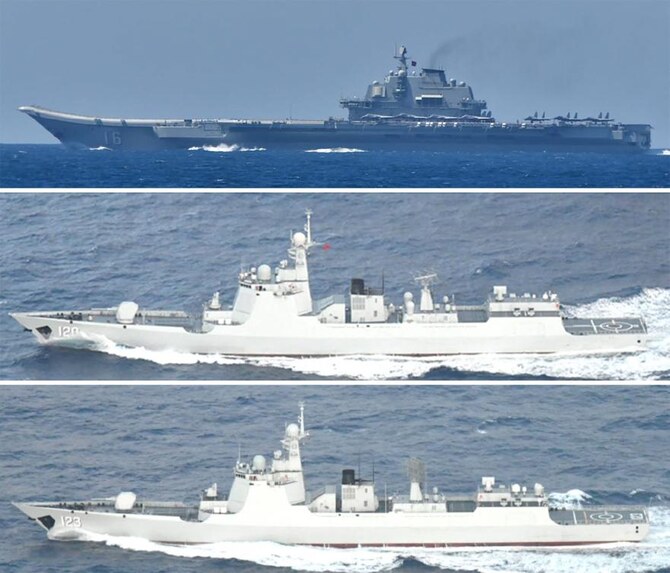
The Liaoning carrier and two Luyang III-class missile destroyers were seen sailing southwards between the islands of Yonaguni and Iriomote, the defense ministry’s joint staff said.
“This is the first time that an aircraft carrier belonging to the Chinese Navy has been confirmed to have sailed through the waters between Yonaguni and Iriomote,” a statement said.
Public broadcaster NHK and other media, citing unnamed defense sources, reported that it was the first time a Chinese aircraft carrier had entered Japan’s contiguous waters.
Contiguous waters are a 12-nautical-mile band that extends beyond territorial waters where a country can exert come control according to international maritime law.
The ministry was unable to immediately confirm the news reports.
Taipei’s government said earlier a Chinese naval formation led by the Liaoning sailed through waters northeast of self-ruled Taiwan on Wednesday and continued toward Japan’s Yonaguni Island.
China’s growing economic and military clout in the Asia-Pacific region and its assertiveness in territorial disputes — most recently with the Philippines — has rattled the United States and its allies.
Tense incidents have involved Japanese and Chinese vessels in disputed areas, in particular the Senkaku islands in the East China Sea, known by Beijing as the Diaoyus.
Tokyo has reported the presence of Chinese coast guard vessels, a naval ship, and a nuclear-powered submarine around the remote chain of islets.
In August, Japan scrambled fighter jets after the first confirmed incursion by a Chinese military aircraft into its airspace, with Tokyo calling it a “serious violation” of its sovereignty.
Japan is ramping up its defense spending with US encouragement, moving to acquire counter-strike capabilities and easing rules on arms exports.
Tokyo is also providing funding and equipment such as patrol vessels to other countries in the region.
In July, Japan agreed on a deal with the Philippines allowing troop deployments on each other’s soil.
Japan last week also scrambled fighter jets after Russian aircraft flew around the archipelago for the first time in five years.
The Tu-142 planes did not enter Japanese airspace but flew over an area subject to a territorial dispute between Japan and Russia, Japan said.
This month Russian and Chinese warships held joint drills in the Sea of Japan, part of a major naval exercise that President Vladimir Putin said was the largest of its kind for three decades.
The Japanese defense ministry said it had observed five Chinese naval ships entering the Sea of Japan and likely on their way to the joint maneuvers.


![]()

Chinese navy flotilla sails between Japanese islands near Taiwan
Short Url
https://arab.news/4zps2
Chinese navy flotilla sails between Japanese islands near Taiwan
Latest updates


© 2026 SAUDI RESEARCH & PUBLISHING COMPANY, All Rights Reserved And subject to Terms of Use Agreement.