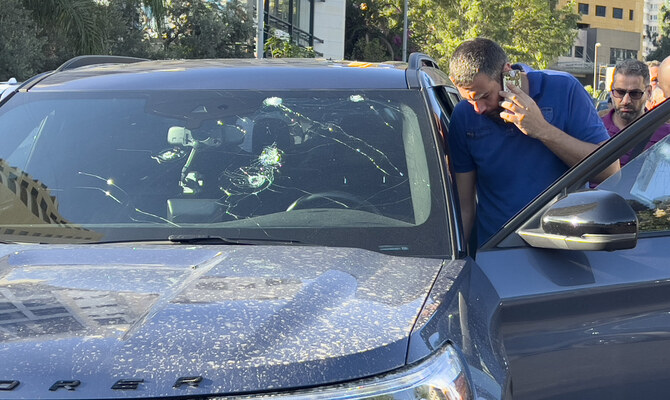
JERUSALEM: Hezbollah and the Lebanese government were quick to blame Israel for the nearly simultaneous detonation of hundreds of pagers used by the militant group’s members in an attack Tuesday that killed at least nine people and wounded nearly 3,000 others, according to officials.
Many of those hit were members of militant group Hezbollah, but it wasn’t immediately clear if others also carried the pagers. Among those killed were the son of a prominent Hezbollah politician and an 8-year-old girl, according to Lebanon’s health minister.
The attack came amid rising tensions between Israel and Iran-backed Hezbollah, which have exchanged fire across the Israel-Lebanon border since the Oct. 7 attack by Hamas that sparked the war in Gaza. Iran’s ambassador to Lebanon was among those injured by the pager explosions.
Israel rarely takes responsibility for such attacks, and its military declined to comment Tuesday. However, the country has a long history of carrying out sophisticated remote operations, ranging from intricate cyberattacks to remote-controlled machine guns targeting leaders in drive-by shootings, suicide drone attacks, and the detonation of explosions in secretive underground Iranian nuclear facilities.
Here is a look at previous operations that have been attributed to Israel:
July 2024
Two major militant leaders in Beirut and Tehran were killed in deadly strikes within hours of each other. Hamas said Israel was behind the assassination of its supreme leader, Ismail Haniyeh, in Iran’s capital. Although Israel didn’t acknowledge playing a role in that attack, it did claim responsibility for a deadly strike hours earlier on Fouad Shukur, a top Hezbollah commander in Beirut.
July 2024
Israel targeted Hamas’ shadowy military commander, Mohammed Deif, in a massive strike in the crowded southern Gaza Strip. The strike killed at least 90 people, including children, according to local health officials. The Israeli military said in August that Deif was killed in the attack, though Hamas previously claimed he survived.
April 2024
Two Iranian generals were killed in what Iran said was an Israeli strike on the Iranian consulate in Syria. The deaths led Iran to launch an unprecedented attack on Israel that involved about 300 missiles and drones, most of which were intercepted.
January 2024
An Israeli drone strike in Beirut killed Saleh Arouri, a top Hamas official in exile, as Israeli troops fight the militant group in Gaza.
December 2023
Seyed Razi Mousavi, a longtime adviser of the Iranian paramilitary Revolutionary Guard in Syria, was killed in a drone attack outside of Damascus. Iran blamed Israel.
2021
An underground nuclear facility in central Iran was hit with explosions and a devastating cyberattack that caused rolling blackouts. Iran accused Israel of carrying out the attack as well as several others against Iranian nuclear facilities using explosive drones in the ensuing years.
2020
In one of the most prominent assassinations targeting Iran’s nuclear program, a top Iranian military nuclear scientist, Mohsen Fakhrizadeh, was killed by a remote-controlled machine gun while traveling in a car outside Tehran. Iran blamed Israel.
2019
An Israeli airstrike hit the home of Bahaa Abu el-Atta, a senior Islamic Jihad commander in the Gaza Strip, killing him and his wife.
2012
Ahmad Jabari, head of Hamas’ armed wing, was killed when an airstrike targets his car. His death sparked an eight-day war between Hamas and Israel.
2010
The Stuxnet computer virus, discovered in 2010, disrupted and destroyed Iranian nuclear centrifuges. It was widely believed to be a joint US-Israeli creation.
2010
Mahmoud Al-Mabhouh, a top Hamas operative, was killed in a Dubai hotel room in an operation attributed to the Mossad spy agency but never acknowledged by Israel. Many of the 26 supposed assassins were caught on camera disguised as tourists.
2008
Imad Mughniyeh, Hezbollah’s military chief, was killed when a bomb planted in his car exploded in Damascus. Mughniyeh was accused of engineering suicide bombings during Lebanon’s civil war and of planning the 1985 hijacking of a TWA airliner in which a US Navy diver was killed. Hezbollah blamed his killing on Israel. His son Jihad Mughniyeh was killed in an Israeli strike in 2015.
2004
Hamas’ spiritual leader, Ahmed Yassin, was killed in an Israeli helicopter strike while being pushed in his wheelchair. Yassin, who was paralyzed in a childhood accident, was among the founders of Hamas in 1987. His successor, Abdel Aziz Rantisi, was killed in an Israeli airstrike less than a month later.
2002
Hamas’s second-highest military leader, Salah Shehadeh, was killed by a one-ton bomb dropped on an apartment building in Gaza City.
1997
Mossad agents tried to kill the head of Hamas at the time, Khaled Mashaal, in Amman, Jordan. Two agents entered Jordan using fake Canadian passports and poison Mashaal by placing a device near his ear. They were captured shortly afterward and Jordan’s king threatened to void a still-fresh peace accord if Mashaal died. Israel ultimately dispatched an antidote, and the Israeli agents were returned home. Mashaal remains a senior figure in Hamas.
1996
Yahya Ayyash, nicknamed the “engineer” for his mastery in building bombs for Hamas, was killed by answering a rigged phone in Gaza. His assassination triggered a series of deadly bus bombings in Israel.
1995
Islamic Jihad founder Fathi Shikaki was shot in the head in Malta in an assassination widely believed to have been carried out by Israel.
1988
Palestine Liberation Organization military chief Khalil Al-Wazir was killed in Tunisia. Better known as Abu Jihad, he had been PLO chief Yasser Arafat’s deputy. In 2012, military censors allowed an Israeli paper to reveal details of the Israeli raid for the first time.
1973
Israeli commandos shot a number of PLO leaders in their apartments in Beirut, in a nighttime raid led by Ehud Barak, who later became Israel’s top army commander and prime minister. The operation was part of a string of Israeli assassinations of Palestinian leaders that were carried out in retaliation for the killings of 11 Israeli coaches and athletes at the 1972 Munich Olympics.


![]()

Israel has a long history of pulling off complex attacks like the exploding pagers
Short Url
https://arab.news/v352t
Israel has a long history of pulling off complex attacks like the exploding pagers
- Israel rarely takes responsibility for such attacks, and its military declined to comment Tuesday


Latest updates


© 2026 SAUDI RESEARCH & PUBLISHING COMPANY, All Rights Reserved And subject to Terms of Use Agreement.