Eid Milad-un-Nabi: Pakistan vows to shape education system on teachings of Prophet Muhammad 

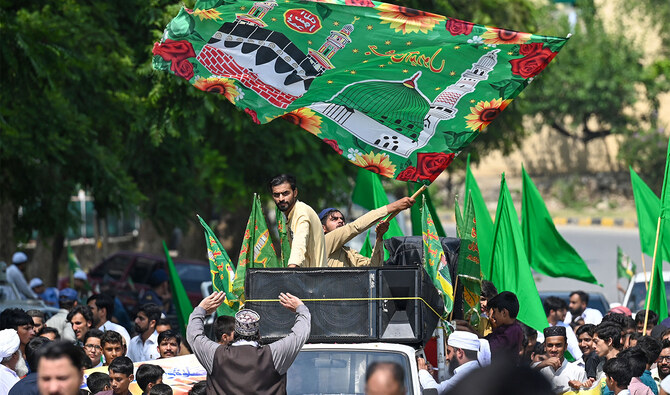
Sunni Muslims wave religious flags as they take part in a rally to celebrate Eid-e-Milad-un-Nabi, the birthday of Prophet Mohammed, in Islamabad on September 17, 2024. (AFP)
Short Url
Updated 17 September 2024
Follow

Eid Milad-un-Nabi: Pakistan vows to shape education system on teachings of Prophet Muhammad 

  • Birth anniversary of prophet (pbuh) is celebrated world over on 12th of the Islamic month of Rabi Al-Awwal
  • Day dawned with 31-gun salute in federal capital of Islamabad, 21-gun salutes in all provincial capitals

ISLAMABAD: A National Seerat Conference organized by the Ministry of Religious Affairs and Interfaith Harmony was held today, Tuesday, in Islamabad on the occasion of Eid Milad-un-Nabi, Radio Pakistan reported, with top leaders urging reform in the Pakistani education sector based on the teachings of Islam and Prophet Muhammad (Peace Be Upon Him).

Eid Milad-un-Nabi is celebrated world over on the 12th of the Islamic month of Rabi Al-Awwal. In Pakistan, the day dawned with a 31-gun salute in the Pakistani federal capital of Islamabad and a 21-gun salute in all provincial capitals.

“Minister for Religious Affairs and Interfaith Harmony, Chaudhry Salik Hussain, on Tuesday emphasized the importance of following the teachings of the Holy Prophet Muhammad (Peace Be Upon Him) to enlighten the daily lives and strengthen the moral fabric of society,” Radio Pakistan said, reporting on the minister’s comments at the opening ceremony of the Seerat Conference.

“Minister Salik … noted that this year’s conference theme, “The Educational System of the State in Light of Seerat-un-Nabi (Peace Be Upon Him)”, highlights the Prophet’s exemplary leadership and governance, which transformed Madina into a welfare state based on education and wisdom.”

In his speech, Minister Salik emphasized the critical need for an education system inspired by Islamic values that not only “focuses on intellectual growth but also moral and spiritual development.”

He recalled the prophet’s first divine command, ‘Iqra’ (Read), underscoring the importance of knowledge as a foundation for human civilization and progress, adding that the inclusion of ethical teachings, such as honesty, justice, and responsibility, into the educational curriculum was “vital for fostering a balanced and well-rounded society.”

“Minister Salik said the key point that shook the very roots of feudalism, inequality, and injustice is the fundamental right to education for all of humanity, without discrimination,” Radio Pakistan said. “The Holy Prophet (Peace Be Upon Him) advocated for every person’s right to acquire knowledge, whether male or female, regardless of race or social status.”

The curriculum should be designed to balance religious and worldly knowledge, Salik said, and subjects like science, mathematics, and history should be taught alongside the Qur’an, Hadith, and Fiqh to ensure a well-rounded education for students.

“The role of technology in the education system cannot be overlooked … The principles taught by the Prophet (Peace Be Upon Him), such as utilizing all available resources to acquire and disseminate knowledge, are still applicable today,” Salik added. “Integrating technology into the education system can make knowledge more accessible and engaging.”

The Seerat-un-Nabi Conference is an annual event organized by the Ministry of Religious Affairs to encourage research and discussion on the various aspects of the life of the prophet and their application in modern times.

Earlier in the day, President Asif Ali Zardari and Prime Minister Shehbaz Sharif urged the nation and the Muslim Ummah to follow the teachings of the prophet as a “guiding light to overcome prevailing challenges.”

In his message, Zardari called on Pakistanis to use the life of the prophet as a “source of guidance” and spread his message of love and compassion for all mankind. In a separate message, the PM said the “blessed life, noble character, and exemplary conduct of Holy Prophet Muhammad (pbuh) serves as a beacon of light for entire humanity.”

Streets, roads, buildings, mosques, and houses around the country were decorated with colorful lights on Monday night and milad processions will be taken out in all cities today, Tuesday. 

Mehfil-e-Milad are also being organized in all small and major cities to highlight the life and teachings of the last prophet.


Pakistan urges concessional finance for developing nations to boost clean energy security

Updated 11 January 2026
Follow

Pakistan urges concessional finance for developing nations to boost clean energy security

  • Pakistan has emerged as one of world’s fastest growing solar markets, with 12GWs of off-grid and 6GWs of net-metered capacity in 2025
  • PM’s aide says Islamabad remains committed to Paris Agreement, looks for continued support in building a resilient and low-carbon future

ISLAMABAD: Pakistan has urged international partners to scale up concessional financing for developing countries, the country’s Press Information Department (PID) said on Sunday, citing an aide to Prime Minister Shehbaz Sharif.

The call was made by Sharif’s coordinator on climate change, Romina Khurshid Alam, while delivering Pakistan’s national statement at the 16th International Renewable Energy Agency (IRENA) Assembly in Abu Dhabi.

Pakistan has emerged as one of the world’s fastest growing solar markets, with 12 gigawatts (GWs) of off-grid and over 6GWs of net-metered solar capacity by the end of 2025. Last fiscal year, renewables accounted for a historic 53 percent of total electricity generation, according to Alam.

The prime minister’s aide stressed that affordable funding for developing nations is critical to accelerating their transition to clean energy and strengthening energy security amid rising climate and economic challenges.

“Alam reaffirmed Pakistan’s target of achieving 60 percent renewables in the power mix by 2030,” the PID said in a statement.

“In her call to action, she urged IRENA and Member States to increase concessional finance for developing nations, treat technologies such as energy storage and green hydrogen as global public goods, and strengthen regional cooperation for shared energy security.”

IRENA is a global intergovernmental agency for energy transformation that serves as the principal platform for international cooperation, supports countries in their energy transition, and provides state of the art data and analyzes on technology, innovation, policy, finance and investment. Its membership comprises 170 countries and the European Union (EU).

The 16th session of the IRENA Assembly is taking place on Jan. 10-12 in Abu Dhabi and focuses on the theme of “Powering Humanity: Renewable Energy for Shared Prosperity.” The session has gathered global leaders and energy decision-makers to discuss strategies and underline necessary actions for the acceleration of renewable energy across countries, regions, and the world, driving economic inclusion, equity, and human well-being.

Alam shared that Pakistan is taking action against energy poverty through initiatives like the Punjab Solar Panel Scheme 2026, which provides free or subsidized systems to low-income households.

She highlighted how distributed solar kits have restored power and livelihoods in flood-affected communities and offer a replicable model for climate-resilient recovery.

“Pakistan remains fully committed to the Paris Agreement and looks to IRENA for continued technical and financial support in building a resilient, inclusive, and low-carbon future,” Alam said.

Adopted in 2015 to combat climate change, the Paris Agreement binds nations to hold “the increase in the global average temperature to well below 2°C above pre-industrial levels” and pursue efforts “to limit the temperature increase to 1.5°C above pre-industrial levels.”