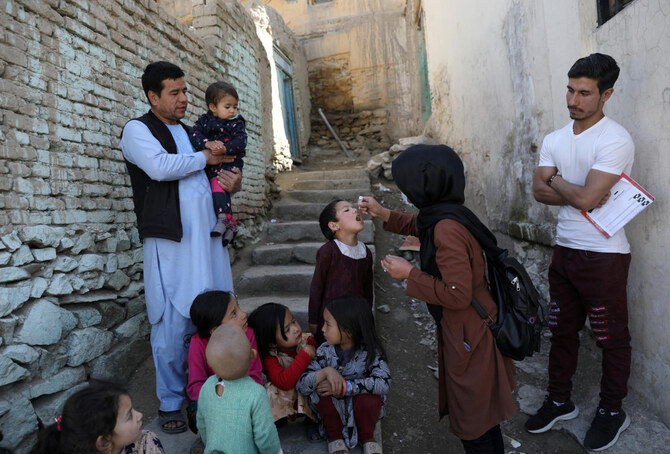
DUBAI: The Taliban have suspended polio vaccination campaigns in Afghanistan, the UN said Monday. It’s a devastating setback for polio eradication, since the virus is one of the world’s most infectious and any unvaccinated groups of children where the virus is spreading could undo years of progress.
Afghanistan is one of two countries in which the spread of the potentially fatal, paralyzing disease has never been stopped. The other is Pakistan. It’s likely that the Taliban’s decision will have major repercussions for other countries in the region and beyond.
News of the suspension was relayed to UN agencies right before the September immunization campaign was due to start. No reason was given for the suspension, and no one from the Taliban-controlled government was immediately available for comment.
A top official from the World Health Organization said it was aware of discussions to move away from house-to-house vaccinations and instead have immunizations in places like mosques.
The WHO has confirmed 18 polio cases in Afghanistan this year, all but two in the south of the country. That’s up from six cases in 2023.
“The Global Polio Eradication Initiative is aware of the recent policy discussions on shifting from house-to-house polio vaccination campaigns to site-to-site vaccination in parts of Afghanistan,” said Dr. Hamid Jafari from the WHO. “Partners are in the process of discussing and understanding the scope and impact of any change in current policy.”
Polio campaigns in neighboring Pakistan are regularly marred by violence. Militants target vaccination teams and police assigned to protect them, falsely claiming that the campaigns are a Western conspiracy to sterilize children.
As recently as August, the WHO reported that Afghanistan and Pakistan were continuing to implement an “intensive and synchronized campaign” focusing on improved vaccination coverage in endemic zones and an effective and timely response to detections elsewhere.
During a June 2024 nationwide campaign, Afghanistan used a house-to-house vaccination strategy for the first time in five years, a tactic that helped to reach the majority of children targeted, the WHO said.
But southern Kandahar province, the base of Taliban supreme leader Hibatullah Akhundzada, used site-to-site or mosque-to-mosque vaccination campaigns, which are less effective than going to people’s homes.
Kandahar continues to have a large pool of susceptible children because it is not carrying out house-to-house vaccinations, the WHO said. “The overall women’s inclusion in vaccination campaigns remains around 20 percent in Afghanistan, leading to inadequate access to all children in some areas,” it said.
Any setback in Afghanistan poses a risk to the program in Pakistan due to high population movement, the WHO warned last month.
Pakistani health official Anwarul Haq said the polio virus would eventually spread and continue affecting children in both countries if vaccination campaigns aren’t run regularly and in a synchronized manner.
“Afghanistan is the only neighbor from where Afghan people in large numbers come to Pakistan and then go back,” said Haq, the coordinator at the National Emergency Operation Center for Polio Eradication. “People from other neighboring countries, like India and Iran, don’t come to Pakistan in large numbers.”
There needs to be a united effort to eliminate the disease, he told The Associated Press.
The campaign suspension is the latest obstacle in what has become a problematic global effort to stop polio. The initiative, which costs about $1 billion every year, has missed multiple deadlines to wipe out the disease and technical mistakes in the vaccination strategy set by WHO and partners have been costly.
The oral vaccine has also inadvertently seeded outbreaks in dozens of countries across Africa, Asia and the Middle East and now accounts for the majority of polio cases worldwide.
This was seen most recently in Gaza, where a baby was partially paralyzed by a mutated strain of polio first seen in the oral vaccine, marking the territory’s first case in more than 25 years.


![]()

The Taliban have suspended polio vaccination campaigns in Afghanistan, the UN says
Short Url
https://arab.news/gktpz
The Taliban have suspended polio vaccination campaigns in Afghanistan, the UN says
- News of the suspension was relayed to UN agencies right before the September immunization campaign was due to start
- No reason was given for the suspension, and no one from the Taliban-controlled government was immediately available for comment.


Latest updates


© 2026 SAUDI RESEARCH & PUBLISHING COMPANY, All Rights Reserved And subject to Terms of Use Agreement.