STOCKHOLM: Sweden is ready to manage a future NATO land force in neighboring Finland, which shares a border with Russia, the two newest members of the military alliance announced on Monday.
The two Nordic nations dropped decades of military non-alignment and applied for NATO membership in the wake of Russia’s invasion of Ukraine in February 2022.
Finland become a member in 2023 and Sweden this year.
NATO said in July that a so-called Forward Land Forces (FLF) presence should be developed in Finland, which shares a 1,340-kilometer (830-mile) border with Russia.
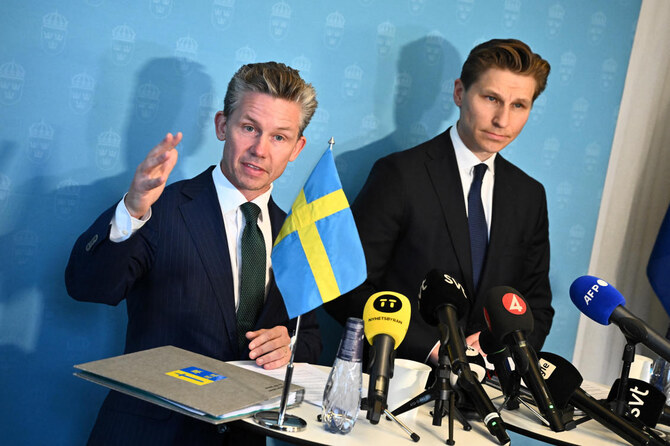
“This kind of military presence in a NATO country requires a framework nation which plays an important role in the implementation of the concept,” Finnish Defense Minister Antti Hakkanen told a press conference.
The countries said Finland had asked Sweden to manage the force.
“The Swedish government has the ambition to take the role as a framework nation for a forward land force in Finland,” Hakkanen’s Swedish counterpart Pal Jonson told reporters.
Jonson stressed the process was still in an “early stage” and details would be worked out inside NATO.
There would also be further consultations with the Swedish parliament, he said.
Hakkanen said details about the actual force would be clarified through planning with other NATO members, adding that the number of troops and their exact location had not yet been decided.
NATO says it currently has eight such forward presences, or “multinational battlegroups,” in Eastern Europe — in Bulgaria, Estonia, Hungary, Latvia, Lithuania, Poland, Romania and Slovakia.

Sweden says willing to lead NATO presence in Finland
https://arab.news/myx48
Sweden says willing to lead NATO presence in Finland
- The two Nordic nations dropped decades of military non-alignment and applied for NATO membership in the wake of Russia’s invasion of Ukraine in February 2022
- The countries said Finland had asked Sweden to manage the force
France’s Le Pen insists party acted in ‘good faith’ at EU fraud appeal
- Le Pen said on her second day of questioning that even if her party broke the law, it was unintentional
- She also argued that the passage of time made it “extremely difficult” for her to prove her innocence
PARIS: French far-right leader Marine Le Pen told an appeals trial on Wednesday that her party acted in “good faith,” denying an effort to embezzle European Parliament funds as she fights to keep her 2027 presidential bid alive.
A French court last year barred Le Pen, a three-time presidential candidate from the far-right National Rally (RN), from running for office for five years over a fake jobs scam at the European institution.
It found her, along with 24 former European Parliament lawmakers, assistants and accountants as well as the party itself, guilty of operating a “system” from 2004 to 2016 using European Parliament funds to employ party staff in France.
Le Pen — who on Tuesday rejected the idea of an organized scheme — said on her second day of questioning that even if her party broke the law, it was unintentional.
“We were acting in complete good faith,” she said in the dock on Wednesday.
“We can undoubtedly be criticized,” the 57-year-old said, shifting instead the blame to the legislature’s alleged lack of information and oversight.
“The European Parliament’s administration was much more lenient than it is today,” she said.
Le Pen also argued that the passage of time made it “extremely difficult” for her to prove her innocence.
“I don’t know how to prove to you what I can’t prove to you, what I have to prove to you,” she told the court.
Eleven others and the party are also appealing in a trial to last until mid-February, with a decision expected this summer.
- Rules were ‘clear’ -
Le Pen was also handed a four-year prison sentence, with two years suspended, and fined 100,000 euros ($116,000) in the initial trial.
She now again risks the maximum sentence of 10 years in prison and a one-million-euro ($1.16 million) fine if the appeal fails.
Le Pen is hoping to be acquitted — or at least for a shorter election ban and no time under house arrest.
On Tuesday, Le Pen pushed back against the argument that there was an organized operation to funnel EU funds to the far-right party.
“The term ‘system’ bothers me because it gives the impression of manipulation,” she said.
EU Parliament official Didier Klethi last week said the legislature’s rules were “clear.”
EU lawmakers could employ assistants, who were allowed to engage in political activism, but this was forbidden “during working hours,” he said.
If the court upholds the first ruling, Le Pen will be prevented from running in the 2027 election, widely seen as her best chance to win the country’s top job.
She made it to the second round in the 2017 and 2022 presidential polls, before losing to Emmanuel Macron. But he cannot run this time after two consecutive terms in office.


