Tech billionaire returns to Earth after first private spacewalk

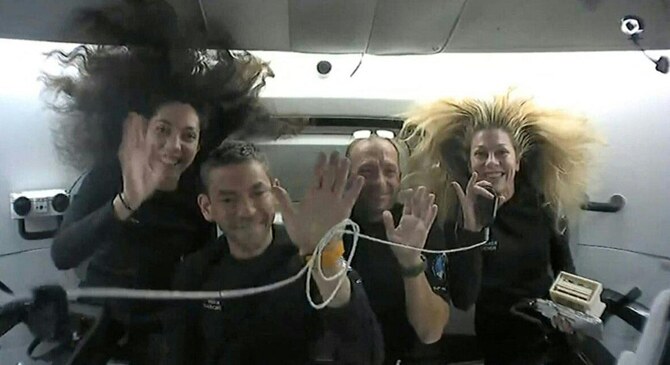
This still image taken from the Polaris Dawn crew on September 13, 2024, shows the SpaceX Polaris Dawn crew Jared Isaacman, Mission Commander, Anna Menon, Mission Specialist and Medical Officer, Sarah Gillis, Mission Specialist, and Scott Poteet, Mission pilot, during the SpaceX Polaris Dawn mission. (AFP)
Short Url
Updated 15 September 2024
Follow

Tech billionaire returns to Earth after first private spacewalk

CAPE CANAVERAL, Florida: A billionaire spacewalker returned to Earth with his crew on Sunday, ending a five-day trip that lifted them higher than anyone has traveled since NASA’s moonwalkers.
SpaceX’s capsule splashed down in the Gulf of Mexico near Florida’s Dry Tortugas in the predawn darkness, carrying tech entrepreneur Jared Isaacman, two SpaceX engineers and a former Air Force Thunderbird pilot.
They pulled off the first private spacewalk while orbiting nearly 460 miles (740 kilometers) above Earth, higher than the International Space Station and Hubble Space Telescope. Their spacecraft hit a peak altitude of 875 miles (1,408 kilometers) following Tuesday’s liftoff.
Isaacman became only the 264th person to perform a spacewalk since the former Soviet Union scored the first in 1965, and SpaceX’s Sarah Gillis the 265th. Until now, all spacewalks were done by professional astronauts.
During Thursday’s commercial spacewalk, the Dragon capsule’s hatch was open barely a half-hour. Isaacman emerged only up to his waist to briefly test SpaceX’s brand new spacesuit followed by Gillis, who was knee high as she flexed her arms and legs for several minutes. Gillis, a classically trained violinist, also held a performance in orbit earlier in the week.
The spacewalk lasted less than two hours, considerably shorter than those at the International Space Station. Most of that time was needed to depressurize the entire capsule and then restore the cabin air. Even SpaceX’s Anna Menon and Scott “Kidd” Poteet, who remained strapped in, wore spacesuits.
SpaceX considers the brief exercise a starting point to test spacesuit technology for future, longer missions to Mars.
This was Isaacman’s second chartered flight with SpaceX, with two more still ahead under his personally financed space exploration program named Polaris after the North Star. He paid an undisclosed sum for his first spaceflight in 2021, taking along contest winners and a pediatric cancer survivor while raising more than $250 million for St. Jude Children’s Research Hospital.
For the just completed so-called Polaris Dawn mission, the founder and CEO of the Shift4 credit card-processing company shared the cost with SpaceX. Isaacman won’t divulge how much he spent.


Thai officials say 72 tigers at tourist parks died of canine distemper, allaying bird flu fears

Updated 9 sec ago
Follow

Thai officials say 72 tigers at tourist parks died of canine distemper, allaying bird flu fears

  • “There has not been an animal-to-human infection case,” Promphat said
  • “If we detect any sick persons, we will prepare for a nationwide monitoring measure,” said Khanasawat

BANGKOK: The deaths of 72 tigers in two animal parks for tourists in northern Thailand shouldn’t be a major concern for the public, officials said Tuesday, because they were caused by a virus not known to affect humans, rather than bird flu.
No one has shown any symptoms so far, but authorities were nonetheless monitoring the health of people who had recently come into contact with the animals.
“There has not been an animal-to-human infection case,” Public Health Minister Pattana Promphat said at a news conference at Government House in Bangkok.
The tigers in the parks in Mae Taeng and Mae Rim districts in Chiang Mai province became sick and died during a roughly 10-day period between Feb. 8-18.
On Friday, the Chiang Mai regional livestock office announced in a statement that autopsies of the animals found genetic material of canine distemper virus, or CDV, and traces of bacterial infection, but no avian influenza type A virus, also known as bird flu.
“If we detect any sick persons, we will prepare for a nationwide monitoring measure,” said Monthien Khanasawat, director-general of the Public Health Ministry’s Disease Control Department. “This will include contact tracing and treatment as necessary.”
Monthien spoke at the news conference in an apparent effort to reassure the public that the tigers’ deaths didn’t come from bird flu, which has been resurgent in parts of Asia. Thailand saw 17 deaths among 25 infected patients from poultry-caused influenza from 2004 to 2007, according to the Public Health Ministry.
CDV, infectious for both dogs and felines, can cause stronger symptoms in cats and tigers and can be spread through bodily fluids and air. Thai authorities said that tigers in confined environments, and which are already affected by stress and inbreeding conditions, could be particularly vulnerable to the viral infection.
The remains of the tigers went through necropsies before being cremated and buried. The carcasses were properly disinfected, photographed and discarded to prevent any further use, Livestock Development Department Director-General Somchuan Rattanamangklanan said at the news conference.
But Visit Arsaithamkul, a veterinarian who took part in the tiger necropsies, expressed concern that the origins of the infections remained unclear without further investigation. In a Facebook post, he said that he suspected that as the two parks were located just 30 kilometers (18 miles) apart, the cause of infection could be food the tigers were fed that came from the same source.
He declined to elaborate when contacted by The Associated Press. Both parks, run under the name of Tiger Kingdom, remain closed. The operators didn’t immediately respond when asked for comment.
Thai authorities are still alert for the threat of a bird flu outbreak. Monthien, the Public Health Ministry director, urged Thais to be careful with their consumption of poultry after a man in a neighboring country that he didn’t name was found infected with bird flu.
The first animal-to-human transmission of bird flu was discovered in Hong Kong in 1997 before a pandemic started spreading in Asia in 2003. In Thailand, tens of millions of poultry were exterminated and consumption plunged in fear of getting infected.