

Salvagers launch new attempt to tow an oil tanker blown up by Yemen’s Houthis
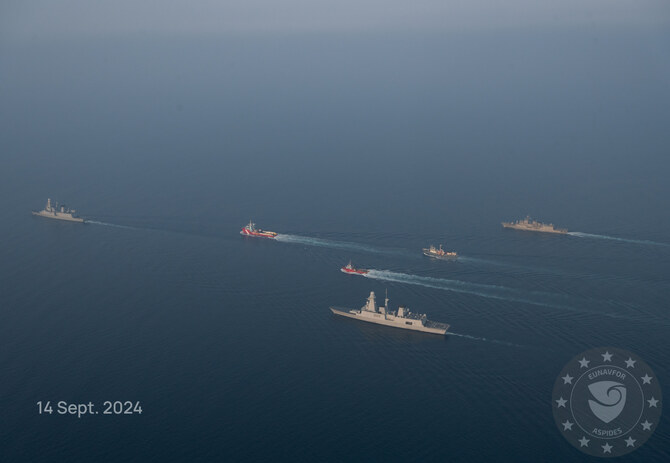
EU’s Operation Aspides published images dated Saturday of its vessels escorting ships heading to the Greek-flagged oil tanker Sounion
Updated 14 September 2024
AP
DUBAI: A new attempt has begun to try to salvage an oil tanker burning in the Red Sea after attacks by Yemen’s Houthis, a European Union naval mission said Saturday.
The EU’s Operation Aspides published images dated Saturday of its vessels escorting ships heading to the Greek-flagged oil tanker Sounion.
The mission has “been actively involved in this complex endeavor, by creating a secure environment, which is necessary for the tugboats to conduct the towing operation,” the EU said.
A phone number for the mission rang unanswered Saturday.
Update on MV SOUNION salvage status
The salvage operation of the MV SOUNION is essential in order to avert a potential environmental disaster in the region. To achieve this, several public and private actors are working together.
The Sounion came under attack from the Houthis beginning Aug. 21. The vessel had been staffed by a crew of 25 Filipinos and Russians, as well as four private security personnel, who were taken by a French destroyer to nearby Djibouti.
The Houthis later planted explosives aboard the ship and detonated them. That’s led to fears the ship’s 1 million barrels of crude oil could spill into the Red Sea.
The Houthis have targeted more than 80 vessels with missiles and drones since the war in Gaza started in October. They seized one vessel and sank two in the campaign that also killed four sailors. One of the sunken vessels, the Tutor, went down after the Houthis planted explosives aboard it and after its crew abandoned it due to an earlier attack, the militia later acknowledged.
Other missiles and drones have either been intercepted by a US-led coalition in the Red Sea or failed to reach their targets.
The militia maintain that they target ships linked to Israel, the US or the UK to force an end to Israel’s campaign against Hamas in Gaza. However, many of the ships attacked have little or no connection to the conflict, including some bound for Iran.
Syrian military tells civilians to evacuate contested area east of Aleppo amid rising tensions
Syria’s military has announced it will open a “humanitarian corridor” for civilians to evacuate from an area in Aleppo province
This follows several days of intense clashes between government forces and the Kurdish-led Syrian Democratic Forces
Updated 3 sec ago
AP
DAMASCUS: Syria’s military said it would open a corridor Thursday for civilians to evacuate an area of Aleppo province that has seen a military buildup following intense clashes between government and Kurdish-led forces in Aleppo city. The army’s announcement late Wednesday — which said civilians would be able to evacuate through the “humanitarian corridor” from 9 a.m. to 5 p.m. Thursday — appeared to signal plans for an offensive in the towns of Deir Hafer and Maskana and surrounding areas, about 60 kilometers (40 miles) east of Aleppo city. The military called on the Kurdish-led Syrian Democratic Forces and other armed groups to withdraw to the other side of the the Euphrates River, to the east of the contested zone. Syrian government troops have already sent troop reinforcements to the area after accusing the SDF of building up its own forces there, which the SDF denied. There have been limited exchanges of fire between the two sides, and the SDF has said that Turkish drones carried out strikes there. The government has accused the SDF of launching drone strikes in Aleppo city, including one that hit the Aleppo governorate building on Saturday shortly after two Cabinet ministers and a local official held a news conference there. The tensions in the Deir Hafer area come after several days of intense clashes last week in Aleppo city that ended with the evacuation of Kurdish fighters and government forces taking control of three contested neighborhoods. The fighting killed at least 23 people, wounded dozens more, and displaced tens of thousands. The fighting broke out as negotiations have stalled between Damascus and the SDF, which controls large swaths of northeast Syria, over an agreement to integrate their forces and for the central government to take control of institutions including border crossings and oil fields in the northeast. Some of the factions that make up the new Syrian army, which was formed after the fall of former President Bashar Assad in a rebel offensive in December 2024, were previously Turkiye-backed insurgent groups that have a long history of clashing with Kurdish forces. The SDF for years has been the main US partner in Syria in fighting against the Daesh group, but Turkiye considers the SDF a terrorist organization because of its association with the Kurdistan Workers’ Party, or PKK, which has waged a long-running insurgency in Turkiye. A peace process is now underway. Despite the long-running US support for the SDF, the Trump administration has also developed close ties with the government of interim Syrian President Ahmad Al-Sharaa and has pushed the Kurds to implement the integration deal. Washington has so far avoided publicly taking sides in the clashes in Aleppo. The SDF in a statement warned of “dangerous repercussions on civilians, infrastructure, and vital facilities” in case of a further escalation and said Damascus bears “full responsibility for this escalation and all ensuing humanitarian and security repercussions in the region.” Adm. Brad Cooper, commander of US Central Command, said in a statement Tuesday that the US is “closely monitoring” the situation and called for “all parties to exercise maximum restraint, avoid actions that could further escalate tensions, and prioritize the protection of civilians and critical infrastructure.” He called on the parties to “return to the negotiating table in good faith.” Al-Sharaa blasts the SDF In a televised interview aired Wednesday, Al-Sharaa praised the “courage of the Kurds” and said he would guarantee their rights and wants them to be part of the Syrian army, but he lashed out at the SDF. He accused the group of not abiding by an agreement reached last year under which their forces were supposed to withdraw from neighborhoods they controlled in Aleppo city and of forcibly preventing civilians from leaving when the army opened a corridor for them to evacuate amid the recent clashes. Al-Sharaa claimed that the SDF refused attempts by France and the US to mediate a ceasefire and withdrawal of Kurdish forces during the clashes due to an order from the PKK. The interview was initially intended to air Tuesday on Shams TV, a broadcaster based in Irbil — the seat of northern Iraq’s semi-autonomous Kurdish region — but was canceled for what the station initially said were technical reasons. Later the station’s manager said that the interview had been spiked out of fear of further inflaming tensions because of the hard line Al-Sharaa took against the SDF. Syria’s state TV station instead aired clips from the interview on Wednesday. There was no immediate response from the SDF to Al-Sharaa’s comments.