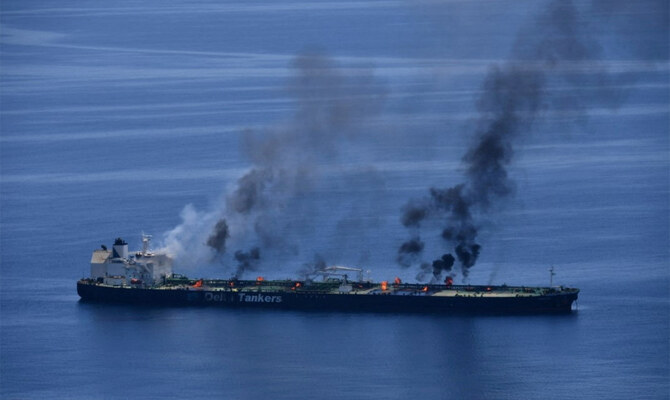
WASHINGTON: The Greek-flagged crude oil tanker Sounion that was recently attacked by Yemen’s Houthis is still on fire in the Red Sea and now appears to be leaking oil, a Pentagon spokesman said on Tuesday.
The Sounion was targeted last week by multiple projectiles off Yemen’s port city of Hodeidah. The Houthis, who control Yemen’s most populous regions, said they attacked it in the Red Sea, as the Iran-aligned group has been attacking ships in solidarity with Palestinians in the war between Israel and Hamas in Gaza.
Pentagon spokesman Air Force Major General Patrick Ryder said that a third party had tried to send two tugs to help salvage the Sounion, but the Houthis threatened to attack them. He said the tanker was carrying about 1 million barrels of crude oil.
“These are simply reckless acts of terrorism which continue to destabilize global and regional commerce, put the lives of innocent civilian mariners at risk and imperil the vibrant maritime ecosystem in the Red Sea and Gulf of Aden, the Houthis’ own backyard,” Ryder added.
The Sounion was the third vessel operated by Athens-based Delta Tankers to be attacked in the Red Sea this month. The attack caused a fire onboard, which the crew extinguished, Delta Tankers said in a statement.

Greek-flagged oil tanker Sounion appears to be leaking oil, Pentagon says
Short Url
https://arab.news/jr4px
Greek-flagged oil tanker Sounion appears to be leaking oil, Pentagon says
- The Sounion was the third vessel operated by Athens-based Delta Tankers to be attacked in the Red Sea this month
Japan protests after a Chinese military aircraft locks its radar on Japanese jets
TOKYO: Japan said early Sunday that it has protested to China after a military jet that took off from the Chinese carrier Liaoning locked its radar on Japanese fighter jets near the southern island of Okinawa, the latest spat between the two countries whose ties have plunged recently over the Japanese leader’s Taiwan remarks.
Japan’s Defense Ministry said China’s military aircraft J-15 “intermittently” targeted its radar at Japanese F-15 fighter jets on two occasions Saturday — for about three minutes in the late afternoon and for about 30 minutes in the evening.
The radar lock by the Chinese aircraft was detected by different Japanese fighters that had scrambled against a possible airspace violation by China, according to the ministry. There was no breach of Japanese airspace, and no injury or damage was reported from the incident.
It was not known whether the radar lock incident involved the same Chinese J-15 both times.
Defense Minister Shinjiro Koizumi, briefing reporters in the early hours of Sunday, said Japan protested to China over the radar lock, calling it “a dangerous act that exceeded the scope necessary for safe aircraft operations.”
“The occurrence of such an incident is extremely regrettable,” Koizumi said. “We have lodged a strong protest with the Chinese side and demanded strict preventive measures.”
There was no immediate comment from the Chinese government or military. On Friday, Foreign Ministry spokesperson Lin Jian said the Chinese navy operates in accordance with international law and that others shouldn’t hype up its activities.
The latest incident comes as relations between the two countries have worsened in recent weeks.
China was angered by a statement by Japan’s Prime Minister Sanae Takaichi in early November that its military could get involved if China were to take action against Taiwan, the self-governing island that Beijing says must come under its rule.
The aircraft carrier Liaoning on Saturday passed between the main island of Okinawa and nearby Miyako island as it conducted aircraft takeoff and landing exercises in the Pacific.
Japanese F-15 fighter jets, scrambled in case of an airspace violation, were pursuing the Chinese aircraft at a safe distance and did not involve actions that could be interpreted as provocation, Kyodo News agency said, quoting defense officials.
Fighter jets can use radars for search, or as fire control ahead of a missile launch.
It is believed to be the first instance of a radar lock involving Japanese and Chinese military aircraft. In 2013, a Chinese warship targeted a radar on a Japanese destroyer, Kyodo said.
Elsewhere in the Pacific, the Philippine coast guard said China fired three flares toward a fisheries bureau plane on patrol in the South China Sea on Saturday. Chinese forces fire flares to warn planes to move away from what they consider their airspace over the disputed waters.
Japan’s Defense Ministry said China’s military aircraft J-15 “intermittently” targeted its radar at Japanese F-15 fighter jets on two occasions Saturday — for about three minutes in the late afternoon and for about 30 minutes in the evening.
The radar lock by the Chinese aircraft was detected by different Japanese fighters that had scrambled against a possible airspace violation by China, according to the ministry. There was no breach of Japanese airspace, and no injury or damage was reported from the incident.
It was not known whether the radar lock incident involved the same Chinese J-15 both times.
Defense Minister Shinjiro Koizumi, briefing reporters in the early hours of Sunday, said Japan protested to China over the radar lock, calling it “a dangerous act that exceeded the scope necessary for safe aircraft operations.”
“The occurrence of such an incident is extremely regrettable,” Koizumi said. “We have lodged a strong protest with the Chinese side and demanded strict preventive measures.”
There was no immediate comment from the Chinese government or military. On Friday, Foreign Ministry spokesperson Lin Jian said the Chinese navy operates in accordance with international law and that others shouldn’t hype up its activities.
The latest incident comes as relations between the two countries have worsened in recent weeks.
China was angered by a statement by Japan’s Prime Minister Sanae Takaichi in early November that its military could get involved if China were to take action against Taiwan, the self-governing island that Beijing says must come under its rule.
The aircraft carrier Liaoning on Saturday passed between the main island of Okinawa and nearby Miyako island as it conducted aircraft takeoff and landing exercises in the Pacific.
Japanese F-15 fighter jets, scrambled in case of an airspace violation, were pursuing the Chinese aircraft at a safe distance and did not involve actions that could be interpreted as provocation, Kyodo News agency said, quoting defense officials.
Fighter jets can use radars for search, or as fire control ahead of a missile launch.
It is believed to be the first instance of a radar lock involving Japanese and Chinese military aircraft. In 2013, a Chinese warship targeted a radar on a Japanese destroyer, Kyodo said.
Elsewhere in the Pacific, the Philippine coast guard said China fired three flares toward a fisheries bureau plane on patrol in the South China Sea on Saturday. Chinese forces fire flares to warn planes to move away from what they consider their airspace over the disputed waters.
© 2025 SAUDI RESEARCH & PUBLISHING COMPANY, All Rights Reserved And subject to Terms of Use Agreement.


