

Biden, Starmer put off Ukraine missiles decision

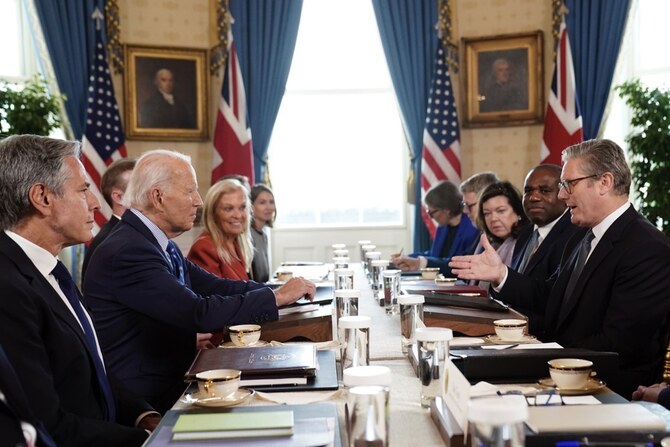
Britain's Prime Minister Keir Starmer, right, and Foreign Secretary David Lammy, second right, during a meeting with US President Joe Biden, centre left, in the Blue Room at the White House in Washington, Friday Sept. 13, 2024. (AP)
Short Url
Updated 14 September 2024
Follow

Biden, Starmer put off Ukraine missiles decision

WASHINGTON: British Prime Minister Keir Starmer and US President Joe Biden on Friday delayed a decision to let Ukraine fire long-range Western-supplied missiles into Russia, a plan that sparked dire threats from Moscow of a war with NATO.
Starmer told reporters at the White House that he had a “wide-ranging discussion about strategy” with Biden but that it “wasn’t a meeting about a particular capability.”
Before the meeting officials had said Starmer would press Biden to back his plan to send British Storm Shadow missiles to Ukraine to hit deeper inside Russia as allies become increasingly concerned about the battlefield situation.
But the Labour leader indicated that he and Biden would now discuss the plan at the UN General Assembly in New York the week after next “with a wider group of individuals.”
As they met with their teams across a long table in the White House, backed by US and British flags, Biden played down a warning by Russian President Vladimir Putin that allowing Ukraine to fire the weapons would mean the West was “at war” with Russia.
“I don’t think much about Vladimir Putin,” Biden told reporters when asked about the comments.

But while Biden said it was “clear that Putin will not prevail in this war,” he is understood to be reluctant to grant Ukraine’s insistent demand to be able to use long-range US-made ATACMS missiles against Russian territory.
US officials believe the missiles would make a limited difference to Ukraine’s campaign and also want to ensure that Washington’s own stocks of the munitions are not depleted.
The two leaders said they also discussed the war in Gaza, with Britain having recently suspended arms deliveries to Israel over concerns that they could be used to violate international humanitarian law.
The US, Israel’s main military and diplomatic backer, has held off such a step.
Biden and Starmer agreed on their “ironclad commitment” to Israel — but stressed the “urgent need” for a ceasefire deal and a “need for Israel to do more to protect civilians” in Gaza, the White House said in a readout.
The White House had earlier played down the chances of a Ukraine decision coming from Friday’s visit by Starmer, the Labour leader’s second to the White House since he took office in July.
“I wouldn’t expect any major announcement in that regard coming out of the discussions, certainly not from our side,” National Security Council spokesman John Kirby told reporters.
Ukrainian President Volodymyr Zelensky however pushed Kyiv’s Western allies to do more.
Speaking in Kyiv, Zelensky accusing the West of being “afraid” to even help Ukraine shoot down incoming missiles as it has done with Israel.
Zelensky added that he will meet Biden “this month” to present his “victory plan” on how to end two and a half years of war with Russia.
Russia has reacted angrily to the prospect of the West supplying long-range weapons to the country it invaded in February 2022.
In another sign of increasing tensions, Russia revoked the credentials of six British diplomats whom it accused of spying in what London termed “baseless” allegations.
Russia’s UN ambassador Vassily Nebenzia warned separately that letting Ukraine use long-range weapons would plunge NATO into “direct war with... a nuclear power.”
Ukraine and the United States’s allies are all meanwhile anxiously waiting for the result of a tense US presidential election in November that could upend Washington’s Ukraine policy.
Biden is on his way out of office while the election is a toss-up between his Democratic political heir Kamala Harris and Republican former president Donald Trump.
Trump has repeatedly praised Putin, and refused to take sides on the war during a debate with Harris on Tuesday, saying only: “I want the war to stop.”
Starmer denied he was worried about a Trump presidency, and said the need to help Ukraine in coming weeks and months was urgent “whatever timetables are going on in other countries.”


What to know about the Israeli president’s state visit to Australia

Updated 5 sec ago
Follow

What to know about the Israeli president’s state visit to Australia

  • Netanyahu had been outraged by Australia’s decision four months earlier to join France, Britain and Canada in recognizing a Palestinian state

MELBOURNE, Australia: The stated purpose of Israel President Isaac Herzog’s visit to Australia is to support the Jewish community still reeling from an antisemitic attack at Sydney’s Bondi Beach that left 15 dead. But his critics warn his presence undermines rather than repairs social cohesion frayed by the far away war in Gaza.
Protest rallies are expected to follow the president, who performs a largely ceremonial role as head of state, as he travels to Sydney, Melbourne and Canberra over four days starting Monday. Some critics demand he be arrested in Australia on suspicion of inciting genocide in Gaza.
He is the first Israeli head of state to visit Australia since Reuven Rivlin in 2020. Herzog’s father, Chaim Herzog, also visited Australia as Israel’s president in 1986.
Here’s what to know:
The Australian visit comes at a time of extraordinary bilateral tensions
Within hours of two gunmen allegedly inspired by the Daesh group launching their attack in Sydney on Dec. 14 last year, Israeli Prime Minister Benjamin Netanyahu blamed his Australian counterpart Anthony Albanese, posting on social media “your call for a Palestinian state pours fuel on the antisemitic fire.”
Netanyahu had been outraged by Australia’s decision four months earlier to join France, Britain and Canada in recognizing a Palestinian state.
Netanyahu has repeatedly sought to link widespread calls for a Palestinian state, and criticism of Israel’s military offensive in Gaza, to growing incidents of antisemitism worldwide.
Albanese has accused Netanyahu of being “in denial” over the humanitarian consequences of war in Gaza. Netanyahu has branded the Australian a “weak politician who betrayed Israel and abandoned Australia’s Jews.”
Australian Jews have appealed to both leaders to restore “diplomatic norms” to a bilateral relationship that had been friendly for decades.
Albanese has made clear his government’s invitation to Herzog to make that state visit was the idea of Jewish leaders.
“President Herzog is coming particularly to engage with members of the Jewish community who are grieving the loss of 15 innocent lives,” Albanese said.
“People should recognize the solemn nature of the engagement that President Herzog will have with the community of Bondi in particular, and bear that in mind by the way that they respond over coming weeks,” he added.
Jewish leaders welcome Herzog’s visit
Sydney-based Jewish leader Alex Ryvchin, co-CEO of the Executive Council of Australian Jewry, said his community “warmly anticipates” Herzog’s arrival.
“His visit will lift the spirits of a pained community and we hope will lead to a much-needed recalibration of bilateral relations between two historic allies,” Ryvchin said.
“President Herzog is a patriot and a person of dignity and compassion and holds an office that is above party politics. He is a person who has sadly had to comfort families, police and first responders after terrorist attacks many times, and will know how to reassure and fortify our community in its darkest time,” he added.
Ryvchin is one of the Australian Jewish leaders who have accused Albanese’s center-left Labour Party government of not doing enough to curb an increase in antisemitism in Sydney and Melbourne, where 85 percent of Australia’s Jewish population live, since the Israel-Hamas war began in 2023.
Herzog sees opportunity to reset relations
Herzog, a former head of Israel’s centrist Labour Party, now holds a job meant to serve as a unifier and moral compass for all Israelis. A onetime rival of Netanyahu, he has good working relations with the prime minister.
Ahead of his visit, Herzog told The Associated Press that the “primary reason” for the trip was to stand with Australia’s Jewish community as the representative of all Israelis.
“From thousands of miles away in Israel, we feel the deep pain of our Jewish Australian sisters and brothers. I am coming to show them our love and support at this devastating time,” he said.
But Herzog also said the visit is an opportunity “to reinvigorate relations” between Israel and Australia.
“There is a long history of partnership between our two nations and deeply held shared values,” he said, adding that the visit “offers a chance to reignite the longstanding bipartisan support for ties between Israel and Australia.”
“I hope to be able to communicate this message of goodwill and friendship to the Australian people, and dispel many of the lies and misinformation spread about Israel over the last two years,” he said.
Israel’s critics have called for Herzog’s invitation to be withdrawn
“This is one of the most divisive figures in the world. Bringing him to Australia will undermine social cohesion, it will not rebuild it. It will increase division, it will not bring about national unity,” Australian human rights lawyer Chris Sidoti said. Sidoti described the invitation as a ”crazy idea.”
Sidoti was one of three experts appointed by the UN’s Human Rights Council to an inquiry that reported in September last year that Herzog, Netanyahu and former Israeli Defense Minister Yoav Gallant had incited the commission of genocide in Gaza.
The findings carry no legal consequence and Israel has rejected genocide allegations against the country as antisemitic “blood libel.” Sidoti and other lawyers say Australian police could potentially arrest Herzog on suspicion of inciting genocide, which is a crime under Australian law as well as international law. Australian Federal Police have declined to comment.
A lawmaker in Albanese’s government, Ed Husic, said he was “very uncomfortable” with Herzog’s visit. Husic, a Muslim and vocal critic of Israel’s conduct in Gaza, said he was “concerned that a figure like that doesn’t necessarily enhance social cohesion.”
Some state government lawmakers from Albanese’s Labour Party have said they will join a protest in downtown Sydney on Monday planned by the Palestine Action Group activist organization.
“We need to send a clear message to our government and to the world … we are fundamentally opposed to this tour, which is designed to normalize genocide,” protest organizer Josh Lees said.
Police prepare to use enhanced powers of arrest to control protesters in Sydney
In response to the Bondi shooting, the New South Wales state parliament rushed through legislation increasing police powers to arrest protesters in the aftermath of a declared terrorist attack.
New South Wales Premier Chris Minns said a heightened police response in Sydney during Herzog’s visit was necessary to ensure safety.
“We will have thousands of mourners and thousands of protesters as well as a visiting head of state all in the same city at the same time. And we’ve got a responsibility to keep people safe in those circumstances,” Minns said.
“Every international city anywhere in the world would apply exactly the same geographical restrictions so that the two groups don’t meet and as a result there’s not a major confrontation,” Minns added.