RABAT: When powerful thunderstorms hit Morocco’s arid south, they brought deadly floods but also provided some relief to farmers as the country grapples with its worst drought in nearly 40 years.
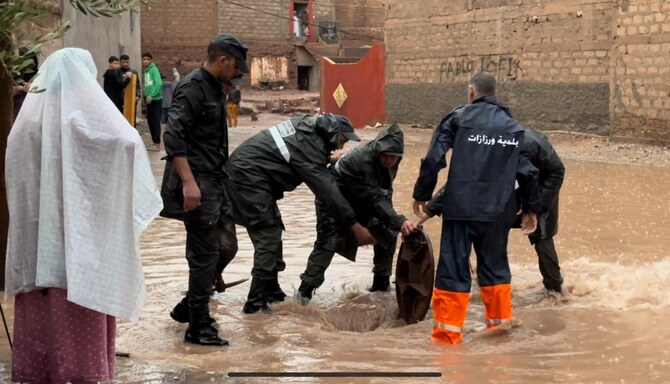
The torrential rains at the weekend triggered floods that killed at least 18 people in areas of southern Morocco that straddle the Sahara desert.
While the rain was devastating in part, it also brought some relief to farmers growing crops like almonds, dates and cereals.
“These rains will bring a breath of fresh air” to the south, said agronomist Mohamed Taher Srairi.
“But it has not rained elsewhere, and the country remains under a heavy structural drought.”
The unusual rainfall resulted from a tropical air mass shifting northward, according to Lhoussaine Youabd, spokesman for Morocco’s General Directorate of Meteorology.
Experts say climate change is making extreme weather, such as storms and droughts, more frequent and intense.
Morocco is one of the world’s most water-stressed nations, with frequent droughts affecting a third of the population employed in agriculture.
Near areas of the northwest African country lashed by the weekend’s rain, water levels in dams have risen and groundwater is expected to replenish.
The four Draa Oued Noun dams, which supply areas impacted by the floods in the Ouarzazate region, saw water levels increase by 19 percent to 191 million cubic meters, according to Youssef Ben Hamou, director of the agency managing the barrages.
The region of Ouarzazate, located in Morocco’s south, sits between the Atlantic Ocean, the Atlas Mountains and the Sahara.
Water levels of the large Ouarzazate dam climbed to 69 million cubic meters, roughly 70 percent of its capacity, while levels at the Fask dam rose by 10 million cubic meters in just 24 hours.
“The rains have proved to be a boon for the region, because these reserves will be able to ensure drinking water supply which remains a priority,” said Ben Hamou.
Mohamed Jalil, a water resources consultant, said the downpours would help to replenish soil saturation levels, although that usually requires rainfall over time after a long drought.
“This will bring respite to the oases, particularly for agriculture,” he said.
The psychological impact of the long-awaited rains was also significant, he said, especially after a harsh, dry summer.
The massive rainfall had “brought hope” to the drought-hit area, he said.
The Moroccan government has pledged financial aid to the flooded areas.
During a visit to Ouarzazate this week, Agriculture Minister Mohammed Sadiki announced the allocation of $4.1 million to repair damaged infrastructure, support agriculture and help those affected by the floods.
Although no further downpours are expected in the immediate future, climatologists warn that Morocco must better prepare for weather disasters driven by global warming.
Moroccans should be ready “for new phenomena whose frequency and violence are unknown, given the effects of climate change,” said Mohamed Said Karrouk, a climatology professor at Hassan II University in Casablanca.


Deadly floods bring relief to Moroccan farmers
https://arab.news/pp2pe
Deadly floods bring relief to Moroccan farmers

- The torrential rains at the weekend triggered floods that killed at least 18 people in areas of southern Morocco that straddle the Sahara desert


UN rights chief Shocked by ‘unbearable’ Darfur atrocities
- Mediation efforts have failed to produce a ceasefire, even after international outrage intensified last year with reports of mass killings, rape, and abductions during the RSF’s takeover of El-Fasher in Darfur
PORT SUDAN: Nearly three years of war have put the Sudanese people through “hell,” the UN’s rights chief said on Sunday, blasting the vast sums spent on advanced weaponry at the expense of humanitarian aid and the recruitment of child soldiers.
Since April 2023, Sudan has been gripped by a conflict between the army and the paramilitary Rapid Support Forces that has left tens of thousands of people dead and around 11 million displaced.
Speaking in Port Sudan during his first wartime visit, UN Human Rights commissioner Volker Turk said the population had endured “horror and hell,” calling it “despicable” that funds that “should be used to alleviate the suffering of the population” are instead spent on advanced weapons, particularly drones.
More than 21 million people are facing acute food insecurity, and two-thirds of Sudan’s population is in urgent need of humanitarian aid, according to the UN.
In addition to the world’s largest hunger and displacement crisis, Sudan is also facing “the increasing militarization of society by all parties to the conflict, including through the arming of civilians and recruitment and use of children,” Turk added.
He said he had heard testimony of “unbearable” atrocities from survivors of attacks in Darfur, and warned of similar crimes unfolding in the Kordofan region — the current epicenter of the fighting.
Testimony of these atrocities must be heard by “the commanders of this conflict and those who are arming, funding and profiting from this war,” he said.
Mediation efforts have failed to produce a ceasefire, even after international outrage intensified last year with reports of mass killings, rape, and abductions during the RSF’s takeover of El-Fasher in Darfur.
“We must ensure that the perpetrators of these horrific violations face justice regardless of the affiliation,” Turk said on Sunday, adding that repeated attacks on civilian infrastructure could constitute “war crimes.”
He called on both sides to “cease intolerable attacks against civilian objects that are indispensable to the civilian population, including markets, health facilities, schools and shelters.”
Turk again warned on Sunday that crimes similar to those seen in El-Fasher could recur in volatile Kordofan, where the RSF has advanced, besieging and attacking several key cities.
Hundreds of thousands face starvation across the region, where more than 65,000 people have been displaced since October, according to the latest UN figures.


